1. Introduction and Goals
1.1. Requirements overview
Situate is a personal organizational system for one person. Its core provides task, note, knowledge and document management. Situate connects these capabilities with external email, calendar and supplementary data sources. Tasks and notes managed by Situate are brought into its core; document originals may remain in connected sources. Situate uses AI for routine and preparatory work, drawing on personal context and the user’s working methods. AI supports personal organization rather than defining the product category.
People who consciously organize their personal lives currently have to maintain connections between information, tasks and commitments across multiple tools. Situate should reduce this maintenance and the effort of handling individual processes, while preserving the user’s preferred organizational method. Technical expertise is not a prerequisite. The foundations define the audience, internal core, external services and single-person boundary.
An organizational process is an ongoing matter that may involve information and next steps across tasks, notes, documents and external services. For example, a request for missing documents may require finding existing material, recording work needed to prepare the remainder, reserving time in a connected calendar and preparing a reply. Situate should retain the relationship between these steps when the remaining material becomes available, rather than treating each interaction as unrelated. This is an illustrative intended workflow, not evidence of implemented functionality.
The Glossary defines shared product and architecture terms. The catalog defines the desired outcomes:
| Goal | Intended outcome |
|---|---|
Keep personal organization connected without continual manual maintenance. |
|
Handle organizational processes with less personal time and mental effort. |
|
Keep commitments and follow-up work visible without remembering them separately. |
|
Delegate internal and external actions within the user’s request, without per-action approval. Internal changes remain reversible; users can inspect outcomes and stop ongoing work. |
|
Experience the system as personally fitting and supportive. |
Relevant capabilities include using existing context, maintaining process history, user-requested integrations and synchronization across the user’s devices. The catalog also specifies adaptable task workflows, import conversion and connected document sources, with content search and a common document view. Their open questions include initial task filters, reconciliation after repeated imports and shared connector contracts.
The product concept describes the free local application and optional paid synchronization and managed AI services. These are intended capabilities and business direction, not a description of a shipped system. The repository contains a client implementation; Client package boundaries describes its package responsibilities. That implementation does not establish complete product delivery or native platform qualification. Reported benefits are based on individual experience; broader demand and the extent of the benefit remain to be validated.
1.2. Quality goals
The following concerns derive from approved catalog entries; their order does not establish a priority ranking.
| Concern | User value | Authoritative basis |
|---|---|---|
Decision authority and recoverability |
Internal work remains reversible. Internal and external actions execute within user requests without per-action approval; users can inspect outcomes and stop ongoing work. |
|
Context continuity and traceability |
Subsequent work uses the known state, and users can distinguish prepared work from completed actions. |
|
Content availability and portability |
Stored personal content remains accessible when a Situate service is unavailable and can be reused without Situate. |
|
Personal fit and understandable organization |
Users retain their working method and can navigate their own notes without relying on AI to explain them. |
Existing scenarios in Quality Requirements address parts of these concerns:
-
Decision authority and recoverability: a lost quit-cancellation notification must not let delayed messages cancel a newer attempt; see Current client: application quit and cancellation. Interrupted file operations preserve files and prior history without automatic replay or rollback; see Git-derived file references.
-
Context continuity and traceability: malformed or newer-format conversations must not be overwritten with empty history; see Conversation storage and overwrite protection. An interrupted file operation may leave its outcome uncertain rather than recorded as complete.
-
Content availability and portability: restarting without derived reference state or copying a closed workspace must preserve reference-resolution results from retained Git history and anchors; see Git-derived file references. This does not establish service-independent access or reuse of all stored content.
These scenarios do not fully cover the four concerns. End-to-end scenarios for user control, context reuse, offline use, reuse without Situate and personal fit remain to be specified. Priority ranking requires stakeholder agreement and remains open. No quantitative targets are established here.
1.3. Stakeholders
| Role | Concern |
|---|---|
Individual user |
Delegate routine organizational work, preserve personal context and working methods, access content across devices, and control actions taken toward others. |
Situate product and service operator |
Provide a useful local application and optional sustainable services without making access to stored content depend on purchasing those services. Pricing and service commitments remain open. |
Developer and operator |
Keep delivery and operational complexity within one person’s capacity, as required by the development and operation constraint. |
Other people may receive communications requested by the user or collaborate in connected external services. They are not co-users of a shared Situate workspace; these interactions belong to Context and Scope.
2. Architecture Constraints
The foundations and referenced requirements define the constraints below. They are approved boundaries for design, not claims about implemented safeguards. The product owner can clarify or change product, budget and distribution boundaries; the CTO clarifies technical restrictions and their consequences within those boundaries. Legal obligations require assessment against the actual processing and cannot be waived by a product decision.
2.1. Product and organizational constraints
| Constraint and source | Scope | Architectural consequence |
|---|---|---|
Single developer and operator; foundations |
Development, delivery and operation are handled by one person. |
Implementation and operational complexity must fit that capacity. Four-digit monthly costs before revenue are conceivable, but no exact ceiling or spending authorization is established. |
New technical baseline; foundations |
No implementation from the previous prototype is carried forward. |
There is no prototype technology or compatibility mandate. Accepted technology choices are recorded in Solution Strategy. |
Personal organizational core; foundations |
Tasks, knowledge and documents belong to Situate’s core. Email and calendar remain external. Situate does not provide built-in workspaces shared by multiple users. |
Built-in device synchronization serves one person, not collaborative editing between users. Custom plugins do not imply built-in collaboration guarantees. External integrations supplement rather than replace the core. |
Optional paid services; REQ-0015 |
Local use with supported user-provided model access does not require paid Situate services. |
Neither synchronization subscriptions nor the managed AI router may be mandatory dependencies for that use. |
Personal working methods; foundations |
No single organizational method is mandatory. |
The content model and workflows must not require users to adopt a method such as Getting Things Done (GTD). |
2.2. Technical constraints
| Constraint and source | Scope | Architectural consequence |
|---|---|---|
Platform availability and distribution; REQ-0012 |
The MVP targets macOS only, through a website DMG and the direct-install updater. iOS, Windows, Linux desktop and Android are deferred. Mobile app-store distribution remains a longer-term constraint, not a current delivery gate. |
Technology and plugin execution choices must support macOS. Deferred-platform compatibility is not an MVP development or acceptance constraint. Package-manager channels are deferred. Supported OS versions, additional channels and deferred-platform sequencing remain open. |
Local reading and manual editing; REQ-0008 |
Locally stored content remains readable and manually editable without internet, AI or Situate services. Initial synchronization replicates the complete current collection and full version history, including previous attachments, to every connected device. |
AI cannot be the only editing interface. Changes must persist locally for synchronization when configured. Selective document download is deferred; connected external sources need not be copied in full. Offline external-service access is not required; local model use relies on user-configured compatible endpoints rather than a bundled model runtime. |
Reuse without Situate; REQ-0009 |
Stored content remains readable and transferable without continuing to operate Situate. |
Storage must avoid dependence on Situate-only readers. The selected Markdown conventions and portable workspace layout are described in Solution Strategy. |
End-to-end encrypted synchronization; REQ-0013 |
Neither the official synchronization service nor Situate as operator may decrypt content synchronized through that service. |
Key handling must preserve this boundary. Authorized plaintext AI processing is a separate flow and must not expose plaintext or decryption keys to synchronization. |
Official synchronization recovery; REQ-0013 |
A new device obtains key material through an authorized device or a user-held recovery key. One key per account covers all officially synchronized workspaces. Users must save and confirm recovery material before official synchronization setup completes. |
Account login alone must not unlock content. Neither the service nor operator may obtain usable decryption keys. Recovery does not restore device-local AI settings or credentials. Cryptographic and provisioning protocols remain open. If neither usable local data nor key access remains, content cannot be recovered. |
Device-local AI settings and credentials; REQ-0015 and REQ-0013 |
Provider connections, endpoints, selected access and model choices belong to one workspace on one device: Device-local AI Settings. They persist outside the portable workspace directory and its histories; provider secrets remain in device-local OS secure storage. |
Neither workspace copying nor official or custom synchronization may transfer these settings or credentials, even if a provider permits key sharing. Authentication and model requests go directly to the chosen provider; Situate-operated services must not store or broker user-provided credentials. Conversation content remains portable, but another device keeps its own access selection. |
Synchronization history and conflicts; REQ-0013 |
Synchronization plugins provide storage and transport; the core owns versioning, merge-conflict handling and file/history recovery for every transport. |
An unresolved merge conflict pauses synchronization for the affected workspace, not local edits or other workspaces. Conflict resolution must work without AI; combined results and binary-version choices require the user’s decision before application. Conflict representation and merge algorithms remain open. |
User decision authority; GOAL-0004 |
Actions stay within the user request and configured access, without per-action approval; internal work remains reversible. |
Execution paths, including plugins, must preserve this boundary. Installed plugins are trusted code, not sandboxed adversaries; this contract does not establish protection against malicious plugins. Enforcement mechanisms remain to be designed. |
Shared UI and local plugin authoring; foundations |
Host and plugin UI use Vue and the same Situate component implementations. Plugins may also define custom components and views. |
Plugin authoring must support plain JavaScript and locally compiled Vue templates without mandatory TypeScript, JSX or an external build pipeline, including on mobile when that platform goal is activated. Shared components do not impose a restricted UI vocabulary. Cross-plugin reuse requires explicit exports and declared dependencies. |
Workspace data and public plugin interfaces have an internal minimum six-month compatibility window measured from each app version’s release. REQ-0069 permits an explicitly approved workspace-format exception for disproportionate transition effort, with safe refusal on affected older apps; this does not waive public plugin-interface compatibility. Public interfaces include SDK operations and shared component properties, events and slots. |
Mixed-version reads and writes must preserve data. Version age alone must not block use; actual incompatibility blocks only the affected workspace. Plugins may require newer app capabilities without older-version fallbacks; disable unsupported plugins only on the affected device and show the required app version. The window does not promise indefinite migration paths, service API compatibility or OS support. |
|
Plugin platform compatibility; REQ-0014 |
Plugins are cross-platform or explicitly restricted. |
Synchronization must not imply that a plugin can execute on an unsupported platform. |
2.3. Legal and licensing constraints
| Constraint and source | Scope | Architectural consequence |
|---|---|---|
EU hosting; foundations |
Situate-operated services must be hosted in the EU. Germany is preferred, not mandatory. |
Deployment choices must respect that region boundary, including the Situate-operated AI router. |
EU data protection; foundations |
Applicable EU requirements govern the actual data flows. |
Legal prerequisites and safeguards must be assessed before processing. EU hosting alone does not establish compliance. |
Managed AI processing; REQ-0016 |
The router may process content authorized for the relevant user request in plaintext. AI providers may process outside the EU when legal prerequisites are met. Supplied content must not be used for model training. |
Provider agreements, configuration and data flows must preserve the no-training rule and the separation from encrypted synchronization. Authorization is not blanket access to the stored collection. |
User-provided AI access; REQ-0015 |
Users choose their own providers and evaluate their terms. The managed service’s no-training guarantee does not extend to those providers. |
Situate remains responsible for how it transmits data and handles credentials. The device-local storage and direct-provider restrictions are described under Technical constraints. |
Software and artwork licensing; licensing guide |
Original software and documentation use MIT; original artwork uses CC BY 4.0. Third-party material keeps its own terms. The separate trademark policy addresses product identity and affiliation. |
Preserve applicable license and attribution notices. Dependency and asset choices still require review of their actual terms; the project licenses do not override third-party rights. |
2.4. Unresolved boundaries
Clarification responsibilities below do not authorize spending, scope changes or exceptions to legal obligations. The product owner decides product boundaries; the CTO develops technical options within them.
| Open question | Source and remaining scope | Clarification responsibility |
|---|---|---|
Budget ceiling and service commitments |
Foundations and REQ-0016: exact spending limits, capacity and verifiable model-quality standards remain undefined. |
Product owner, with CTO cost and feasibility input. |
Supported OS versions and additional distribution channels |
REQ-0012: macOS DMG and direct updates are selected. iOS and other product platforms are deferred; additional channels, supported versions and any platform activation or sequencing remain open. |
Product owner, with CTO platform and store feasibility input. |
Insufficient storage and incomplete synchronization |
REQ-0008: how to communicate these conditions without silently dropping required local content or history. Selective document download remains a later stretch goal. |
CTO; product owner for changes to replication scope. |
Key provisioning and synchronization metadata protection |
REQ-0013: key hierarchy, provisioning and rotation protocols, device authorization/revocation, and metadata protection and retention remain open within the approved recovery boundary. |
CTO, with product-owner clarification of recovery interactions. |
Conflict representation and imported-source reconciliation |
REQ-0013: merge algorithms and representation of deletion and structural conflicts remain open. Foundations: reconciliation between imported copies and their sources remains unspecified. |
CTO for conflict mechanisms; product owner for reconciliation behavior. |
AI-context authorization and data-processing safeguards |
REQ-0016: context authorization mechanisms, request/response/log retention and deletion periods, and provider-specific legal safeguards remain open. |
Product owner with appropriate legal review; CTO for mechanisms and data flows. |
Trademark rights and registration |
Trademark policy: software and artwork licenses are selected, but the policy does not establish trademark ownership, registration or enforceability in a particular territory. |
Product owner with appropriate trademark review. |
The business and technical exchanges are described in Context and Scope. Implementation choices within these constraints belong in Solution Strategy and consequential decisions in Architecture Decisions. The constraints include the shared Vue UI boundary, but do not select a storage engine or deployment topology.
3. Context and Scope
3.1. Business context
The system boundary covers Situate’s personal organizational capabilities, including its intended optional synchronization and managed AI offerings. It is not limited to a single application installation. Whether a capability runs on a device or in a service is a deployment question, not a change to this product boundary.
Within this boundary, Situate manages one person’s tasks, notes and knowledge, and documents. It maintains context across organizational processes: ongoing matters such as gathering documents and preparing a reply. It uses AI to prepare work within those matters. Tasks and notes from other systems must be imported for Situate to manage them. The foundations are authoritative for these scope decisions.
A workspace is a personal organizational system whose portable content, conversations, plugins, configuration and histories reside in one directory. Operational AI settings and credentials are a device-local exception, described below. Users may keep separate workspaces; Situate does not provide a shared organizational workspace or its own email or calendar service.
Document sources may include local folders and external services, including repositories shared with other people. Connecting a source does not require migrating its originals or keeping a complete local copy, as specified by REQ-0054.
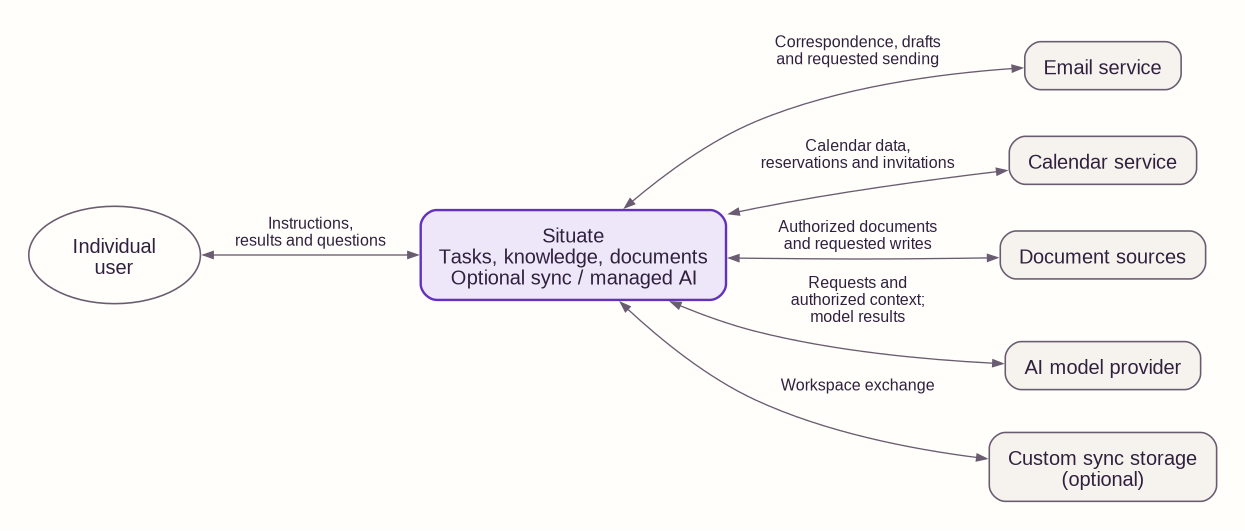
Bidirectional arrows summarize information exchanges and requested actions, not network connections. The table below separates incoming information from outgoing effects. The Situate box represents the product boundary, including optional services; it does not imply a single deployment. Other people participate through external services, not through a shared Situate workspace. The user may also send a prepared draft directly in their email application.
| External party or system | Information entering Situate | Information or effects leaving Situate |
|---|---|---|
Individual user |
Instructions, personal content, missing context and preferred working methods. |
Results, organized content, process history (relevant information, actions and results) and questions for missing data. |
Email service controlled through the user’s account |
Authorized messages and related correspondence. |
Reply drafts in the connected account. A draft request does not authorize sending; a separate sending request executes without per-action approval, or the user sends the draft in their email application. |
Calendar service controlled through the user’s account |
Authorized calendar information, including availability used to plan work. |
Personal time reservations and invitations within a user request, without per-action approval. |
Document source: local folder or external service |
Authorized documents and project material, for example in a local folder, Paperless or a shared Google Drive repository. |
Any supported write-back depends on the individual integration and granted access. External actions execute within the user request without per-action approval. |
AI model provider |
Model results used in processing the assigned work. |
Processing requests and authorized context, through user-provided access or Situate’s managed AI service. The managed router may process that context in plaintext. Neither Situate nor its managed providers may use content supplied through managed AI for training; this guarantee does not extend to independently selected providers. Users evaluate those providers' processing terms. Exact context-authorization and managed-routing mechanisms remain to be designed. |
User-configured storage or service for custom synchronization |
Workspace data from the user’s other devices through the selected synchronization transport. |
Workspace data for the user’s other devices. The selected custom plugin determines content encryption; the official service’s encryption guarantee does not extend to custom alternatives. |
The user authorizes access to external accounts and sources; their providers retain control of those services. Other participants may control content in shared repositories. Such participants do not gain access to the user’s Situate system merely because a shared source is connected.
Preparation and external effects
Situate may independently perform reversible internal organizational work within a user request. User direction does not require approval of every preparatory step. It also does not authorize autonomous external commitments.
For a document request, Situate can assemble available material, identify missing work, organize tasks and prepare a reply. Preparing a draft does not send it. A user request to send can execute directly, or the user can send the prepared draft through their email application. A prepared draft is not recorded as a sent message. Calendar invitations and changes with effects on collaborators remain within the requested task and configured account access.
Content ownership and device scope
Synchronization serves the same person across connected devices, not multiple people sharing a workspace. It is configured per workspace and runs only while that workspace is open, as specified by REQ-0013. Users may choose no synchronization, the official service or a custom plugin using external storage or transport. A synchronization transport transfers data; the Application Core retains responsibility for versioning, merge-conflict handling and history recovery for every transport.
Workspaces keep content, conversations, plugins and account configuration separate. A plugin intentionally designed to access another workspace may do so where operating-system access and permissions allow it; workspace separation is not a security sandbox. Device-local AI settings include provider connections, endpoints and model selections for one workspace on one device. They stay outside the portable workspace directory and its histories; provider secrets remain in device-local OS secure storage. Neither copying a workspace nor any synchronization mode transfers these settings or credentials, as specified by REQ-0015.
External sources remain external unless their content is imported or copied into Situate. Import leaves the source unchanged and creates workspace-local copies; handling later changes between those copies and their sources remains unspecified.
Centralizing organizational access in Situate does not select a centralized storage architecture. Local availability and reuse without Situate remain required for stored content.
3.2. Technical context
The business exchanges above identify what crosses the product boundary. The table below separates established technical constraints from unresolved interface details. The repository contains a client implementation and internal interfaces, described in Client package boundaries and Agent Integration: Native conversation execution. Their presence does not establish deployed Situate services or native and live-provider qualification; see the provider qualification record.
| Boundary | Established requirement or constraint | Unresolved detail or verification |
|---|---|---|
Connected email, calendar and supplementary services |
Integrations use technically available access and the user’s permissions. REQ-0001 permits user-requested integrations beyond a fixed catalog. |
Protocols, authentication, permission scopes, failure handling and external-change detection for each integration. |
Local folders and connected document sources |
REQ-0054 requires agreed source subsets, permitted operations and filing rules without mandatory migration of originals. Local folder access remains subject to operating-system permissions; remote access also depends on the service’s interfaces and permissions. |
Shared connector capabilities, document metadata and source identity across moves, duplicates and copies. |
Devices and official Situate synchronization |
REQ-0013 requires optional synchronization while the workspace is open. Official synchronization must use end-to-end encryption that prevents operator decryption. New devices require an authorized device or the account’s user-held recovery key; account login alone cannot unlock content. Users must save and confirm recovery material before official synchronization onboarding completes. Local reading and manual editing remain available without internet or AI. |
Transport protocol, cryptographic key hierarchy, provisioning and revocation protocols, metadata protection and merge representation. Recovery policy is established; its cryptographic construction and provisioning interactions remain design work. |
Custom synchronization storage or service |
Custom plugins supply storage access and transport; the Application Core owns versioning, merge-conflict handling and history recovery. Custom plugins may use different content-encryption policies. Directory transfer alone does not establish consistent history; uncontrolled writes can corrupt it. Operational AI settings and credentials are excluded from every synchronization mode under REQ-0013. |
Storage-specific protocols and authentication, consistent transfer mechanisms and verification of each transport’s integration with core history handling. |
User-configured AI model endpoints |
REQ-0015 requires access configured per workspace and device, including compatible local or remote OpenAI-compatible endpoints. Authentication and model requests go directly to the selected provider; Situate-operated services neither store user-provided credentials nor broker their renewal. Local-network HTTP requires a destination-specific warning and explicit acknowledgement, without permitting insecure redirects or disabling HTTPS certificate validation. |
Provider/authentication coverage and model capabilities require method-specific verification; protocol compatibility alone is insufficient. The qualification record identifies evidence and remaining gaps. |
Situate managed AI and external model providers |
REQ-0016 requires optional managed access through a Situate-operated router using separate device sessions and account entitlement, not uploaded user-provider credentials. The router may process authorized context in plaintext without exposing synchronization plaintext or keys. Supplied content must not be used for training by Situate or its managed providers. Situate-operated services must remain EU-hosted; managed providers may process outside the EU only when legal prerequisites are met. Managed availability must not silently replace the device’s selected access. |
Context-disclosure authorization, retention and deletion periods, routing criteria and service capacity/quality commitments. |
Task scope and external actions |
Execute actions within the user request and configured access without per-action approval. |
How task scope, configured access, cancellation and durable intent/results are preserved across generated integrations. |
Provider Transport is the native host adapters' communication with a selected model endpoint, including authentication and streamed responses. It is distinct from Model Access, the internal capability through which conversation execution requests model work. These internal responsibilities are refined in Agent Integration: Native conversation execution; they do not move an independently operated local model endpoint inside Situate’s product boundary.
Internal decomposition, deployment placement and technical safeguards are described or tracked as open questions in the subsequent architecture views and decisions.
4. Solution Strategy
The accepted direction is a Tauri 2 application with an application core implemented in Rust, a shared web interface and JavaScript extensions. It addresses local independence, recoverability and personal context continuity within single-person development and operation capacity. The linked catalog entries define the product behavior; acceptance of this strategy does not imply a completed product implementation.
4.1. Application and execution
Application structure
Tauri provides the application shell; Rust implements the application core that owns local storage, version history, synchronization logic and operating-system access. Application and plugin views use Vue and the same responsive Situate components. This avoids maintaining separate native widgets alongside plugin rendering, but shared components still require cross-engine, accessibility and input testing in Tauri’s system WebViews. Rust supplies a common native boundary, not a measured performance guarantee. The active MVP target is macOS only; iOS and other platforms remain deferred under REQ-0012.
Native capabilities ship with the host. Plugins add plain JavaScript and Vue templates compiled locally by the shipped runtime/compiler, without rebuilding the host. Plugin editing and activation require neither TypeScript nor JSX nor an external build or mobile Node process; host development tooling is separate. Downloading new native Rust or Swift binaries is not the cross-platform extension model. Local template compilation requires dynamic code generation, weakening Content Security Policy protection and providing no plugin isolation. Notes, messages and imported documents must remain data, never trusted templates. Production loader policy and mobile qualification remain work to complete; see the plugin contracts and recovery boundary.
Application-bound execution
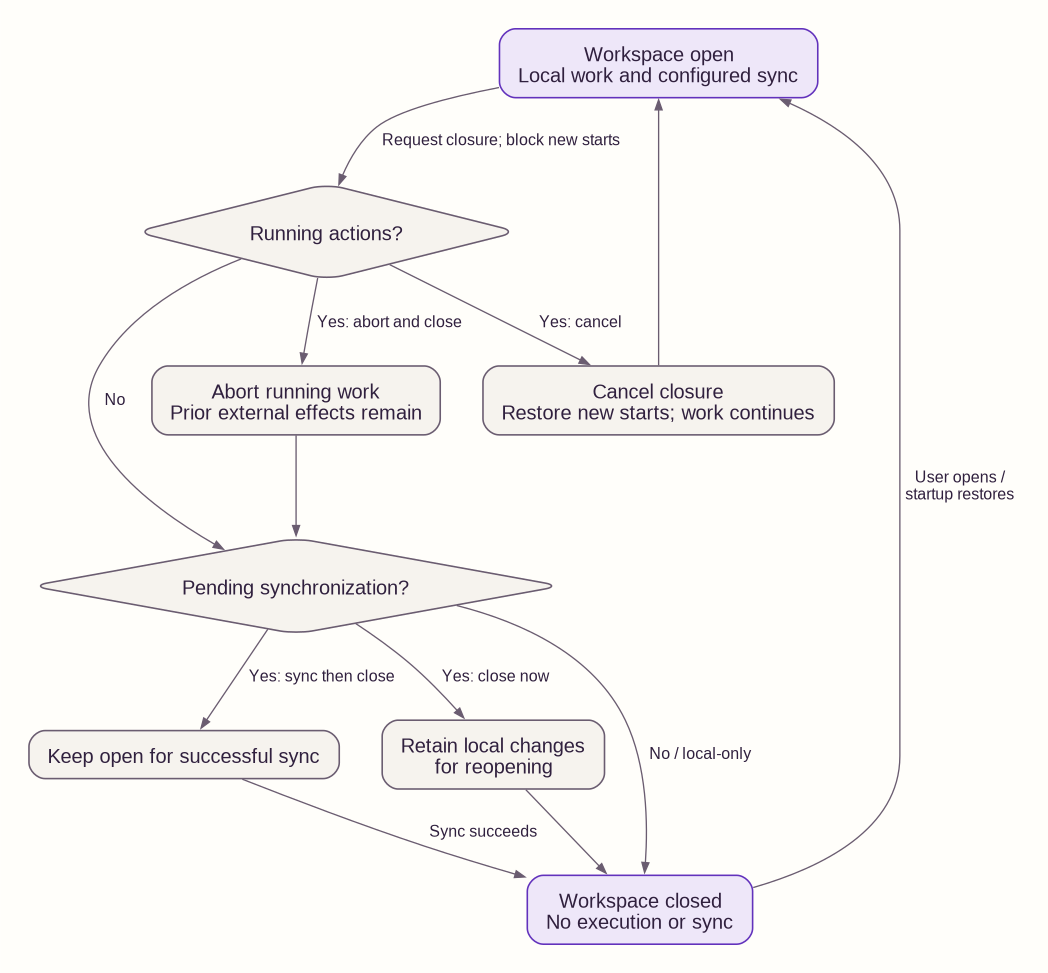
Agents run within open workspaces, not an always-running server service. Closing or hiding a chat view does not stop its agent; closing the workspace or quitting the application does. Desktop work can continue while the workspace remains open; mobile background work remains subject to operating-system limits. Explicit closure with running actions offers cancelling closure or aborting the actions and then closing. No new work starts while that decision is pending; cancelling restores normal operation without interrupting work or scheduling later closure. Aborting does not undo external effects. Suspension or forced termination cannot guarantee this interactive procedure.
Retained work supports continuation on the same device without repeating actions recorded as completed. After closure or application exit, reopening waits for user interaction before continuing an interrupted conversation. Outside recovery mode, separately configured plugin triggers follow their missed-run policy instead of silently resuming that conversation. Normal and development conversations share the conversation list, which shows ongoing work under REQ-0039.
Devices synchronize completed conversational turns so work can continue elsewhere when Situate is waiting for input. Live progress mirroring, simultaneous execution of one conversation and in-flight run handoff are not required, avoiding a distributed agent runtime. An interrupted external call can have an uncertain outcome. Situate retains that uncertainty and does not replay the effect automatically; investigation depends on the agent runtime and model, without a dedicated recovery protocol or guaranteed resolution. Task scope and process-history obligations still apply. See REQ-0011 and Current client: application quit and cancellation.
Conversation ownership and agent foundation
Each conversation has one native Conversation Owner: the component that serializes its actions and owns execution, persistence, drafts and pending input. Views observe that state; showing one conversation in several panes neither starts duplicate execution nor shares another conversation’s draft. Rig supplies the native agent library under ADR-0013; ordinary, onboarding and development conversations use the same owner and application-owned provider/tool adapters, with no WebView-based Pi fallback. Core conversation storage is authoritative: one append-only JSONL history and metadata file per conversation under ADR-0016. Stable entry IDs and parent links permit shared ancestry without duplicating originals; model context and UI history are derived from the selected path. There is no fixed total conversation-size ceiling, compaction-based file rotation or separate pending-state file. Execution stays in memory; history reads and UI projections do not require loading the entire tree. Operational model and thinking settings remain device-local, outside portable conversation records. Attachments retain durable local identities as copied input, not live content references.
The owner records effect intent before execution and observed completion afterward, preserving tool-call/result pairing and uncertain outcomes. Cancellation targets the captured run; late events cannot revive a replaced or closed owner. Submitted steering and follow-up input are saved user messages whose waiting, consumed or recalled status is distinct from their original content and from the draft. Stop does not resubmit them; explicit Recall merges still-waiting input while preserving order, attachments and references. Unsaved draft text may be lost after a crash; saved inputs remain available without automatic execution. Compaction appends a summary and retained-entry boundary without rewriting source history. Failed or cancelled compaction preserves the previous usable context. The native conversation decomposition, ADR-0013 and storage concept define the ownership and persistence contracts. See the pending-input runtime scenario for submission, Stop and Recall ordering, and Conversation context and compaction for context masking, summarization and compaction publication.
The owner requests model work through Model Access, the internal host capability. Native adapters perform Provider Transport: authentication and communication with the selected endpoint. The host validates each request’s caller, workspace and captured context through Operation Admission; this is not user confirmation or proof of completion. Source integration and deterministic journeys do not establish live-provider, physical-device or deferred-platform qualification; see provider qualification.
The agent uses the same core content and plugin interfaces as the application, subject to authorization and native capabilities.
Its intended tool surface includes file and plugin editing, activation, history, UI interaction, screenshots and testing; embedding Rig does not provide every integration automatically.
The agreed working method is saved after conversational confirmation in .situate/working-method.md and read with bounded, non-symlink-following access.
Workspace-installed plugins supply plugin instructions. Root AGENTS.md, .pi/skills and visible Situate/ files are user content, not automatic instruction sources; personal developer-machine Pi instructions and credentials are not imported.
Pi’s terminal UI, package manager, extension loader, MCP, codemode, subagent orchestration and conversation branching/import/export are not adopted product interfaces.
See REQ-0001 and REQ-0026.
Workspace access and native commands
The agent may independently search and read local files in its workspace, including earlier chats and process histories, without per-file approval or attachment. Situate neither specially restricts nor encourages history inspection; selection remains with the agent and model. Workspace content APIs, conversation context and credential access remain independent between workspaces. That API boundary is not a filesystem sandbox for native commands or trusted plugins.
Shell commands, plugin process calls, mutating plugin HTTP requests and manual exports execute within the user request and configured access without per-action confirmation. A shell command starts in the actual path-backed workspace with the application’s OS permissions, not a filesystem jail, command allowlist or container. It can reach other readable files, workspaces, the network and internals; Situate-managed provider credentials are not injected into its arguments or environment. Native authorization, capability checks, Operation Admission, validation, cancellation/drain and durable intent/results remain required.
Commands share the content mutation window with editor and conversation writes. The host retains or settles drafts, records pre-existing changes and reconciles observed changes after every outcome, including cancellation. Cancellation must finish host cleanup before releasing that window. Process groups and bounded pipe draining do not contain programs that detach. There is no atomic rollback or reliable attribution of indistinguishable concurrent external edits. Changes outside managed content have no Situate history guarantee, and unrestricted commands can damage the history store. Mobile process execution requires separate evidence of real workspace access, cancellation and distribution/license compliance; a simulator or external device shell alone is insufficient. The client runtime guide defines interpreter, output, environment and lifecycle limits. See REQ-0004 and REQ-0037.
Device-local AI access
The MVP supports OpenAI API keys and direct ChatGPT browser login, Anthropic and OpenRouter API keys, and OpenAI-compatible custom/local endpoints with optional keys. Other providers, external credential sources, subscription methods and arbitrary provider extensions are deferred; classifiers and embedded model/server management are excluded. Native adapters own authentication, credential injection, renewal and destination checks. Browser return alone is not authentication success. Known provider restrictions require method-specific disclosure and own-risk acknowledgement under REQ-0015, not permission to bypass provider rejection. Custom HTTP needs destination-specific acknowledgement without insecure redirects or disabling HTTPS certificate verification.
Connections, endpoints, credentials, defaults, conversation overrides and discovery observations belong to one workspace on one device, outside its portable directory and histories. Public Models.dev metadata is cached separately per installation; model choices require a match with that connection’s discovery list. A local identifier associates these records with the authorized canonical location: the Device-local Workspace Namespace, not the portable diagnostic identifier or a runtime authorization handle. Neither official nor custom synchronization transfers these settings. New devices configure access independently; same-phone enrollment remains required on mobile rather than requiring desktop setup. The proposed ADR-0002 describes local custody separately from content recovery. Only prototype formats verified never to have shipped publicly are exempt from credential migration and legacy-session compatibility. Published device-local connections and settings must survive app upgrades through compatible storage or a tested, recoverable migration. Unknown records must not be silently imported, overwritten or deleted.
A conversation inherits the device’s workspace selection unless explicitly overridden; each request captures its connection, model and thinking settings without later preference changes redirecting active work. Recommended and initial selection use the same ranked, capability-eligible catalog. Connection discovery, model metadata and unknown availability remain distinct; catalog presence proves neither entitlement nor capability, and selection makes no billable probe. Saved explicit choices are not replaced by catalog updates, discovery or failure; unresolved/custom endpoints require explicit model selection rather than a guessed default. Automatic provider retries, provider prompt-cache requests and model/provider fallback remain disabled pending separate policy decisions. Ordinary tool-loop continuation is not permission to repeat a completed effect. Activity comments use a separately configured model with thinking off or minimal and a short work description rather than full context or raw tool results. Their usage and cancellation are independent, they never block the main task, and disabled comments make no calls. Late replies after terminal states or question waits are ignored and cannot change main-run completion. See the provider configuration and request contracts for selection, provenance and qualification limits.
Paid managed AI through a Situate-operated router is a separate approved capability under REQ-0016, not an automatic fallback for unavailable user-provided access. Its routing and service implementation remain open; authorized plaintext AI processing must remain separate from encrypted synchronization.
4.2. Workspace ownership and lifecycle
Independent workspaces
A workspace is a self-contained personal organizational system. Its content, conversations, plugins, configuration, connected accounts and model settings belong to that workspace. Users may keep everything together or separate areas of their work into independent workspaces; no particular division is prescribed. The core does not automatically search other workspaces, share their conversation context or connect plugin dependencies across them.
Workspace separation is an ownership and lifecycle boundary, not a security sandbox for trusted plugins. A deliberately developed plugin may access another workspace where operating-system access and permissions allow it. Such extensions do not introduce built-in team collaboration, roles or multi-user conflict guarantees. See REQ-0037.
Open-workspace lifecycle
Several workspaces can operate independently in separate desktop windows. Mobile workspace switching changes presentation without closing the previous workspace. Execution and synchronization require that workspace to remain open, not merely a running application; closing its last window stops its agents, plugins, automation and synchronization without stopping other workspaces. The native host coordinates whether closure may start through Lifecycle Admission, distinct from accepting individual requests through Operation Admission. The closure policy blocks new starts while the user decides, preserves running work on cancellation and warns that aborting does not undo external effects. Pending synchronization remains a separate choice between synchronization before closure and retaining local changes for later. Combined presentation of those choices remains open. Mobile work remains subject to operating-system limits; suspension and forced termination cannot guarantee interactive closure.
At application startup, Situate automatically reopens the workspaces that were last open. Workspaces explicitly closed individually are not reopened merely because they were used earlier; application exit preserves the set to restore on startup. Reopening makes local content usable immediately, detects external edits and resumes configured synchronization. Conflicts pause only that workspace’s synchronization, not local editing or other workspaces. Interrupted conversations wait for user interaction; new scheduled work follows the plugin’s missed-trigger policy. The recovery startup suppresses plugin code across restored and subsequently opened workspaces before loading it. No always-running service keeps a closed workspace active; the workspace guide defines session navigation and restoration details. See REQ-0011 and REQ-0031.
Local entry, recognition and registry
Creation makes a new named child directory and an initially empty .situate marker, never reusing an existing file, directory or symlink at that destination.
Partial creation failure preserves created data and reports what happened rather than recursively deleting leftovers or claiming no change.
Opening recognizes an accessible marker without converting ordinary folders; recognition grants neither trust nor execution permission.
The native host keeps known locations, open sessions, startup restoration and mobile presentation as distinct device-local registry state. Removing a remembered location does not delete content, close its session or remove it from restoration. Corrupt or unsupported registry data is not silently reset. Native session authorization binds requests to the actual workspace; frontend identifiers and display names cannot grant access. Mobile entry uses real directory access and persistent grants where supported, not fictitious paths or temporary copies of provider storage. Lost access requires retry or renewed authorization rather than replacing the remembered location. See the workspace guide for registry persistence, location reuse, startup failures and platform access limits. See REQ-0044, REQ-0045 and REQ-0046.
Portable directory and per-workspace services
Each workspace is one portable directory containing user files, chats, plugin code, configuration, data, internal state and all associated histories. Ordinary files remain directly accessible; internal state can occupy a hidden area without requiring a separate export to copy the complete workspace. A consistent copy can be made with the workspace closed; a safe live-copy mechanism remains open. Operational AI settings are an exception to directory completeness: connections, endpoints, credentials, selected access, model defaults and conversation overrides remain local to the workspace on each device. Neither official nor custom synchronization transfers them. New devices configure access independently; copied content remains readable and manually editable before setup. See REQ-0038.
Synchronization is configured independently for each workspace: no synchronization, the official service or a custom synchronization plugin. AI connections are chosen per workspace and device, including compatible locally operated endpoints as well as external providers. Choosing a local endpoint and no synchronization does not prohibit networking by the workspace or its plugins. See REQ-0013 and REQ-0015.
4.3. Content, references and recovery
File-based organizational core
Notes and tasks use ordinary editable Markdown; imported documents and attachments remain ordinary files usable by appropriate applications. Situate supplies editing interfaces and operating-system file access, including a Finder location on macOS. While a workspace is open, external edits are detected and independently versioned, then synchronized when configured. This preserves tool choice and offline access, but requires handling partial writes, moves and invalid metadata.
Files use Git-anchored references without embedded file IDs. The default task convention stores identity and extensible metadata in a structured HTML comment at the checkbox entry.
Import, editing and workspace copies preserve existing content and user metadata; imported task copies receive fresh task identities.
This is a Situate convention, not a Markdown standard. A database may support indexes and conversation metadata, but cannot be the sole readable representation of notes, tasks or documents; SQLite remains a candidate.
Workspace-local application state belongs under .situate/; files elsewhere remain user content rather than implicit configuration.
Device-local AI settings, credentials and diagnostics have separate storage boundaries.
See REQ-0009 and Client diagnostics.
Connected documents without mandatory migration
Document originals may instead remain in external sources, including shared repositories. Reusable integration plugins connect the accounts and subsets agreed with the user; workflow plugins reuse their access and source-specific filing rules. An authorized filing workflow can store a document in a writable source and include it in the configured collection and search preparation, without creating a shared Situate workspace. Import is different: it leaves the source unchanged and creates workspace-local copies.
The common document view and content search must cover that agreed collection, not only imported files. Search preparation includes OCR when needed within the agreed processing and provider boundaries; local read access does not authorize transmitting an unrestricted workspace to a model provider. Shared connector capabilities, document metadata and external-source reference continuity remain design questions. Git-anchored workspace file references do not by themselves identify external documents or reconcile imported copies with later source changes. See the document boundary and REQ-0054.
Workspace file editing
A default Files view supports navigation and file-and-folder operations without an agent request.
Markdown source editing and rendered reading are baseline capabilities; formatted editing is should-have and becomes the normal editing experience when available, with source still accessible.
Both representations preserve metadata and unsupported constructs. Manual editing remains available offline and without AI.
Text opens internally, Markdown supports rendered reading and binary files open externally; detection uses content, not the extension alone. Read failures and unsupported encodings remain errors.
Technical internals are excluded from ordinary browsing except the editable .situate/working-method.md document.
Edits save automatically. Pending writes and failures remain visible, and failed writes retain the draft for retry or recovery rather than being discarded when a view closes. Workspace closure and application quit offer retry, securing a copy, cancellation or confirmed discard; memory-only text is not represented as durable after persistence failure. The file-to-chat action waits for pending saves and captures the selected saved revision, then opens a new conversation with a composer reference and empty input without sending a message. Reference resolution, pane presentation and the shared save queue remain separate responsibilities. See REQ-0030, REQ-0023, REQ-0042 and REQ-0043.
Normal editing preserves task identity and file-reference continuity. Deliberate task-ID overrides require a warning and are versioned, but cannot guarantee reference preservation; file frontmatter has no protected system identity. Malformed metadata is reported with a source-correction route, not silently repaired or allowed to block unrelated editing. Document HTML is not executable plugin content. Remote images may contact their hosts without a per-domain approval prompt and are not guaranteed offline availability. See Document rendering and resource boundaries for the document/plugin trust boundary and image-resource scope, and the file guide for metadata and save behavior.
Concurrent editor and file changes
The core attempts a three-way Git merge of the editor’s base, pending text and changed file. A conflict-free result saves silently and refreshes the live view without changing focus or navigation; unrelated files and historical inspection remain unchanged. External changes retain independent history. An unresolved conflict requires the user to select between complete candidates; dismissal leaves it unresolved, and applying a choice rechecks the underlying file rather than overwriting later changes. External deletion with a pending draft does not automatically recreate the file: the user can restore it, save a new file or discard the draft. These recovery responsibilities do not depend on AI and are separate from workspace-wide synchronization conflicts. See the file guide for the interaction and its noncooperating-writer limits.
File-reference continuity and task identity
ADR-0012 selects one Git-anchored live-reference model for every workspace file, including Markdown. A reference stores its original path and commit anchor. Ordinary edits preserve continuity; confirmed managed moves advance its derived location; copies and restorations create separate file lineages. Known deletion ends the old lineage, even when another file later occupies that path. Restoring content does not revive old live references; historical access remains available. External moves or insufficient evidence leave references unresolved rather than guessing from equal bytes or rename similarity.
Tasks instead use a locally generated UUID v4 in a YAML mapping in an HTML comment containing situate-task-id.
That comment distinguishes a task from an ordinary checkbox and travels with it when moved. Moving or restoring the same task preserves its identity; copying through Situate creates a new one.
Copies retarget recognized task links and relative Markdown links/images within the copied set while preserving outside targets; unsupported forms are not guessed.
Unmarked checkboxes are not automatically promoted to tasks. Removing or changing an identifier can break references.
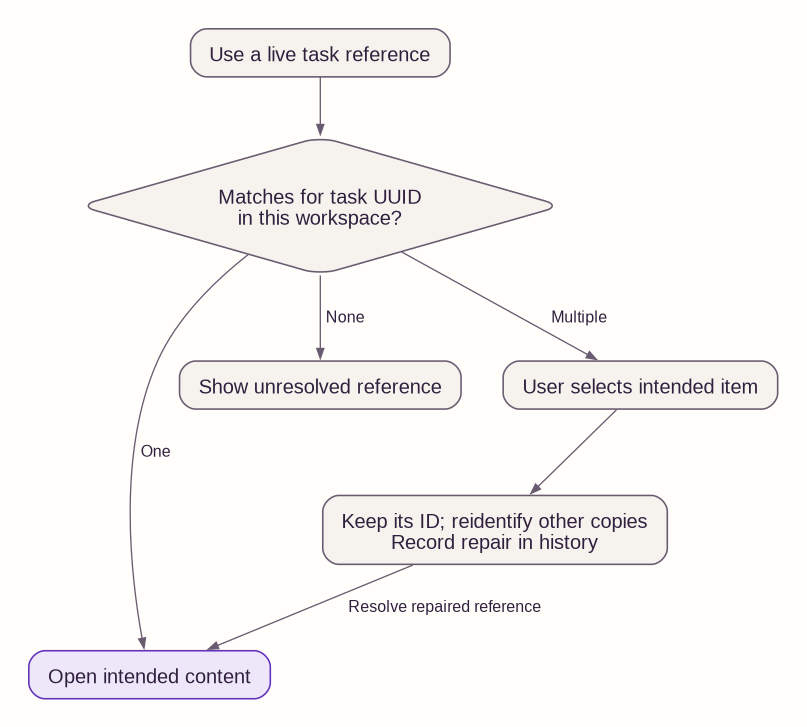
External copies can duplicate task IDs despite practically collision-free generation. An ambiguous reference must not open or modify an arbitrary match: the user selects the intended entry, which keeps the ID, while other copies receive new IDs in a versioned repair. The agent follows the same restriction. Ambiguity is currently rejected; interactive selection and repair remain unimplemented. Accidental UUID-generation collisions may be reported without a dedicated recovery path; they are distinct from external duplication. See REQ-0035.
Shared file-reference model
Markdown, PDFs, images and other workspace files use the same model, avoiding embedded file IDs, companion files or an authoritative identity registry. Confirmed moves preserve references without rewriting conversations, at the cost of automatic rediscovery of external moves. Binary files participate in history; their reference model does not provide text extraction. See Git-derived file references for the resolver and stored-selector contracts under ADR-0010 and ADR-0012.
Stored conversation references
Git owns confirmed operation facts and their result snapshots. The resolver derives current targets from that history without an independently writable move journal or durable identity witness. Structural operations record a boundary before filesystem changes and a matching completion commit afterward. Without a valid completion, the operation remains uncertain: restart may record observed state but must not continue or roll back filesystem effects, or infer continuity from matching bytes or Git rename heuristics. Working files and prior history remain preserved. File publication and Git reference publication are separate boundaries; failure does not prove that neither occurred. See Git-derived file references for the detailed protocol and the original unpublished-format replacement. Its no-migration exception does not apply to published formats; later changes follow released-version compatibility and must not reset or delete existing workspaces.
Portable selectors contain no runtime location IDs. On load, native storage associates them with the authorized session through a Runtime Workspace Binding, without changing their anchors or storage revisions. A copied workspace can share its Diagnostic Workspace Identifier for correlation, but that identifier grants neither access nor shared runtime state or AI credentials. Historical references retain the exact commit and path, including inline-resource revisions. Sending resolves source text without fetching linked images. Opening retains the selector through loading, polling, discard and retry rather than falling back to an unguarded path read; unsupported stored selectors fail explicitly without conversion, overwrite or automatic recapture. See Conversation storage and overwrite protection for record validation and overwrite protection.
Versioned changes and explicit reversal
All stored content, including binary attachments, has recoverable history. The file view exposes earlier versions and comparisons without Git commands or AI; Markdown comparisons include metadata changes, and inspection leaves current content unchanged.
Initial history follows default git log behavior, without editing-session grouping. History follows confirmed managed moves, and a recovery entry point reaches deleted files independently of the current tree.
Reversing a change, making a new historical copy and restoring a deleted file are distinct operations. Copies create new file lineages and task IDs; restoration preserves task IDs but does not reactivate old live file references, and an occupied destination requires a decision.
A separate wholesale reset to an old snapshot is outside initial delivery; detailed recovery controls and non-text comparison presentation remain open.
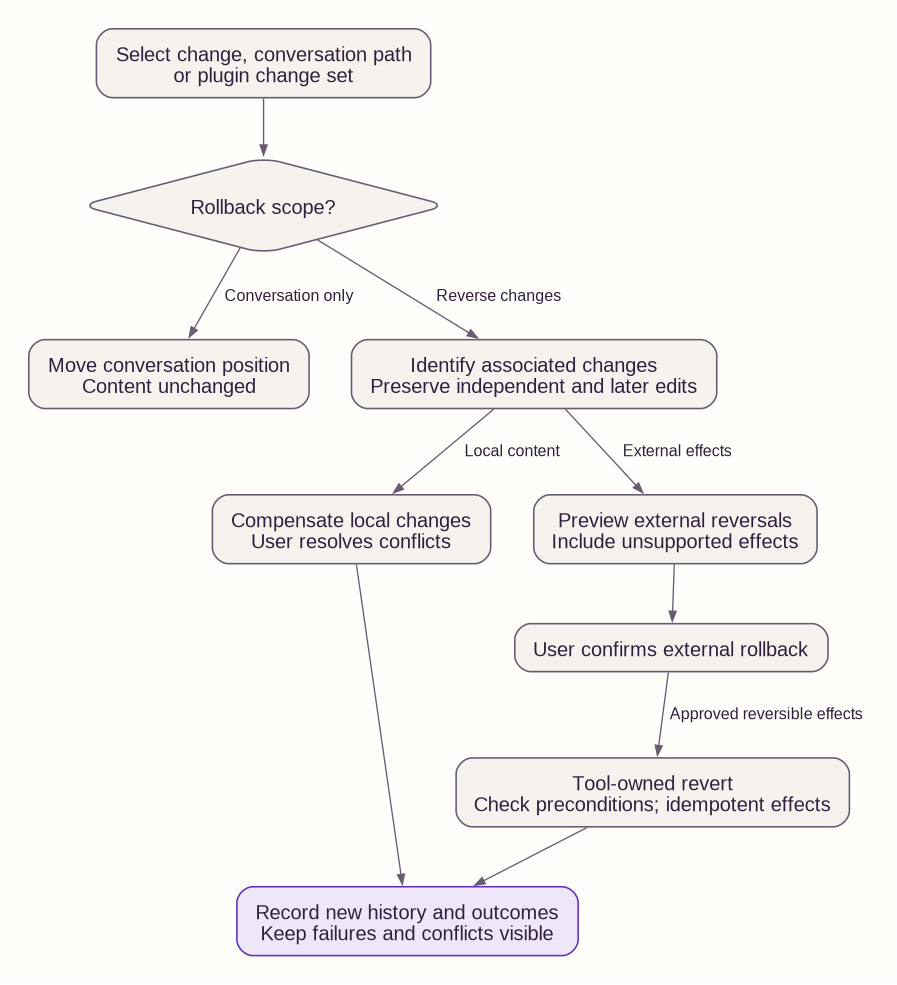
Users can undo individual changes or return to a branching conversation position with or without reversing associated content. Rollback adds compensating changes, preserves later independent edits and requires a user decision for conflicts; whole-file restoration is insufficient when it would overwrite unrelated work. Plugins use versioned core writes. External tools declare effects and supply an idempotent, precondition-checked revert operation or declare reversal unavailable. External rollback requires preview and confirmation; failed and unsupported reversal remains visible.
Git is the chosen basis for versioned storage. Organizational content shares one history per workspace; each plugin’s code and plugin-specific histories remain in its own directory, separately from general content history.
Deleting that directory removes retained installation state, not unrelated content or general history.
The path-backed core embeds libgit2 through git2 without a Git CLI or networking dependency, using .situate/history.git; external applications edit content, not Git internals.
Recovery drafts remain readable independently of damaged history. Durability requires more than writing a file or advancing a Git reference, and noncooperating external writers can still race a checked replacement.
History has no initial product-imposed retention limit, increasing storage and synchronization costs.
See REQ-0022, Filesystem durability and flush failures and the storage API for flushing, structural bounds, supported reference forms and reversal limits.
Current writes support desktop filesystem workspaces and application-owned mobile folders; external mobile providers remain read-only without history initialization. Native platform qualification is separate from these source contracts.
Damaged history and confirmed reinitialization
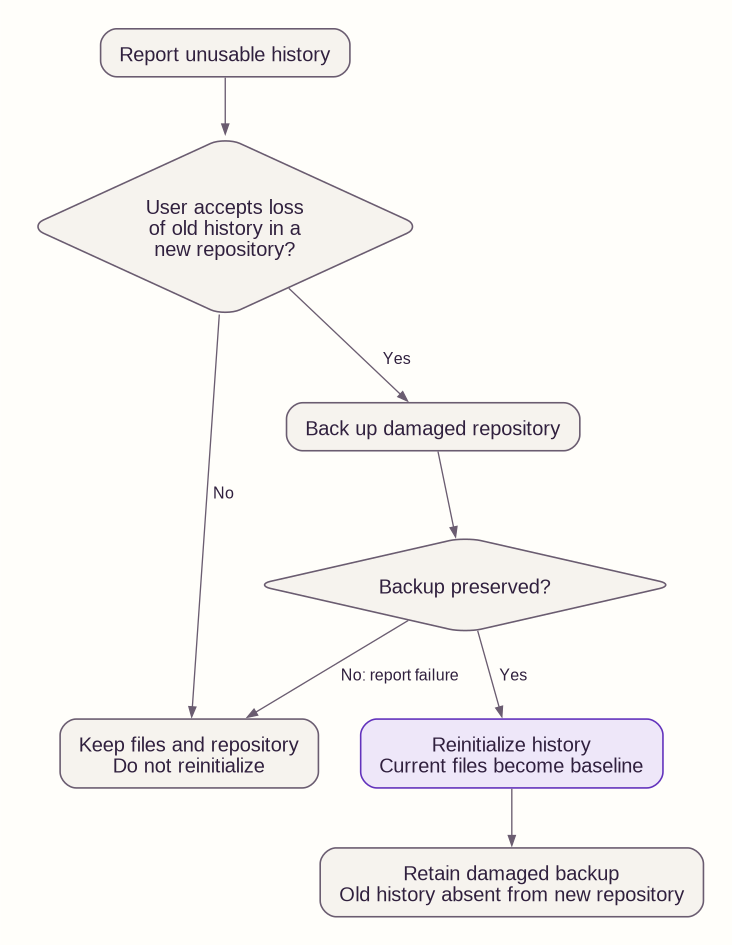
Repository corruption is distinct from a merge conflict in usable history. The core reports unusable history without asserting an unverified cause; versioning cannot guarantee recovery of a damaged repository. Reinitialization requires explicit confirmation that the new repository will not contain the old history, and must first preserve the damaged repository as a backup. Existing content remains intact and becomes the new baseline. The backup preserves a possibility of recovery, not a guarantee. Recovery scope, backup placement and coordination with other devices remain open; local reinitialization does not authorize replacing remote histories or deleting other devices' history. See REQ-0022.
Adaptable task defaults
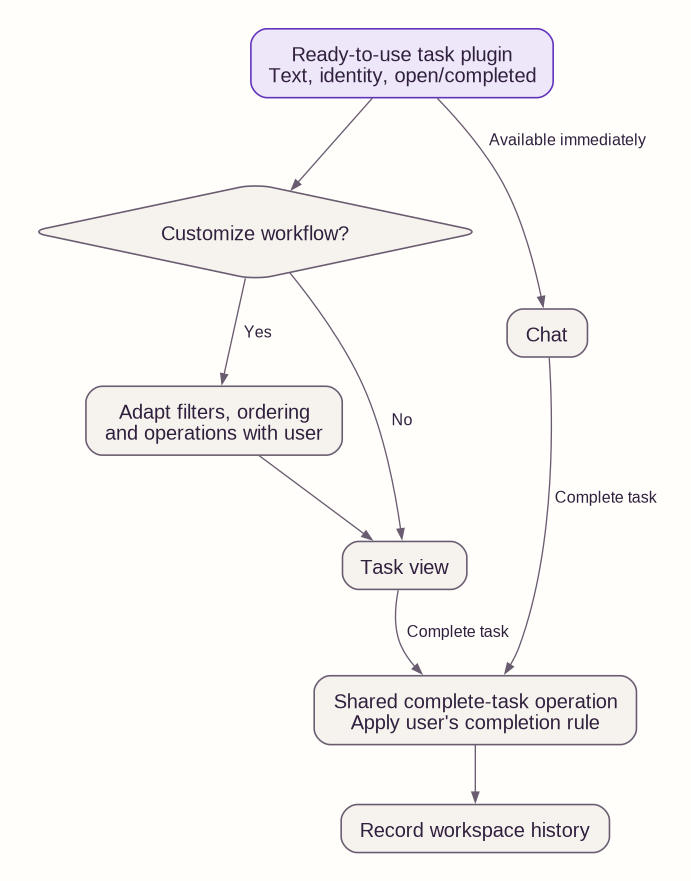
Situate includes a ready-to-use task workflow plugin with basic filtering, backed by reusable task operations. Users start with a useful view rather than having to build their first task interface. During import and onboarding, the agent adapts the view, filters, ordering and operations to the user’s working method. The view uses the same movable, resizable and responsive placement capabilities as other plugin views; there is no additional immutable core task overview.
The initial task contract contains text, identity and open/completed state. Due dates, scheduled dates, priorities and other fields have no prescribed default vocabulary or interpretation; these are established from the user’s source system and workflow. Tasks can live in project notes, thematic lists or individual files, without a mandatory project concept or file-per-task rule.
Chat and the task view call the same reusable operations, including completion. A user’s completion rule may check an entry, archive it or remove it from the current file; deletion alone is not universally interpreted as completion. The agent may change the default contract and state model while updating its consumers under the existing grouped-change rules. Stored-content history remains recoverable regardless of the chosen display and completion behavior. See REQ-0034.
Import and external editing
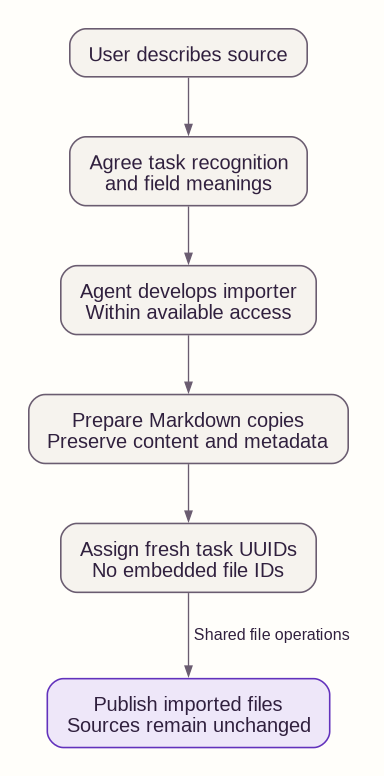
Import is available during setup and in later ordinary conversations, including new chats. It is agent-assisted rather than limited to a fixed catalog of prebuilt importers. The user describes where notes, tasks and documents currently reside; the agent clarifies their structure and the desired transfer, then develops suitable importers for the source technology as needed. Access still depends on available interfaces and permissions; generic importer development does not guarantee access to every system.
Import leaves source data unchanged and creates copies in the workspace. Imported notes and tasks are converted into Situate’s Markdown conventions, including normalization of existing Markdown copies. The agent establishes the source’s task recognition and metadata meanings with the user. It assigns fresh task identifiers and can replace a source-specific task marker with the task identifier comment in the imported copy. No file identifier is required or inserted. Notes and tasks from other formats become a suitable Markdown organization that preserves titles, body content, links, actual attachment files and task field meanings. Within the imported copies, supplied content and metadata remain in place alongside actual attachments and working links. Temporary conversion mappings are removed after acknowledged completion. Under ADR-0012, conversion prepares content; shared write/edit and bounded batch-creation operations perform file publication into the workspace. The same tools serve setup and ordinary conversations. Native writes, edits and batch creation assign UUIDs to explicit null task-ID placeholders while preserving existing IDs and other source bytes. Converted imports use null task IDs; the agent reconciles links using acknowledged assigned IDs. Explicit workspace copies regenerate task IDs and retarget recognized internal links, while managed moves preserve task IDs. Creation prevents overwrite; corrections check current revisions. Partial and uncertain batch outcomes retain actual file publication results without automatic replay or an all-or-nothing promise. PDFs, images and other document files remain ordinary files rather than universally converted into Markdown; all file references use Git-anchored paths.
When an external editor creates a Markdown file in a workspace, Situate records detected changes without inserting a file identifier or rewriting content for reference capture.
An externally written checkbox without a task identifier remains an ordinary checkbox; import-time task recognition does not become an unconditional background conversion rule.
Unknown file and task metadata survives import and Situate’s own edits to existing workspace files.
Import does not trigger cleanup of existing workspace files.
Malformed or unsupported metadata is reported; transformations that cannot preserve its meaning fail safely.
Cancellation markers such as [-] remain unchanged and are not recognized as open tasks.
A source task state without a supported equivalent retains its source representation and is reported as a limitation rather than mapped to another state.
Keeping metadata in the file preserves independent editing and transfer, but comments can be removed by other tools and become unwieldy with many fields. The parser and write path therefore need to preserve content and detect invalid metadata without depending on AI to repair every edit. Task field mappings remain source-dependent; preserved file frontmatter does not require a fixed source metadata schema. See REQ-0036 and REQ-0009.
4.4. Extensibility and shared interfaces
Trusted extensions with core-owned content rules
Installed plugins are trusted code with broad access. The core relies on declared effects and reversal capabilities rather than trying to infer arbitrary side effects. Task scope and configured access remain binding, but this contract does not prevent malicious or defective plugins from bypassing them. This reduces initial isolation complexity at the cost of a larger trust boundary. Separate workers or WebViews are not a mandatory isolation layer for plugin execution or rendering. Faulty synchronous plugin code can consequently block the application’s shared UI runtime; exception handlers or timeouts on that blocked runtime cannot guarantee a usable disable action. Trust in plugin code does not remove operating-system boundaries or store obligations. Mobile extensions use JavaScript and the host’s available interfaces, not an unrestricted desktop process environment. See the plugin trust boundary.
Reusable integrations and individual workflows
Connections own external access and account configuration within their workspace and expose reusable service functions. Document sources are connections that implement a document service convention. Separate plugins compose those functions into workflows, chat tools, skills and workspace views. Connections can contribute access settings, but not those plugin contributions or reusable UI components. When upgrading packages from the previous manifest format, Situate assigns them the general plugin role. Package identity, settings, contributions and exports stay intact. The migration converts the active revision independently of editable code and retains the original in history. Each consuming plugin selects the accounts relevant to its purpose, rather than inheriting every newly connected account. This avoids duplicate connection setup without imposing the same account selection on unrelated workflows.
The core supplies explicit exports, declared dependencies and invocation mechanisms, not domain contracts for mail, inbox entries or particular organizational methods. The development agent discovers existing integrations and their consumers within the workspace, designs reusable interfaces and extends them when necessary. Types can describe plugin-defined contracts; their format and compatibility scheme remain open. Host SDK and supplied shared-component compatibility separately follow REQ-0070; that policy does not require every user-authored plugin change to support older apps. Plugins can depend on a concrete plugin or a plugin-defined shared provider interface with interchangeable implementations. Dependencies are initially required; optional dependencies are deferred. Required installations are presented together for user confirmation.
Integrations can be used directly through chat without a separate workflow plugin. Their designated chat tools are all available from the start; specialized functions can be omitted from that tool list while remaining callable by plugins or code. Tool-list selection controls context size and discoverability, not authorization. Dynamic tool discovery is not part of the initial approach; tool visibility does not expand task scope or configured access. See REQ-0001 and REQ-0029.
Independent plugin copies and histories
Local plugin management is delivered first; the shared marketplace is deferred under the delivery boundary. The planned marketplace distributes free versioned templates that become independent local copies and serve as development starting points. The agent adapts them to the user’s workflow and existing integrations, consulting the user when additional integrations are needed. Templates can convey a presentation and workflow without prescribing the user’s external accounts or a core-owned domain interface. There are no automatic updates or upstream merges; ongoing development belongs to the user and their local agent. Use a Git-backed marketplace and a separate Git repository for each plugin’s code history. Client source histories use embedded Git; plugin activation selects checked code and dependency revisions. Marketplace hosting and provider-interface details remain open; optional dependencies remain deferred. The planned catalog offers descriptions, optional previews and autonomous agent search for reusable templates, including combinations of their parts, without download-count ranking.
The agent prepares a separate marketplace submission copy with English user-visible plugin text without altering the personal plugin. Adoption adapts that text to the user’s language under REQ-0049. Code, fixtures and marketplace material must exclude personal data and credentials; optional screenshots use synthetic data. A complete store-page preview precedes explicit Publish, which submits for manual administrator review rather than immediate marketplace publication. Any signed-in user may submit; every version needs approval. Rejection feedback, reporting and immediate blocking at adoption follow REQ-0019. Blocking does not warn existing adopters or remotely disable their independent copies.
Initially, general marketplace terms provide uniform rights to reuse, modify, combine and redistribute free templates, without publisher-selected licenses or guarantees of legal clearance. The actual terms and review procedures require legal and operational work; these product rules do not select the repository’s license. Automated malware and prompt-injection review remains deferred under REQ-0020, not a prerequisite replacing initial manual review. Local security review before use, including adaptations, is required under REQ-0021. A failed local review produces a warning and proposed corrections; the existing explicit user override remains available. Marketplace approval does not replace that review or guarantee safety. See REQ-0019.
The core supplies Git-backed versioned storage for plugin-owned data and configuration inside the owning plugin directory, alongside its separate code history. Retained runtime metadata and development drafts also belong to that directory; its absence cannot be overridden by an external installation index. Uninstallation removes the complete directory while preserving ordinary user content and general workspace history. See plugin directory ownership. It does not supply a universal reverse-migration framework. The agent may independently reconcile earlier code with later data using the histories, but must preserve independent changes and surface unresolved conflicts. This permits flexible plugin evolution while placing migration correctness on the local agent and its tests. See REQ-0022.
Coordinated development and activation
Development uses a separate native-owned conversation with specialized instructions and ordinary workspace capabilities and task-scope rules. The selected plugin supplies starting context, not an access boundary: an assignment can span integrations, consumers and ordinary files. Shared chat presentation exposes recorded source diffs; complete-plugin inspection remains available without executing disabled code under REQ-0017.
A temporary workspace copy is not a mandatory development access boundary. Editable source and active code revisions remain separate: preparing source does not replace the installed version before successful checks and activation. Ordinary workspace edits use normal versioned writes and become durable independently of plugin activation. See the source preparation and publication boundary. Automated tests, including UI tests, use strictly synthetic data, test configurations and test dependencies. Agentic investigation may read workspace data and connected accounts; system instructions forbid incidental real external writes during trials. This is a behavioral instruction to the agent, not a technical sandbox or access-control guarantee. Personal data and credentials must not be embedded in generated code or test fixtures.
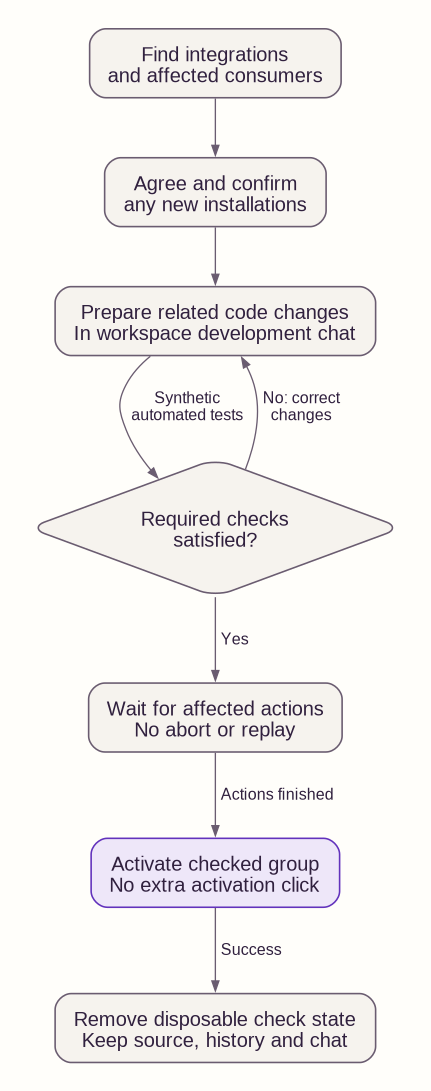
A requested change can span a reusable integration and its dependent workflow plugins. The development agent may update the affected local plugins autonomously within that request, while preserving their established behavior. These related changes form one plugin change set for checking, activation and rollback, even when their code histories live in separate repositories. Generated or modified code within an explicit development request can be activated after successful checks without a separate activation approval, including after recovery startup; task scope and configured account access remain unchanged.
Active versions remain available while replacements are prepared and checked. A Check Receipt retains which code and dependency revisions passed the required checks; it does not itself activate code or prove safety against malicious code. Plugin activation publication replaces the affected selections together in the Active Revision Map, the workspace record of active immutable plugin revisions. It must first wait for affected running work without aborting or repeating it. That includes a Root Action (a top-level plugin tool or export call and its nested calls) and independent native requests retaining a Worker Lease until completion and cleanup. Long-running work can therefore delay activation. Trial data and test configuration are never activated; ordinary workspace edits can already be durable when checks or activation fail. The agent activates the checked group without a further user click, including a disabled or temporarily suspended target, while unrelated suspensions remain. Unknown plugin activation publication outcomes must not be blindly retried or automatically repaired. The grouped activation scenario and client contracts define revision checks, Operation Admission, draining and outcome inspection.
Incomplete development remains in the conversation list without automatic expiry; the MVP has no development-storage display, manual cleanup or age-based retention policy. Successful completion removes disposable candidate/check state but retains live source, conversation and recovery history. Stopping work does not reverse durable workspace edits or activated code. Closing or hiding a view does not stop work; workspace closure and application quit do. Reopening an interrupted conversation waits for explicit user input. This is a development lifecycle, not an additional security sandbox.
Rollback compensates the related changes together while preserving later independent edits and exposing conflicts for user resolution. Tests reduce regressions but cannot guarantee the absence of defects. Remaining data-compatibility and interrupted-switch scenarios still need design or verification. The selected activation coordination and retained-outcome protocol do not settle every dependency-drift or recovery question; see Plugin development and adoption. See REQ-0033 and REQ-0022.
Plugin status and lifecycle
The built-in Plugins destination manages plugins independently of plugin-provided views and Settings contributions. Disabled code and Settings views are not loaded or executed, while code, configuration and data remain stored for later re-enabling. After confirmation, disabling blocks new actions, pauses triggers and removes chat tools. Running actions normally finish; users may abort instead, with a warning that existing external effects are not undone. Required dependencies expose the affected consumers before confirmation and block their use too. Re-enabling a dependency does not re-enable its dependents; each requires an explicit choice. The dependency graph therefore serves both development impact analysis and operational visibility. See REQ-0032.
Recovery mode
Recovery mode suppresses all plugin execution before loading any plugin code, across restored and subsequently opened workspaces, while preserving code, configuration and data. Built-in management and the agent can disable, remove or repair plugins without invoking their tools. This temporary startup suspension is distinct from persistent disabling. Users can resume individual plugins or all previously enabled ones without restarting; permanently disabled plugins stay disabled on resume-all. Requested development permits previews, executable checks and checked target activation without resuming unrelated plugins or replaying interrupted work. Recovery ends when no temporary suspensions remain. The entry path and repair interface must work without executing faulty plugins or relying on a previously frozen UI. Concrete target-platform entry and qualification work remains below. This supplies a repair path, not a sandbox, reversal of damage or freeze prevention: testing or resuming faulty code can freeze the application again. See REQ-0032 and REQ-0037.
Shared interface and plugin development
Desktop and mobile target the same functional scope, including local plugin creation, modification and testing. Use Vue and a centrally verified Situate component library for both built-in and plugin views, rather than separately styled implementations. Both use the same component definitions, not merely similar styles. Plugins compose shared components declaratively by default but may implement custom components, add views and extend existing interfaces. Shared components own their standard appearance, input behavior and adaptation to the available container width, including narrow panes on a large display. Central component updates can therefore improve both built-in views and unchanged plugins. This does not make arbitrary custom layouts responsive or accessible without their own verification. Plugins explicitly declare function- and view-level platform limits where capabilities differ. This supports consistent local development, but previews on one device do not prove compatibility on another. See REQ-0012, REQ-0014 and REQ-0026.
Local plugin development requires app-local UI interaction, screenshots and different-size previews, not merely developer-host test tooling. The development lifecycle requires synthetic automated tests and forbids incidental real external writes during agentic trials; it is not a technical sandbox. These capabilities still need qualification inside installed mobile apps.
Component exports and compatibility
A plugin can define Vue components for its own views and explicitly export reusable components through declared plugin dependencies. Components remain local unless exported; importing through a declared dependency avoids an automatic global pool of plugin component names. The core does not prescribe domain-specific components or provider contracts.
Keep the public SDK and component contracts small, with documented properties, events and slots rather than dependencies on internal DOM structure or private host modules.
Prefer compatible additions and preservation of existing contracts; validate existing consumers when the shared implementation changes.
Changes to plugin-owned exported components follow the affected-consumer checks and grouped activation used for other plugin-defined interfaces; the host’s public API policy below is separate.
A shared Vue runtime avoids each plugin requiring its own host framework copy, but Vue upgrades and third-party dependencies still carry compatibility risk.
Public SDK and shared-component contracts follow the internal minimum six-month compatibility window from each app version’s publication under REQ-0070, with a long-term objective of never breaking them.
This is not an automatic expiry policy or a promise to support arbitrary third-party framework versions. A plugin using newer capabilities can require a newer app without an older-version fallback; unsupported devices disable that plugin locally before execution and show the required app version.
Mixed-version workspace data must also remain usable under REQ-0069; a plugin’s minimum version alone does not make the whole workspace incompatible.
The current macOS host exposes declared function exports through dependencies.invoke; the client guide lists its Vue and runtime services. A separate Vue component export format and broader compatibility verification remain design work.
Connections can use the general local process host on supported desktop platforms instead of requiring a service-specific core interface. The current macOS API exposes literal executable/argument execution without per-command consent, with bounded output and duration, workspace change observation and the same action/request drain as other host work. Synthetic checks match explicit process responses and never start local programs. The workspace working directory is not a filesystem sandbox, and code checks neither freeze installed executables nor grant OS permissions or account access. Service-specific convenience APIs may supplement this access path; they are not a prerequisite for every integration. The client guide defines the process reply, environment and lifecycle limits. See REQ-0001 and REQ-0033.
Responsive layout and view placement
Each workspace has user-named topic tabs with independent layouts of movable, resizable panes. Tabs group presentation without creating data or execution scopes; each pane has one active view and its own back/forward history. Navigation, hiding views and switching tabs preserve workspace-owned execution. Multiple panes can show one conversation without creating multiple owners. Phones normally project one pane at a time; larger displays can show several. Narrow or maximized presentation preserves the stored tab arrangement. Layout and supported navigation state are device-local, scoped to a workspace and excluded from synchronization and workspace transfer. Each device restores its own arrangement; viewport changes affect its presentation, not another device’s layout. Built-ins, plugins and agents use host navigation instead of manipulating layout internals. The User Interface decomposition defines focus, opening, tab/pane controls and the separation of coordination, layout, navigation, sessions and rendering. See REQ-0011 and REQ-0026.
Content references and chat handoff
Plugins can offer an explicit action that opens a new chat with a visible reference to a content item. The user can then write a request about that item; opening the chat alone does not start its processing. This makes the reference explicit without implicitly adding every current selection to conversation context.
Ordinary references identify the live source and may become unresolved after that source is deleted. They do not require retaining a source snapshot, and they do not remove the existing version history of Situate-owned content. A reference may instead select a historical revision when one exists, enabling discussion of an earlier state. The plugin determines whether following a reference opens an internal view or the source in an external application or browser. The core supplies navigation and reference mechanisms rather than domain-specific display rules. See REQ-0030.
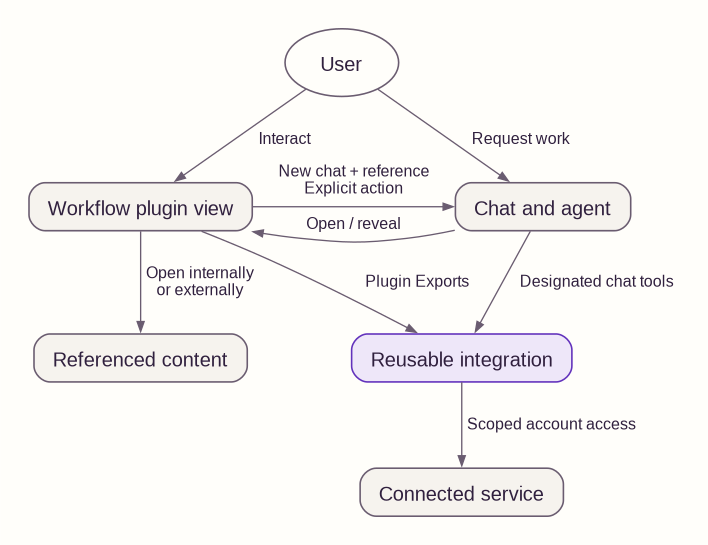
Mobile extension boundaries
Plugins extend Situate’s personal organizational functions rather than form a storefront for unrelated standalone applications. Locally authored or agent-modified code and adopted templates use the same JavaScript runtime and available host interfaces. Files outside the application’s container require operating-system-authorized access; access to external accounts remains subject to the user’s permissions.
Existing applications provide relevant precedents: Obsidian on iOS supports community plugins, while Scriptable supports user-authored JavaScript with file, calendar and web-view capabilities. Obsidian’s mobile plugin documentation explicitly excludes Node.js and Electron APIs on mobile. These precedents support purpose-bound extensions but do not establish approval for Situate’s particular marketplace or agent behavior.
Apple’s Developer Program License Agreement, section 3.3.1(B) permits downloaded interpreted code subject to purpose, OS-security and distribution restrictions. It must be read together with the other agreement provisions and App Review Guidelines, sections 2.5.2 and 4.7. The applicable treatment of generated plugin variants, native API exposure, data consent and marketplace obligations remains to be clarified for the concrete implementation. For the deferred Android target, Google Play’s Device and Network Abuse policy likewise distinguishes interpreted code from downloaded native executable code while retaining policy obligations.
4.5. Automation and synchronization
View-independent execution and triggers
Plugin execution is independent of whether a plugin view is open. During normal operation with their workspace open, plugins can respond to shortcuts, intervals, scheduled times, application events and available operating-system events. Recovery startup suppresses those triggers across all restored workspaces. Requesting explicit workspace closure blocks new action starts while the user decides whether to cancel closure or abort running work and close. Cancelling closure restores normal operation without interrupting running work or scheduling later closure. Once the last window for that workspace closes, execution stops, even if Situate and other workspaces remain open. Mobile suspension and platform capability limits still apply; this does not introduce an always-running server agent or guarantee execution while the workspace is closed.
Plugins define whether missed triggers are skipped or caught up after the workspace becomes available again. A configured trigger may start an agent run without an open chat, within its configured task and account access, without per-action approval. Each plugin chooses whether to present that work as a conversation or show only its result with history accessible on demand. Presentation does not waive traceable process history. See REQ-0005 and REQ-0031.
Cross-device execution policy
A scheduled workflow normally aims to run once across devices using the same workspace, but per-device execution is also supported. The plugin defines whether it waits for coordination, runs offline or accepts possible duplicate execution. Completed results are synchronized when synchronization is configured and the workspace is open; execution coordination must not require mirroring in-flight conversations between devices.
The core provides coordination capabilities alongside synchronization, without prescribing a universal offline policy or promising exactly-once execution. A marker synchronized between devices alone cannot exclude simultaneous starts or disconnected execution. The coordination protocol, transport capability requirements and recovery after a device disappears remain open. This preserves workflow choice at the cost of making duplicate handling and availability an explicit part of plugin development. See REQ-0013.
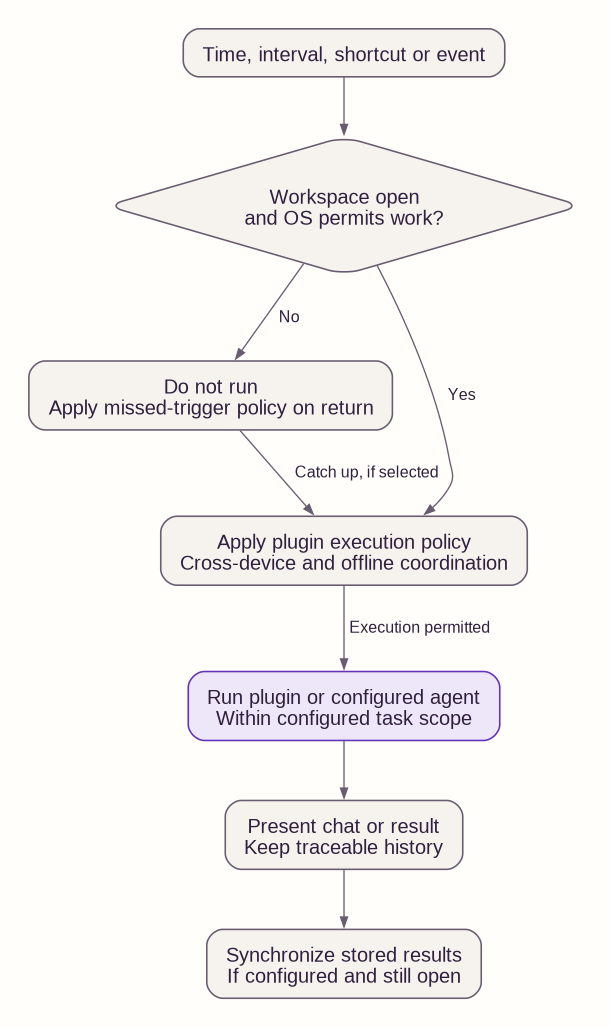
Replaceable synchronization transport
Synchronization is configured separately per workspace, including the choice not to synchronize it. Only an open workspace synchronizes; reopening detects external edits and resumes the configured synchronization. Existing local content is immediately usable without waiting for remote changes, and the synchronization state remains visible. When connectivity permits, synchronization runs automatically in the background without user-managed saves, Git commits or manual synchronization steps. Transfer batching and cadence remain implementation choices.
The core owns versioning, conflict detection, merging and history recovery regardless of transport.
Synchronization plugins provide storage access and transfer; they may use a Git server or transfer the entire workspace directory, including .situate/history.git and other internal files.
This flexibility does not make an arbitrary copy of live internal state consistent, nor does it transfer conflict or recovery ownership away from the core.
Uncontrolled modification or transfer of Git internals can damage a repository rather than produce an ordinary merge conflict.
External changes from other programs are detected and incorporated through local file reconciliation or the applicable transport, subject to conflict resolution. How a transport represents and retrieves changes must match its storage format; arbitrary external edits to the official encrypted representation are not assumed to be interoperable. ADR-0015 proposes client-encrypted incremental Git packs for the official transport, with client-owned reconciliation and an operator-blind service. Encrypted Git synchronization proposal develops the candidate mechanisms and required evidence. The detailed protocol, merge-aware integration, consistent treatment of active internal state and security verification remain open.
Initially every device synchronizing a workspace retains all of its workspace-local content and full history, including earlier attachments. This does not require migrating externally retained document originals into the workspace. This simplifies availability and recovery at the cost of disk usage and transfer volume. Selective document download, offline pinning and cache eviction are later stretch goals, not part of the initial implementation scope. Notes and tasks remain fully local in that future direction. Git LFS-like references to remotely stored file versions are an option for later history optimization. See REQ-0008 and REQ-0013.
User-resolved merge conflicts
Non-conflicting Git changes merge automatically, except when plugin source revisions genuinely diverge under the same declared version. That case requires the user to select one revision even if a textual merge would be clean; the unselected revision remains in history. A later return to the retained revision is a new checked change, not a reset of newer plugin data. Source selection is not automatic activation. See plugin source divergence.
A merge conflict in an intact repository requires the user to choose either version or work with the agent in chat on a combined result, which the user approves before application. Manual resolution remains possible without AI. For conflicting binary files, users can keep either version or retain both as separate files; automatic binary merging is not assumed.
An unresolved merge conflict pauses synchronization for the entire affected workspace. Other local edits remain possible, and other open workspaces continue independently. Synchronization resumes after the blocking conflicts are resolved; partial synchronization around unresolved conflicts is not part of the initial approach.
No additional domain-semantic conflict pass is required during synchronization. Practically negligible UUID-generation collisions may be reported as errors without special recovery. Externally copied identifiers remain a separate case: ambiguity is resolved when a reference is used under REQ-0035. See REQ-0013.
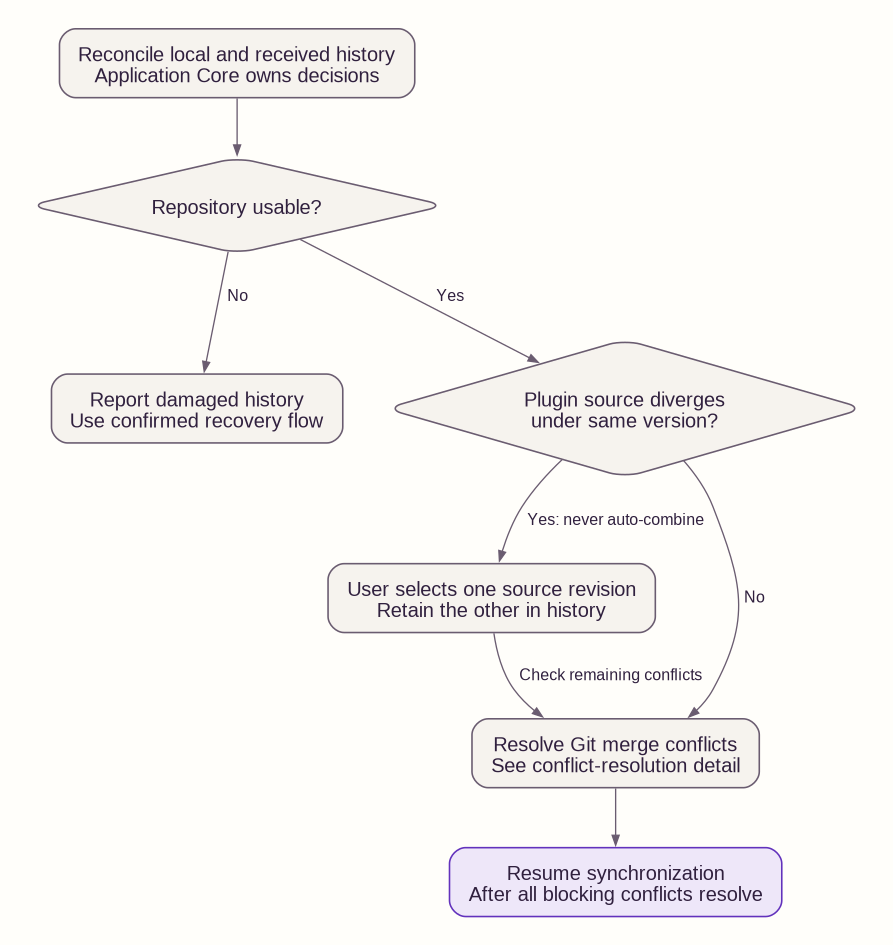
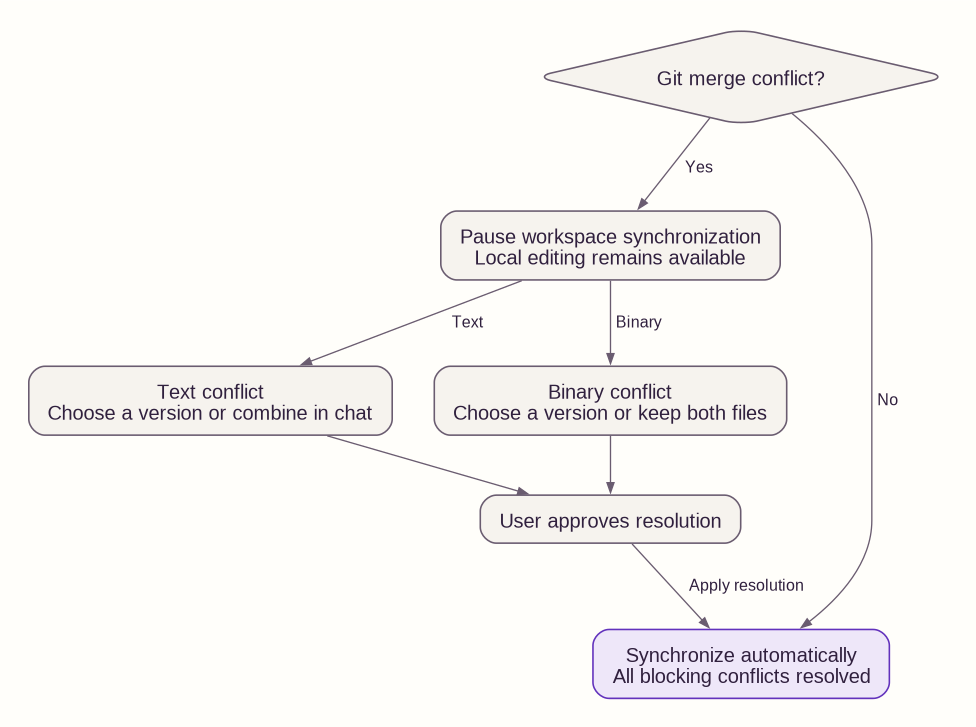
Closing with pending synchronization
Before closing a workspace with unsynchronized changes, Situate offers synchronization before closing or immediate closure with local changes retained. Synchronization before closing keeps the workspace open until the exchange completes; offline conditions, unresolved conflicts or transfer failures must not be presented as successful completion. Immediate closure stops synchronization, retaining changes for the next opening rather than continuing work in the background. The synchronization state and decisions needed from the user must be recognizable; notification prominence, placement and exact UI remain open.
Encryption and device provisioning
The official synchronization service provides mandatory end-to-end encryption; neither it nor the operator can decrypt synchronized content. Alternative plugins may use other content-encryption policies, including unencrypted storage chosen by the user. Provider connections, credentials, endpoints, selected access, model defaults, conversation overrides and endpoint consent belong to the workspace on each device, outside its portable directory and histories. Neither official nor custom synchronization transfers these operational settings or credentials, including reusable API keys. A new device configures access independently without replacing another device’s settings or credentials. Provider secrets remain protected by OS secure storage; authentication, model requests and token renewal go directly to the provider, not through a Situate credential broker. Separate device sessions must not share rotating refresh tokens or silently displace another device’s session.
For the official service, a new device signs in and is then provisioned through an existing authorized device or a user-held recovery key. Account login alone does not unlock content. One recovery key per Situate account recovers all officially synchronized workspaces while their configuration and runtime access remain independent. Onboarding requires saving and confirming the recovery material, offers PDF export, explains loss consequences and recommends a separately stored printed copy. An authorized device can reveal/export it again after explicit action and additional OS authentication where available. Ordinary use requires no extra Situate password, default application lock or routine biometric prompts beyond OS storage access restrictions. Without a usable local copy or authorized device and without the recovery key, Situate cannot recover the encrypted server content. QR-assisted provisioning is a possible interaction, not a selected security protocol. Local-only and custom-synchronized workspaces require no Situate recovery setup or portable credential vault. The device-local storage design in ADR-0002 is separate from content recovery; the account recovery hierarchy and provisioning protocol are not yet selected.
This keeps recovery outside operator control but places key-custody responsibility on the user. Authorized plaintext AI processing remains a separate flow and must not expose keys or plaintext to the official synchronization service. Cryptographic protocols, key separation, rotation, revocation and metadata protection remain to be designed. See REQ-0013.
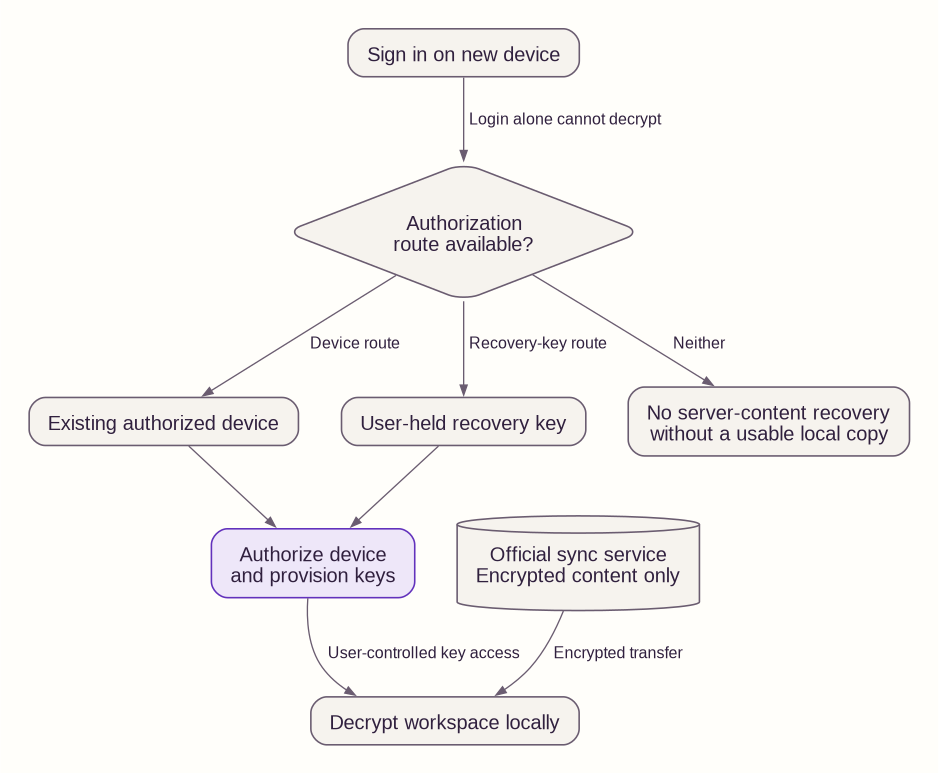
4.6. Evidence and remaining decisions
Implementation scope
The client under client/ implements workspace entry and lifecycle, a Files view with Markdown editing, reading and history/recovery, and persistent topic tabs with pane-local navigation.
A window-authorized bridge connects those views to path-backed Git storage, drafts, metadata and structural operations.
Desktop filesystem and application-owned mobile folders are writable; external mobile providers remain read-only without history initialization.
An unobserved external write can still be overwritten; source integration does not establish platform durability or complete recovery.
See Initial file-editor delivery, User Interface and Client package boundaries for detailed mappings and limits.
Native conversation execution uses Rig under ADR-0013, with application-owned storage and provider/tool adapters rather than a WebView-based Pi fallback. Versioned records protect against invalid-data overwrite but do not by themselves implement conversation history or branching. Workspace-scoped operations and quit coordination are described in Current client: workspace operations and closure and Current client: application quit and cancellation; native AI ownership, browser dependency boundaries and the initial JavaScript budget are described in Native AI execution and browser dependencies and Initial JavaScript budget. The qualification record distinguishes source integration, deterministic checks, native platform evidence and live-provider evidence.
Feasibility prototypes demonstrated runtime JavaScript editing and activation, shared/custom UI, core-view contributions and app-local checks.
Commit 82770f1188730fb7e6ef7db0fc72a4ce8aec1a0e on prototype/tauri demonstrated shared host/plugin Vue components, local template editing, container-responsive layouts and view cleanup on Android, the iOS simulator and macOS; prototypes/tauri/VERIFICATION.md on that branch records the evidence.
A central component update changed both consumers without changing stored plugin source. This verifies that scenario, not general SDK compatibility, mobile plugin qualification or store approval.
Those prototypes used change journals, not Git, and do not verify the current core’s Git durability, synchronization or interruption recovery.
The macOS client supplies declared function exports, required local dependencies and recovery startup; plugin-to-plugin Vue component exports remain design work.
Detailed design and verification work
The selected direction is Tauri, Rust, shared Vue components, plain JavaScript with locally compiled templates, native Rig conversation ownership, Markdown and Git-backed history within independent workspaces. Trusted plugins have no additional mandatory isolation runtime; recovery startup supplies a repair path, not prevention of every runtime failure. The following gaps do not imply that all mechanisms are absent or that every item requires an ADR. Consequential alternatives belong in decision records; detailed protocols and qualification belong in their corresponding views.
Interfaces, storage and runtime
-
Vue component export formats, typed contracts and verification within the approved public-interface compatibility policy; mixed-version workspace handling under REQ-0069 and plugin version checks under REQ-0070.
-
Broader loader/local-compilation qualification, native mobile execution and access, and effective recovery entry before plugin code loads.
-
Interruption and durability qualification of Git-backed plugin source, checked dependency revisions, the Active Revision Map and plugin activation publication outcomes. Overlapping development does not imply automatic conflict-free merging or repair of uncertain activation.
-
Local security-review coverage and inconclusive results, retaining the specified warning override; automated review does not replace initial manual marketplace review.
-
Interactive duplicate-task-ID repair, additional reference forms, non-text comparison/reversal controls, mobile external recovery export and larger structural operations.
-
Consistent snapshots, partial external writes, and checked-replacement races with noncooperating writers; native Apple permission, interruption and durability evidence.
-
Connected-document metadata, connector capabilities, external reference identity and search preparation within agreed source/processing boundaries.
-
Remaining structural agent tools, the full plugin-development tool surface and the managed AI router; database choices remain open.
Synchronization and service design
-
Consistent transport representations and active-state snapshots; cadence and recording local edits during unresolved synchronization conflicts.
-
Cryptographic protocols, key separation, rotation, revocation, metadata protection and account recovery/device provisioning.
-
Corrupt-history backup placement and coordination with remote histories after confirmed local reinitialization.
-
Cross-device trigger coordination, transport support and recovery after stale execution claims, without an exactly-once guarantee.
-
Deferred marketplace hosting, identity, submission/review storage, reports, blocking and general terms/administrator procedures; deployment providers and operating-system file integration remain open.
Interaction and verification
-
Target-platform shared-component, accessibility and interruption qualification; broader compatibility than the demonstrated prototype scenarios.
-
Same-workspace window assignment and mobile workspace switching/closure, including combined action and pending-synchronization choices.
-
Mobile recovery entry and broader multi-workspace startup gating; testing or resuming faulty code can freeze the app again.
-
Import preservation of content, metadata, links, attachments and task field meanings, including unsupported states and malformed metadata.
-
Presentation of retained binary variants, uncertain external continuity, missing restoration parents, whole-version conflicts and failed-save recovery.
Evidence invalidating a central assumption can require revisiting the strategy. iOS, Windows, Linux desktop and Android qualification remain deferred rather than prerequisites for the macOS MVP.
5. Building Block View
This view records the accepted decomposition of the selected solution strategy. It defines component responsibilities, interfaces and client package boundaries. Logical interface names describe capability contracts rather than method signatures or transport encodings. The components are logical boundaries, not separate processes or services unless explicitly stated.
5.1. Level 1: Overall system
The Situate product boundary includes the application, optional Situate synchronization and managed AI services, and the deferred marketplace. External model endpoints and connected email, calendar and document systems remain outside this boundary, as defined in Context and Scope.
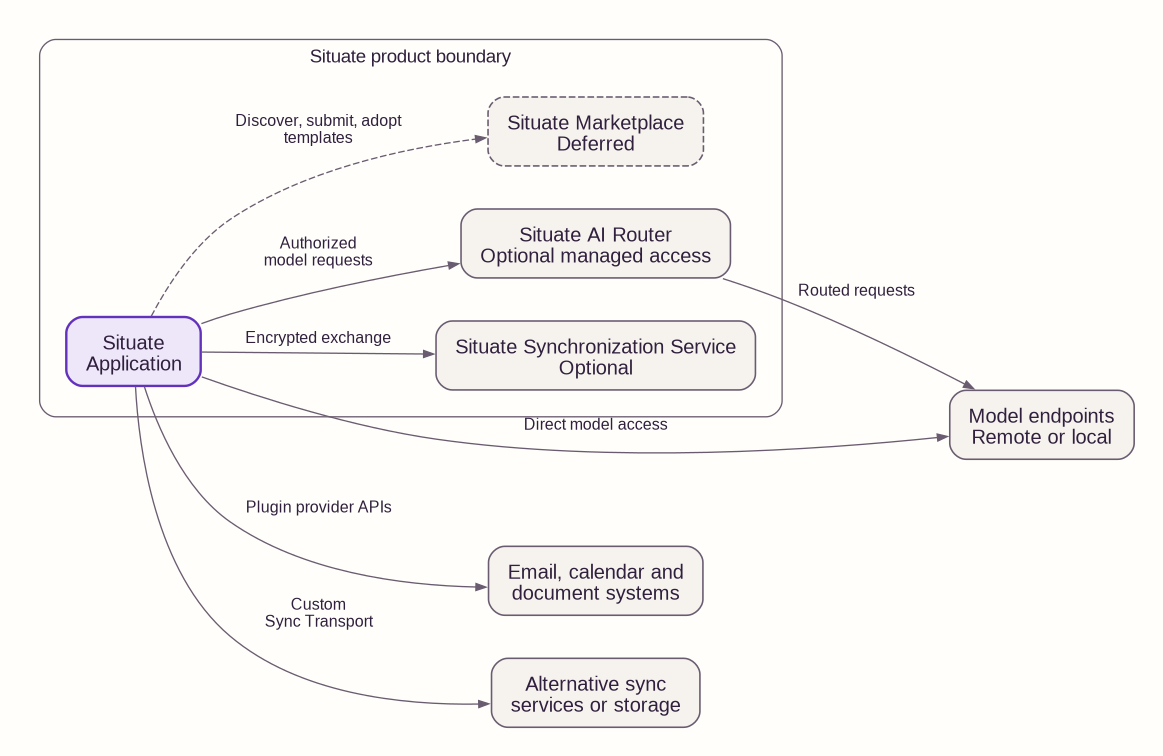
| Component | Responsibility | Data boundary |
|---|---|---|
Local content management, manual interaction, plugin execution and agent execution. It remains usable for local manual work without either Situate service or an AI model. |
Workspace content, conversations, plugins, configuration and histories reside on the device. |
|
Situate Synchronization Service |
Optional exchange of end-to-end encrypted workspace data between the user’s devices. Clients retain responsibility for versioning, merge decisions and recovery. |
The service must not be able to decrypt synchronized user content. Device-local AI settings and credentials are excluded from synchronization; see [glossary-device-local-ai-settings]. |
Situate Marketplace (deferred) |
Shared template discovery, marketplace publication submissions, per-version manual approval, reports and blocking. Local plugin management does not depend on marketplace delivery. |
Public templates and store pages, submission state and administrator review feedback; not personal workspace content. Hosting and service internals remain unspecified. |
Situate AI Router |
Optional managed model access, routing authorized requests to model providers. It does not replace the agent loop inside the application. |
It may process the content authorized for a model request in plaintext, but has no general access to the user’s workspaces or decryption capability for synchronized content. |
The application can access a user-configured model endpoint directly instead of using the Situate AI Router. The endpoint can be remote or local, including on the same device; physical proximity does not put an independently operated model endpoint inside the Situate product boundary. AI functions require a suitable model, but neither the Situate AI Router nor a Situate-provided model subscription is required for user-provided access. Agent Integration runs inside the application and uses these model endpoints; Rig is not itself the model. The native conversation service executes in the native application host, independently of frontend views.
Plugins connect to external email, calendar and document systems through their respective provider APIs. Custom synchronization plugins can use alternative storage or transport services. Neither kind of integration changes ownership of the external system or authorizes unrelated work. Service internals, authentication protocols and deployment placement are not refined here. See REQ-0013, REQ-0015 and REQ-0016.
5.2. Level 2: Selected building blocks
Only the Situate Application is refined here. The optional services and deferred marketplace retain their Level 1 descriptions; their internal structure remains unspecified.
Situate Application
Parent: Situate Application in Level 1.
The decomposition separates presentation, plugin execution, agent execution and shared workspace services. Views do not own background execution, and shared storage does not take over domain ownership. The boundaries and their rationale are developed in Solution Strategy; detailed SDK packaging and bindings remain open.
Agent Integration runs in the native application host using Rig. The package mapping identifies its implementation and the separate frontend presentation boundary.
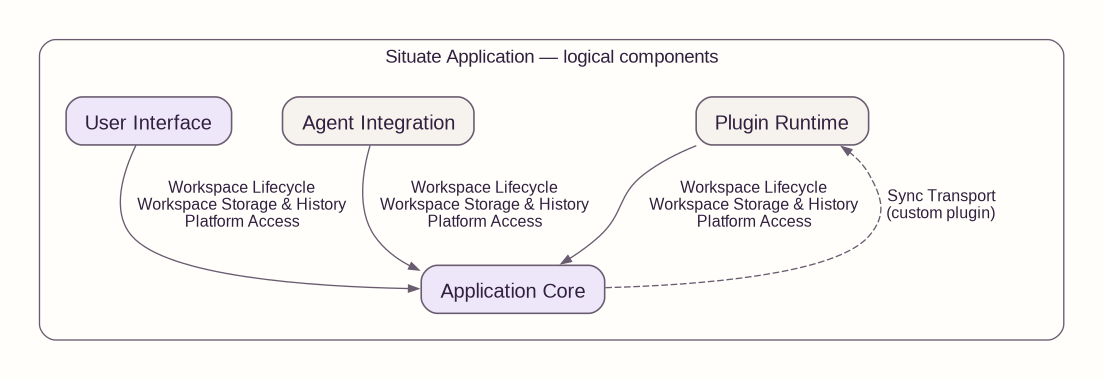
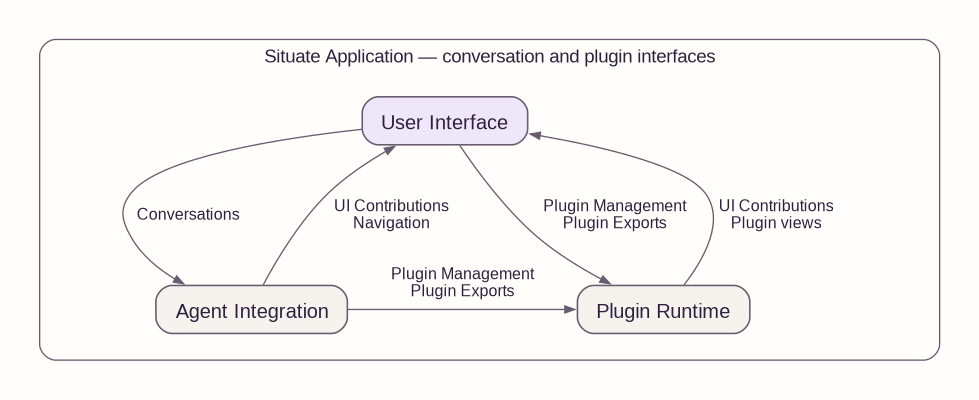
| Component | Responsibility | Owned state and persistence |
|---|---|---|
Application Core |
Workspace lifecycle, local storage, Git-backed history, synchronization coordination, content/history recovery and operating-system capabilities. Coordinates blocking new starts during closure, restoring normal operation on cancellation, and aborting active work when the user proceeds with closure. |
Open-workspace state, storage and history operations, and synchronization state. Persists workspace-owned content and other components' durable state without taking ownership of their domain semantics. |
Built-in content and chat views, named topic tabs, pane layout and navigation histories, question presentation and the independent Plugins destination for workspace plugin management. Hosts normal plugin views and optional plugin-owned Settings views with the same Situate components and contracts. Provides read-only plugin-file inspection, development-mode visibility and conversation working indicators. |
Presentation state such as selection, active view and pane arrangement. Durable settings use core storage; rendered content is not a separate authoritative copy of workspace data. |
|
Plugin Runtime |
Plugin loading, dependency resolution, registration of exports, views, tools and triggers, version activation and plugin enabling/disabling. Does not load or execute disabled plugin code or Settings views. Hosts plugin execution independently of whether a view is open. |
Loaded versions, registrations and active plugin execution state. Durable plugin status uses core storage. Individual plugins retain ownership of their domain logic, configuration and data. |
Embeds Rig in the native conversation service, owns execution and completion, uses native model/tool adapters and exposes eligible plugin tools. Executes eligible actions directly within the requested task, without plugin-requested execution approval. The agent integration does not infer arbitrary plugin effects. |
Normal, onboarding and development conversation state, accepted input and agent execution resources, including task/context handoff into specialized development chats. Durable conversations and process history use core workspace storage, not a separate Rig-owned store. The native conversation decomposition refines this component and its interfaces. |
The shared Situate Vue components are a library used by built-in and plugin views, not an independently deployed service. Their public properties, events and slots form part of the UI contract; internal DOM structure and private host modules do not. Plugins can also implement custom components and explicitly export reusable components through declared dependencies.
The User Interface and Agent Integration do not maintain parallel implementations of plugin integration logic. For example, a mail view and an agent tool use the same mail plugin functionality rather than each owning an independent mail connection layer. Reusable integration plugins define connections and account semantics, while consumers select which accounts to use. The Application Core stores the relevant configuration and credentials without imposing a universal mail or inbox domain model. See REQ-0001 and REQ-0026.
Named interfaces
Consumers use the published interfaces rather than reaching into another component’s private modules or mutable internal state. Callbacks and events are part of those contracts, not permission to bypass ownership boundaries. This is an architectural rule for trusted code, not a security sandbox against malicious plugins.
| Interface | Provider | Consumers | Purpose and boundary |
|---|---|---|---|
Workspace Lifecycle |
Application Core |
User Interface, Plugin Runtime, Agent Integration |
Open and close workspaces, report lifecycle state and coordinate work. Execution components report active work and completion, and respond to blocking new starts, cancelling closure and aborting work. The core need not understand the domain meaning of each action. |
Workspace Storage & History |
Application Core |
User Interface, plugins, Agent Integration |
Read workspace content, make versioned changes and inspect history. Durable runtime and agent state also use core persistence. A shared storage boundary does not make every record use an identical format or retention policy. Under Git-derived file references, confirmed file-operation facts belong to Git and reference resolution is reconstructible, not an independently writable ledger. Native persistence stores workspace-local reference selectors. On load, the host establishes a Runtime Workspace Binding to the authorized local workspace session. Portable selectors contain no absolute workspace locations and cannot authorize another copy. |
Platform Access |
Application Core |
User Interface, Plugin Runtime and plugins, Agent Integration |
Expose the operating-system capabilities shipped with the host, subject to platform permissions. The exact supported operations remain open; plugins do not add downloaded native binaries. |
Plugin Management |
Plugin Runtime |
User Interface, Agent Integration |
Inspect status and dependencies, stage changes, coordinate activation and disable plugins. Lifecycle coordination with the core remains necessary; this interface does not independently authorize external effects. |
Plugin Exports |
Individual plugins, registered through Plugin Runtime |
Declared dependent plugins, User Interface and Agent Integration where applicable |
Provide explicitly exported functions, tools and components. Each plugin defines its domain contracts; unexported implementation details remain private. Agent tool descriptions and read/write declarations belong to this boundary. |
UI Contributions |
User Interface |
Plugin Runtime and plugins, Agent Integration for navigation |
Register and mount views or other UI contributions, use shared components and manage view-scoped cleanup. Published navigation capabilities route plugin and agent view-opening and reveal requests through UI Coordinator. Questions can obtain missing task data; ordinary action dispatch has no approval interaction. Shared component contracts and registration contracts are distinct parts of this interface. |
Conversations |
Agent Integration |
User Interface |
Submit domain actions and observe native-owned conversation state through authorized snapshots and ordered events. Covers input, drafts/queues, answers, cancellation and persistence retry without frontend-owned transcript saving or lease release. See Agent Integration: Native conversation execution. |
Model Access |
Native Host Adapters within Agent Integration |
Conversation Owner, driving Rig |
Provide the Conversation Owner with the internal Model Access capability for requesting model work. Native adapters use Provider Transport to communicate with the selected endpoint directly or through the Situate AI Router. They retain credential custody and validate each request’s caller, workspace, connection and destination through Operation Admission. Credentials, model defaults and conversation overrides remain device-local, associated with the workspace’s Device-local Workspace Namespace; portable conversation history does not contain them. Capability differences require adapters or checks rather than an assumption of universal compatibility. |
Sync Transport |
Built-in transport adapter or custom synchronization plugin |
Application Core |
Transfer data through the selected service or storage backend. The core owns versioning, merge-conflict handling and history recovery for every transport; transfer success alone does not establish a consistent workspace history. |
Model Access and Sync Transport are adapter interfaces within the application. They are not names for the external providers' network protocols. Likewise, external email or calendar APIs are consumed by the corresponding integration plugin, not standardized into a universal core integration API.
The Client Diagnostics interface is provided by the Application Core in the accepted design to the User Interface, Agent Integration, Plugin Runtime and plugins. It accepts validated, bounded structured events through JavaScript and Rust bindings; this diagnostic data admission does not authorize execution. The native host owns installation-local retention, separate from Workspace Storage & History. The portable Diagnostic Workspace Identifier correlates events across devices and workspace copies. It neither selects a device-local credential namespace nor establishes a Runtime Workspace Binding. It does not provide installation-wide log reading or export to plugins. ADR-0008 records the decision; it is not yet an implemented SDK capability.
The SDK presents supported host interfaces to plugins; it does not create a second implementation of storage, lifecycle or UI behavior. Its exact packaging, compatibility rules and JavaScript-to-Rust bindings remain design work.
Ownership and lifecycle rules
Workspace scope
Content, conversations, plugin configuration and histories belong to their workspace. Operational AI connections and model settings are additionally device-local and remain outside the portable workspace directory. Their Device-local Workspace Namespace associates these settings with an authorized local workspace location; it is not a portable identity or runtime authorization handle. Component instances or resources associated with one workspace do not automatically consume another workspace’s data or dependencies. Application-level presentation and startup coordination can span workspaces without merging their ownership. Explicit trusted cross-workspace integrations remain possible under operating-system permissions; this separation is not an adversarial sandbox. See REQ-0037.
Coordinated execution
The Application Core coordinates the workspace lifecycle; the Plugin Runtime and Agent Integration control their respective execution resources. Closing a plugin or chat view releases view-scoped resources, not plugin or agent work or its workspace. Navigation and pane closure do not stop development, pause it or request discard. Development conversations use the same workspace capabilities and task-scope rules as ordinary chat; their affected-package lists do not restrict access. Source preparation remains distinct from checked grouped activation. Ordinary workspace edits become durable independently; synthetic test data and configuration do not become production state. A Check Receipt records the plugin revisions and checks covered by a development check. Disposable synthetic state belongs to the check; conversations, shared editable source and Git history do not expire with its receipt. Incomplete assignments remain resumable. Internal check completion and release dispose of synthetic test files while retaining trial identity until the owning temporary directory is released. Pending or uncertain plugin activation publication retains its evidence. The MVP exposes neither storage inspection nor manual development cleanup and adds no age-based cleanup policy. Leftover development artifacts may accumulate. Only legacy draft formats verified never to have shipped publicly are exempt from compatibility and migration requirements; published draft formats follow REQ-0069. Development remains bound to its workspace: closure stops its work, and application quit stops all work. When closure is requested, the core coordinates blocking new starts across both execution components. The Lifecycle Admission gate controls whether closure may start; Operation Admission validates each individual execution request against its caller, workspace and lifecycle conditions. Neither gate is per-action user approval or proof of completion. With active work, the user can cancel closure or abort the work and proceed with closure. Cancellation restores normal operation without interrupting running work or scheduling later closure; proceeding retains the separate pending-synchronization choice. Completion and abort reporting must not imply that external effects have been undone. A Root Action is a top-level plugin tool or exported-function invocation whose nested calls share its execution context. Its generated action signals pass through nested calls without borrowing another Root Action’s Operation Admission. Each independent native host request keeps a Worker Lease, a lifetime handle, until its work and cleanup actually finish. Chat snapshots retain resources but do not delay plugin activation publication. An ordinary view callback does not implicitly group multiple requests into one Root Action.
This coordination does not guarantee that an abort request can stop synchronous plugin code blocking the shared runtime. It also does not add a separate protocol for resolving uncertain external outcomes; the agent and model retain that responsibility under the solution strategy. See REQ-0031 and REQ-0037.
Startup without plugins
The host must be able to start core services, built-in management UI and Agent Integration without loading or executing plugin code.
The Plugin Runtime must honor the recovery startup gate across every restored or subsequently opened workspace, before any plugin initialization or registration executes.
Recovery tools must therefore be built-in capabilities rather than depend on the faulty plugin’s exports.
Users may resume individual plugins or all previously enabled plugins without restarting; persistent disabling remains separate.
Requested development retains ordinary checks and activation for its target without resuming unrelated suspended plugins.
The macOS --recovery startup flag gates restored and newly opened workspaces. Built-in source/check routes remain available; checked activation resumes only its selected targets. Native mobile recovery qualification remains separate work.
See Recovery mode and REQ-0032.
Client package boundaries
The current implementation has the following package boundaries. The native conversation gateway, registry and host adapters in Agent Integration: Native conversation execution implement conversation execution. Platform and live-provider qualification remain separate from these source boundaries.
| Location | Responsibility |
|---|---|
|
Vue application views, editor state and frontend presentation lifecycle. Chat and onboarding submit native actions and render bounded, acknowledged snapshots; they do not execute model/tool loops or replace stored transcripts. |
|
Reusable Vue components. Application views depend on this library; the library must not depend on application-specific modules. |
|
Window-authorized conversation registry and host adapters, model operation admission and provider transport, built-in and plugin tool dispatch, conversation persistence, workspace sessions, lifecycle coordination and platform integration. |
|
Storage, content history, path policies and conversation format validation without application-window ownership. Uses the selected filesystem adapter for native operations. |
|
Native process and filesystem contracts, and compile-time selection of the filesystem implementation. Neither crate depends on Tauri or on the storage domain. |
|
Native filesystem operations and owned subprocesses. The macOS host reuses POSIX primitives and adds Apple-specific durability barriers. Native primitive tests live with their implementations. |
|
Conversation owner embedding Rig and using core domain/storage contracts. Owns accepted input, pending decisions, request preparation, tool scheduling, checkpoints, cancellation and completion through the native application’s host implementation. |
|
Native supervision and termination of plugin service execution contexts. Plugin services run in Workers rather than the application UI realm. |
|
Native workspace access under operating-system permissions, including Swift and Kotlin adapters. |
Shared UI independence is checked for TypeScript, Vue and JavaScript sources, including .mjs and .cjs modules and dynamic imports.
This prevents ordinary dependency drift; it is not a sandbox against malicious code.
File operations use operation-specific requests and replies at the frontend/native boundary.
The native host rejects malformed requests, and the frontend validates replies before using them; window and workspace authorization remains a separate host responsibility.
Shared contract fixtures keep the two sides aligned without moving storage or authorization into the UI library.
See dependency rules and file operation contracts.
5.3. Level 3: Selected refinements
Refinements within Situate Application
The following views refine Agent Integration and User Interface from the Level 2 application decomposition. Application Core and Plugin Runtime appear only as dependencies in these views; their internals are not refined here. These logical boundaries do not prescribe internal classes, a message bus, separate worker processes or additional services.
Agent Integration: Native conversation execution
Parent: Agent Integration in Level 2.
This decomposition follows ADR-0013 with the storage representation selected in ADR-0016.
Agent Integration runs in the native application host and embeds Rig through situate-agent, owning conversation execution and completion independently of frontend views.
Native provider, tool, persistence and projection adapters connect the owner to the application.
See Client package boundaries for package locations and provider qualification for evidence limits.
IPC command names and wire encodings are separate from the capability contracts below.
The storage boundary preserves published native conversation data through a numbered conversion in the existing workspace migration runner; the conversation-format rollout must satisfy REQ-0069. It does not import former Pi prototype chats or serialize Rig sessions. Conversation branching is a property of stored entry ancestry, not a Pi runtime dependency.
Component placement
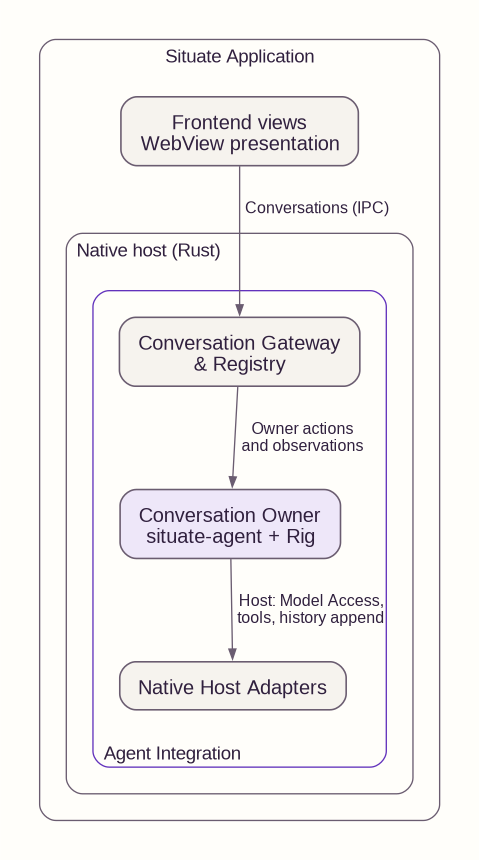
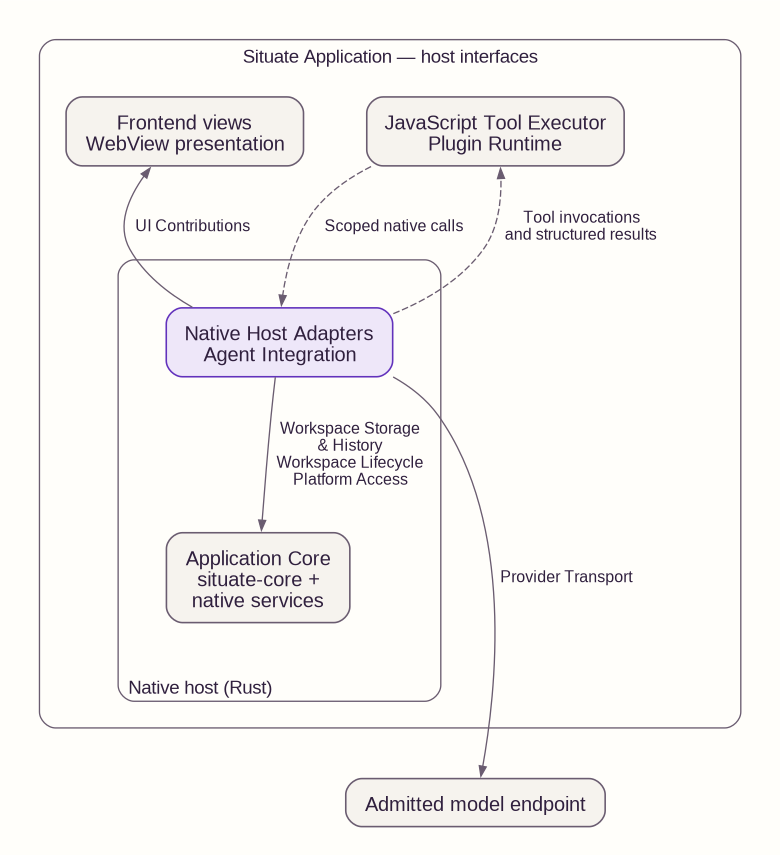
| Building block | Location | Responsibility and owned state |
|---|---|---|
Frontend views |
|
Render conversation projections, collect user actions and own focus, selection, scroll and unacknowledged local input. Ordinary, onboarding and development views share the same native conversation owner. Views own neither execution nor the capability needed to finish saving a turn. |
Conversation Gateway & Registry |
Native application host, |
Authorize callers and resolve one owner per workspace-session generation and conversation. Bind snapshot/event attachment to that owner, route stable action identities to its Operation Admission state and coordinate its lifetime with workspace/application closure. Registry entries are device-local execution handles, not portable conversation records or a second history store. |
Conversation Owner |
|
Own accepted input, input consumption, derived branch context, question state, work periods, cancellation, observed outcomes and terminal completion. Serialize append and metadata operations; retain unsaved outcomes in memory while the process lives without repeating effects. Reconstruct history on reopen, not execution handles or an exact run continuation. Rig is a library inside this component, not an independent service or conversation authority. |
Native Host Adapters |
Native application host, |
Implement the owner’s |
Rust Core and native lifecycle/platform services |
|
The core crate supplies validated history entries, incremental history access, atomic metadata replacement, content history and path/reference policies without frontend or Rig ownership. The native host supplies window/session authorization, operation lifetime handles, credential/platform access and close/quit coordination. These are parts of the logical Application Core, not all responsibilities of the |
JavaScript Tool Executor |
Supervised WebView and per-service-generation Workers in the Plugin Runtime |
Run eligible JavaScript/plugin functions under native-issued invocation and executor-generation identities. Own only executor-local code and resources, not conversation state. Report structured results or disconnection; callbacks cannot acquire a new invocation or revive a revoked generation. Existing JavaScript/Vue authoring remains supported. |
A native owner survives detachment of all frontend observers while the workspace and application remain open. A JavaScript executor is a fallible tool dependency: it may use a WebView, but losing it must not discard native ownership or trigger automatic redispatch. This does not introduce a JavaScript engine for the agent loop or select a new sandbox for trusted plugins. Non-cooperative JavaScript and direct browser operations require effective executor supervision; generation revocation alone cannot stop them.
Interfaces between the building blocks
| Interface | Caller → provider | Contract |
|---|---|---|
Conversations |
Frontend → Conversation Gateway & Registry; native IPC |
Submit domain actions for input, draft/queue edits, answers, cancellation and persistence retry. Bind each action to the authorized workspace/conversation, stable action identity and applicable revision or pending decision. Return snapshots with matching event positions and ordered bounded updates. A gap, overflow or owner-generation change requires a new snapshot, not inferred execution or resubmission with a new identity. A submitted-input receipt follows saving its history entry. Draft edits do not promise crash recovery; transient progress is not a durable save acknowledgement. Subscription acknowledgements release delivery capacity only and grant no effect authority. |
Owner actions and observations |
Conversation Gateway & Registry → Conversation Owner; Rust API |
Serialize domain mutations and expose owner state independently of a view. Repeated Operation Admission of the same action cannot start another run; conflicting reuse fails. Caller authorization stays in the native gateway, and the host revalidates the captured workspace session inside operations. Snapshot and subscription lifetimes do not determine execution lifetime. |
Model Access; tool and history operations ( |
Conversation Owner → Native Host Adapters; Rust API |
Use the internal Model Access capability to request model work. Supply derived context, captured calls and new history entries through host operations. Save submitted input and tool calls before dispatch; append observed outcomes and compactions without replacing the transcript. Cancellation stops/drains active work. A storage failure blocks further effects and retains available unsaved outcomes in memory; reopening does not restore a durable execution journal or replay calls. |
Workspace Storage & History; Workspace Lifecycle; Platform Access |
Native Host Adapters → Application Core services; Rust APIs |
Use validated entries, serialized history append, incremental reads and metadata replacement, alongside core-managed content history and native-held authorization/lease handles. Append referenced history before updating metadata. Distinguish accepted writes, durable success, conflicts and uncertain file or Git reference publication. A read-back may reconcile revision but does not establish durability after a failed write. Window/session, credential and operating-system services stay in native adapters rather than being imported into Vue or the agent library. |
JavaScript tool execution |
Native Host Adapters → JavaScript Tool Executor; host/executor messages |
Dispatch a captured tool call with invocation, workspace and executor-generation identities. Validate structured replies and deduplicate acknowledgements; reject revoked or stale callbacks. Native calls made by that invocation return through scoped Operation Admission and keep their lifetime handles until cleanup finishes. After executor loss, preserve observed native outcomes or uncertainty; neither a replacement executor nor the owner automatically repeats the invocation. |
UI Contributions and presentation requests |
Native Host Adapters → User Interface / UI Coordinator |
Route navigation and other view-dependent operations through existing semantic UI capabilities with explicit request identity and observed acknowledgement. Questions remain native domain state projected to views. Missing presentation cannot fabricate success or a user answer; the native owner retains any pending interaction without relying on a frontend continuation to save outcomes. |
Provider Transport |
Native Host Adapters → admitted model endpoint |
Communicate with the selected endpoint through Provider Transport. Keep credential custody native, validate connections and destinations through Operation Admission, and assemble provider-specific streams. Preserve model capability and continuation metadata, cancellation/drain and usage accounting. Main turns, compaction, model checks, titles and comments use native request services with distinct purposes; auxiliary requests do not mutate another request’s context or consume its pending input. |
Before each main model request, the host prepares current instructions, tools and service generations together. The admitted model, connection, thinking settings and limits remain fixed. Every tool call in one model response retains that request’s captured services and revisions; a later main request can observe activation or enabling. The Active Revision Map selects active plugin code revisions; it is distinct from the service generations already captured by a request. A retired call rejected before dispatch is unavailable, not an uncertain external effect. Executor loss after dispatch retains uncertainty and does not reroute or replay the call.
The UI exchanges serializable Situate contracts, not Rig objects, raw host handles or replacement transcripts. A conversation ID, action ID or event position is correlation data, never an authorization grant. Opaque provider signatures and retained message content can be part of domain data; provider credentials and operational connection/model settings remain device-local rather than being copied into portable history.
Dependency direction and data authority
-
situate-agentdepends on Rig and the domain types/contracts insituate-core, and calls its host abstraction. It does not depend on Tauri, Vue or a particular JavaScript runtime. -
situate-coredoes not depend on Rig,situate-agentor frontend modules. It validates and persists domain records; it does not become a second agent scheduler. -
The native application composes both crates, implements the host operations and owns Operation Admission, registry and platform services. Frontend code depends on the public action/projection contracts rather than private agent modules.
-
The owner alone changes active execution state. Durable history is authoritative for saved information, not a serialized execution machine; model context and frontend snapshots are derived, not independently writable transcripts.
-
Each conversation uses
.situate/conversations/<id>/history.jsonlandmetadata.json. No separate pending-state file is introduced. Onboarding retains its separate domain record; unrelated content, attachment identities and device-local credentials keep their boundaries. -
Portable history preserves original messages, calls, available outcomes, compactions and input-status information. Active execution and unsaved drafts remain in memory. Published records and opaque information must survive migration; damaged history is not silently reset. See Conversation storage and overwrite protection.
-
Native Operation Admission and durable intent/result barriers do not create exactly-once external effects. On interrupted execution, retain observed results and uncertainty rather than inferring that cancellation undid an effect. Reopening after process exit waits for user interaction; it does not replay retained work.
The client package mapping records package-level responsibilities.
Conversation modes and tools
This reference describes the tool surface of Agent Integration in the current native implementation, not platform or provider qualification. Situate has two fixed conversation types: normal chat and plugin development. Development adds assignment-specific instructions, not a separate workspace or a restriction to one plugin. Under the same workspace, device capabilities and recovery state, both types have the same workspace writes, navigation, available shell access and eligible plugin tools, as required by REQ-0001, AC-32. Development-specific authoring tools and normal-chat handoff differ as shown below.
The matrix assumes a writable native macOS workspace with history and conversation storage, outside guided onboarding. Yes means registered for that conversation type under those conditions, not guaranteed to execute successfully. Conditional means eligible plugin contributions must be available; No means not registered for that type.
| Tool | Purpose | Normal chat | Plugin development |
|---|---|---|---|
|
Read workspace text or supported images; return a revision for subsequent edits. |
Yes |
Yes |
|
List the immediate children of a workspace directory. |
Yes |
Yes |
|
Find workspace paths containing a literal query, recursively. |
Yes |
Yes |
|
Search workspace text for a literal, case-sensitive query, with line numbers. |
Yes |
Yes |
|
List submitted conversations in the same workspace with IDs, titles and record revisions. |
Yes |
Yes |
|
Read submitted messages and recorded runs/events from a workspace conversation; exclude drafts, queued input and credential storage. |
Yes |
Yes |
|
List retained versions of a workspace file. |
Yes |
Yes |
|
Read a retained file version without restoring it. |
Yes |
Yes |
|
Create or replace a workspace text file using revision-checked, versioned storage. |
Yes |
Yes |
|
Apply exact, non-overlapping replacements at a known file revision. |
Yes |
Yes |
|
Create prepared new files from a workspace JSONL manifest. Inspect partial or uncertain file publication before retrying; do not replay the whole batch blindly. |
Yes |
Yes |
|
Ask for missing task information and wait for an answer, not per-action approval. Do not call further tools after the question in the same batch. |
Yes |
Yes |
|
Run a POSIX shell command starting in the workspace; access is not confined to that workspace. |
Yes |
Yes |
|
Open a registered view in the focused pane when the user requests navigation. |
Yes |
Yes |
|
Reveal content in a registered view, optionally at a retained revision, when the user requests navigation. |
Yes |
Yes |
|
Show an existing conversation without creating one, sending input or starting work, when the user requests navigation. |
Yes |
Yes |
|
List plugins, inspect source or validate source declarations without executing or enabling code. Development also supports package creation, source directory changes and capturing external source edits. |
Yes |
Yes |
|
Read bundled interface guidance without network access or workspace mutation. |
Yes |
Yes |
|
Persist development mode on the current conversation. The next model request uses development instructions and tools. |
Yes |
No |
|
Start an assignment in a separate retained development conversation. A failed handoff retains that conversation; do not retry creation to resume it. |
Yes |
No |
|
Inspect a retained plugin activation publication outcome without retrying or resuming work. |
No |
Yes |
|
Functionally check related plugin revisions using synthetic fixtures and optional UI previews. Checks do not activate source. |
No |
Yes |
|
Activate the exact related revisions covered by a successful Check Receipt. |
No |
Yes |
Plugin-contributed tools (plugin-defined names) |
Perform functions supplied by eligible, enabled plugins; names and purposes depend on installed plugins. |
Conditional |
Conditional |
Ordinary chat normally enters development in place. The separate-conversation tool remains available for requested handoffs and guided setup. Neither entry tool is available once a conversation is in development mode.
| Condition | Effect |
|---|---|
Workspace capabilities |
Registration of |
Platform and execution guards |
Plugin authoring tool registration is selected by conversation type. Registration does not establish native iOS support or qualification. Execution still requires the relevant local storage, native services and available executor. Revision checks, editor drafts, missing access, cancellation, stale run state and invalid Check Receipts can prevent execution. |
Navigation |
Navigation tools are registered without a frontend callback filter. Their native execution must obtain the appropriate presentation response; unavailable presentation cannot count as successful navigation. Development, checks and activation do not themselves authorize navigation. |
Guided onboarding |
Native onboarding roles filter built-in tools and add role-specific tools. The matrix does not describe that separate role-dependent surface; onboarding is not a third conversation type. |
Recovery |
Recovery is an application startup state, not a conversation type. Source inspection/editing, checks and checked activation remain required capabilities. Suspended plugins contribute no active tools until resumed or successfully activated; unrelated plugins remain suspended. Native registration applies the same conversation-type selection during recovery. |
Plugin lifecycle |
Each model request captures eligible tools and service generations together. Later requests can observe activation or enabling; calls from the current response retain their captured services. No fixed list can enumerate every plugin-defined tool. |
The tools above are model-callable interfaces.
Plugin source files use the ordinary file tools with explicit paths under .situate/plugins/<pluginId>/code/, retaining plugin-specific history, revision checks and limits.
Workspace-root searches do not traverse these technical directories; other plugin internals remain excluded.
inspect_plugin operations create, mkdir, rename, remove and capture are available only in development, without activating code.
Retained conversations can still display historical edit_plugin_sources results.
Plugin host APIs, skills, model selection, activity comments and compaction are not extra entries in this inventory.
Skill mode assignments do not grant tool access.
Workspace write and edit use revision checks and do not overwrite unsaved editor drafts.
Preparing plugin source does not activate it.
A successful Check Receipt identifies the revisions and checks covered; activation requires an applicable receipt.
Plugin activation publication changes the Active Revision Map, the record selecting active plugin code revisions.
An uncertain file or plugin activation publication outcome must be inspected rather than retried blindly.
Shell commands are not sandboxed and can reach files and networks outside the workspace. Plugin code is trusted code, not sandboxed code. Both conversation types execute actions within the requested task and configured access without per-action approval; exposing a tool or starting development does not authorize unrelated work.
When changing registration, capability filters or tool names, update the matrix and its conditions together.
User Interface
Parent: User Interface in Level 2. The overall system and application views form Levels 1 and 2 respectively. The client implements this structure for workspace tabs, panes and built-in views; production plugin loading remains a separate integration boundary. The design combines an application shell, an explicit coordinator, a composite layout tree and unidirectional state changes. See ADR-0001 for rationale and alternatives, and REQ-0011 and REQ-0026 for required behavior.
The following diagrams show complementary dependencies within the User Interface: coordination, then rendering and registration. Repeated boxes denote the same logical components, not separate instances. Arrows point from consumers to capabilities they use, not the direction of returned data. External application components retain the interfaces shown at level 2.
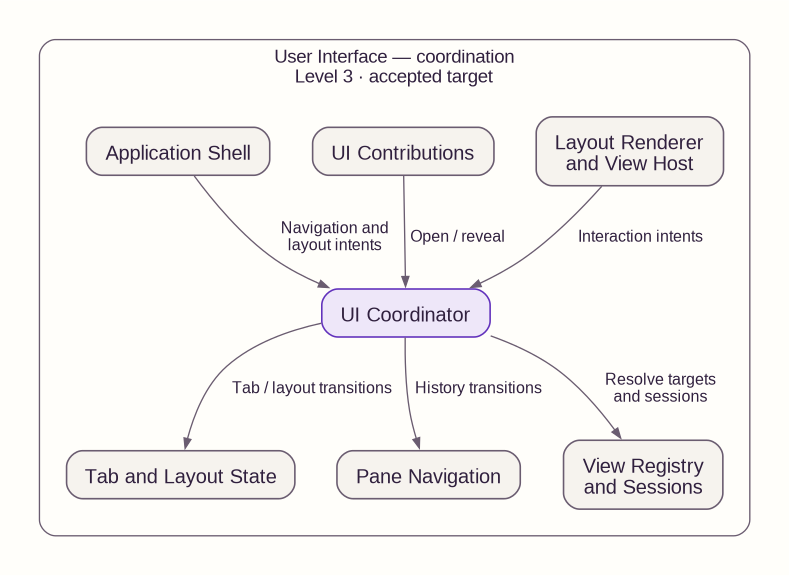
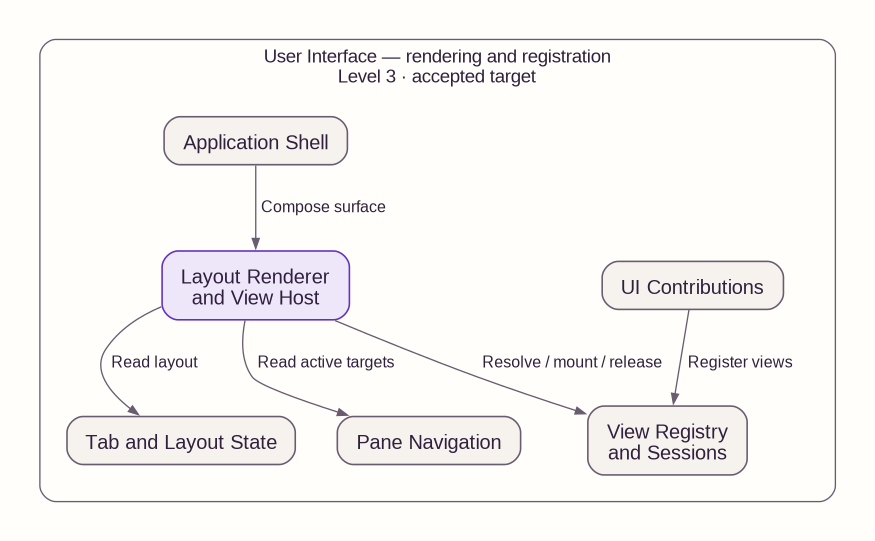
| Component | Responsibility and interface | Owned state and dependencies |
|---|---|---|
Application Shell |
Workspace-bound window surface, tab selection and naming, navigation controls and global UI. Sends semantic navigation and layout intents to UI Coordinator. |
Transient shell presentation, such as an open navigation drawer. Uses existing Workspace Lifecycle and management interfaces; does not duplicate native window authorization or workspace closure coordination. |
UI Coordinator |
Single orchestration entry for built-in UI, plugin and agent navigation: open, activate, reveal, back, forward, move, resize, maximize and close. Resolves ordinary view opening to the focused pane, distinguishes conversation-list reveal from pane-local history navigation, and creates a destination only when no tab exists. |
Coordinates state transitions through the model interfaces below. Does not own file contents, conversations, plugin execution or a second authoritative layout copy. |
Tab and Layout State |
Expose window tabs and each tab’s composite layout; apply validated tab and layout transitions. |
Ordered tab identities and names, active tab, per-tab split tree, active pane and temporary maximization. Split nodes hold direction, children and relative sizes; leaves reference panes. Depends on identifiers, not Vue instances or domain records. |
Pane Navigation |
Expose a pane’s current target and independent back/forward transitions. |
Per-pane ordered navigation entries and cursor. New navigation truncates the forward branch. Moving a pane retains this state; geometry changes do not create entries. |
View Registry and Sessions |
Register view types, resolve navigation targets to view instances, and retain or restore view-specific presentation state through supported view contracts. |
Registered definitions and presentation sessions scoped to their workspace. A view type, view instance and content identity are distinct. Content and drafts remain owned by their respective domain modules. |
Layout Renderer and View Host |
Project the active tab into tiled, maximized or narrow presentation; mount the active view of each visible pane, manage focus and release view-scoped resources. Render state and send interaction intents to the coordinator rather than mutate model internals. |
Mounted Vue instances and transient interaction resources. Reads layout and navigation state, resolves views through the registry, and uses the shared Situate component library. |
UI Contributions |
Accept plugin view registrations and supported extensions to the surrounding interface. Expose host navigation capabilities to plugins and Agent Integration through published contracts. |
Contribution registrations tied to plugin availability. Uses the registry and coordinator, not direct access to their mutable state. Supported shell regions and conflict policies remain open under REQ-0028. |
These are logical module responsibilities, not a requirement for separate packages, classes, stores or processes. Built-in and plugin views use the same host placement and navigation path and the same shared component implementations. The shared library does not depend on application modules or own layout, navigation or domain state.
Presentation hierarchy and ownership
Workspace
  Window presentation
    Tab (user-defined name)
      Split tree
        Pane (navigation history and cursor)
          Active view instance
Each tab belongs to exactly one workspace through its window presentation and contains one or more panes. A tab groups a topic’s surface; it is not a storage, authorization or execution scope. On mobile, switching workspaces selects the corresponding workspace presentation without closing other open workspaces. Whether tabs can move between windows of the same workspace remains undecided.
Each pane has exactly one active view instance, even when the pane is not currently visible. A history entry records a navigation target and any supported restorable presentation state, not a permanently mounted component or a copy of authoritative content. Pane identity survives movement independently of the active view and its content identity. Tab selection preserves its layout, active pane and pane histories. Names are display values, not tab identities. An empty name follows the first pane’s current view title. Closing the last pane resets it to an empty chooser. Closing the last tab or all tabs opens one fresh empty tab with a focused pane and the normal view chooser; the next view-opening intent fills that pane. Closed tabs can be reopened with their arrangements and histories, without recreating content or execution.
The layout tree uses the Composite pattern: split nodes arrange child nodes, and pane leaves display views. The narrow renderer normally shows only the active pane of the active tab and offers pane switching; it does not rewrite the tree into a single-pane layout. Maximization is likewise a projection of an existing layout, not a destructive tree transformation. Shared components additionally adapt to their own container width.
Tab and pane controls
The tab strip remains visible for a single tab. Desktop overflow offers an overview alongside horizontal scrolling and keyboard navigation; narrow presentation shows the active tab and exposes the overview when several tabs exist. Tab close buttons remain visible without hover or focus and occupy fixed-width targets. Closing an inactive tab does not select it first. Tab actions separate renaming from individual and bulk closure. Renaming from the overview returns there without activating the renamed tab; closing an entry retains the overview and moves focus to an available action.
Only the active tab’s pane count determines the control hierarchy. One pane uses history and layout controls in the tab row, without an additional tile header or footer. Multiple tiled panes have local headers, history controls and movement grips. Empty panes offer a new conversation, pinned views in main-menu order and access to all registered views. Choosing one fills the existing pane; pinning changes discovery order without navigating. Settings and plugin management are independent shell destinations outside the arrangement, which is retained when returning to the workspace. Both use host navigation and sidebar controls; plugin management is not a Settings subview or a modal.
Pane movement stays within the current tab. Spatial drag targets and a labeled Move dialog offer the same four relative placements; the dialog names its source and uses native selects so option-picker behavior remains platform-owned. Dividers support pointer and keyboard resizing and balancing. Minimum pane geometry constrains resizing; large arrangements scroll instead of indefinitely shrinking controls.
Narrow presentation uses a bounded horizontal pane-title switcher, separate from content gestures and pane-local history. It advances one pane per completed swipe and supports arrow and Home/End navigation without circular wrapping. Explicit maximization remains active across viewport changes until restoration. Its single compact row combines local history, the current title as a pane-selection trigger, Restore and pane actions, without a duplicate tile header or footer. The selection dialog exposes complete destination names even when the toolbar title truncates. Restore has the same inward-corner icon in the toolbar and menu, distinct from Split and Maximize; the icon-only toolbar control retains an accessible name and tooltip. Keyboard dismissal and system Back restore focus to the originating control. Pane-action and selection dialogs close when their source pane or tab disappears, rather than applying an action to a replacement destination. Maximization is workspace presentation, not operating-system or browser fullscreen.
Navigation, effects and lifecycle
The coordinator accepts semantic requests rather than DOM instructions or access to private stores. Ordinary built-in and plugin view opening advances the focused pane’s history without creating a split, a new tab or a maximization change. Splitting and maximizing are explicit layout intents. Main-navigation conversation selection first looks for that conversation among the current targets of all panes in the workspace presentation, including inactive tabs and hidden panes. A match activates its tab and pane without appending history. Entries behind or ahead of a history cursor are not open instances. If history navigation has produced multiple instances, prefer the focused pane, then another pane in the active tab, then tab order and split-tree order. Back and forward affect only the addressed pane, even if that displays a conversation already open elsewhere. Multiple views share the conversation’s draft, saved model override and execution; their display state is independent. Discarding a forward branch removes navigation entries, not content, conversations or running work. Revealing an entry uses the registered view’s supported contract; the host does not interpret plugin-specific domain objects. Opening a different file, revision or conversation adds an entry; scrolling, selection and reading/source mode update the current entry’s presentation state. The host registration and navigation guide specifies the current client API; it does not establish a production plugin loader or a complete plugin SDK.
State changes flow from intents through controlled transitions to rendered state. Layout and history transitions can be tested without Vue or a native window; mounting, focus, persistence and domain operations remain explicit effects outside those transitions. The coordinator must not become a general domain service: creating a referenced chat uses Conversations, while file reads and writes remain with their existing owners. A UI target’s workspace identifier does not establish a Runtime Workspace Binding; the native host independently authorizes the local workspace session. Deferred navigation captures a workspace, tab, pane and lifecycle generation before asynchronous work begins. Focus changes cannot retarget the result; closing and reopening a destination invalidates old operations even when persistent identifiers are reused. Removal or replacement of a view registration also invalidates its pending reveal results. Unavailable registrations retain their saved targets and histories rather than deleting them.
Hiding a tab, navigating away or unmounting a view does not stop workspace-owned work. The host releases view-scoped resources without stopping independent plugin or agent execution. Content drafts cannot rely on keeping historical views mounted. Workspace closure continues to use Application Core coordination rather than being inferred from tab, pane or component counts.
Persist versioned presentation state through core storage as device-local state scoped to the workspace. Persist tab identities, names and order, split geometry, active tab and pane, navigation histories, pinned views and supported presentation sessions. Each device restores its own arrangement independently of synchronized conversation content. Layout and navigation state must not be synchronized or transferred with the workspace. DOM references, mounted components, request handles and device viewport measurements are not persisted. File target/revision, reading/source mode, selection, cursor and scroll position, and chat scroll position are supported restorable state. Drafts and per-conversation model overrides remain in their domain stores, not duplicated in layout data. Missing targets retain their history entry and render an unavailable state with applicable recovery actions rather than redirecting silently. Each workspace permits 20 open tabs and retains the 20 most recently closed tabs. Each tab permits six panes and each pane retains 50 navigation entries, including the current entry. Existing over-limit open tabs and panes are preserved; new creation is blocked until capacity is available. Each pane separately retains its latest Files target and presentation so ordinary Files navigation survives history trimming without borrowing another pane’s state. Storage versioning, validation and write-failure handling must preserve existing data rather than silently replace unreadable state. Assignment of multiple same-workspace windows remains a separate design question; device-local persistence does not implement synchronization transport. The UI owns presentation semantics; Application Core provides storage and authorization. No global event bus, particular state-management library or docking dependency is selected by this decomposition.
Layout persistence
The native layout adapter stores a versioned envelope in application-owned device-local storage, keyed by the canonical workspace location rather than the runtime authorization scope or portable workspace identifier. Reopening the same location restores its layout; a copied or moved location has independent presentation. The legacy workspace .situate/layout.json is migrated on first access. Its bytes and referenced plugin presentation are durably published locally before removing the legacy host layout; unreadable or conflicting source/destination states are reported without reset. Legacy layout payloads and recovery snapshots are moved into device-local recovery storage without touching plugin domain state. After a successful durable save, unreferenced device-local plugin presentation records are pruned on a best-effort basis; recovery archives and interrupted temporary files are retained, so the file-size limit is not a total disk quota.
Byte-hash revisions, workspace locking and atomic replacement reject stale saves; frontend saves are serialized and uncertain outcomes require readback before another write.
The envelope is bounded to 30 MiB. Invalid or newer state is preserved and reported, not replaced by an empty successful layout. A missing record is distinguished from a valid saved layout with zero tabs; the latter receives a fresh empty tab while retaining pins and closed histories.
Regular save starts are separated by at least one second per workspace. Changes during a pending write are coalesced into the newest state instead of queued as snapshots. Explicit flushes bypass the regular interval and drain pending changes. Native filesystem work runs through a blocking-worker task, not the UI thread; frontend serialization and IPC responsiveness require separate qualification. Close and quit coordination includes layout persistence alongside domain save barriers. Inactive but still-open workspace presentations retain their sessions; unmounting the shell does not discard pending saves.
Layout upgrades require data-preserving migration where needed, not mixed-version or downgrade compatibility; see REQ-0069. This storage protocol does not provide atomic exclusion of noncooperating filesystem writers.
Implementation mapping and verification boundary
AppShell.vue composes workspace navigation, settings and the layout renderer. The layout model owns pure tab, pane and navigation transitions; the registry and coordinator own view registration and effect routing. Layout sessions retain presentation state and persistence, while ViewHost.vue mounts registered targets. Core layout storage provides the persistence primitive, and the native adapter enforces workspace access. App.vue coordinates workspace and application lifecycle interactions; that responsibility must not migrate into pane closure. Existing file and conversation modules retain their domain state rather than being replaced by the layout model.
Verification must cover independent pane histories, forward-branch truncation without content deletion, tab-switch state retention, pane movement, and restoration after narrow or maximized presentation. Integration checks must exercise built-in and plugin navigation through the same coordinator, referenced-chat opening, and continued workspace execution when views are hidden or closed. Focus and view cleanup require rendered interaction tests; pure state-transition tests alone do not establish their behavior.
6. Runtime View
The plugin and synchronization scenarios describe the selected design, not evidence that every path is implemented or verified. Sections explicitly marked as current client behavior describe the implemented file and AI lifecycle. Conversation input and reopening follow ADR-0016: Append conversation history and derive branch context. Source descriptions do not establish native platform qualification. Participants and interface names correspond to the Building Block View.
6.1. Direct plugin action execution
Trigger and preconditions
In an open workspace, an agent invokes an available plugin tool within the user’s request, or the user invokes a plugin export from a view. Configured account access, read-only connector restrictions, capabilities, validation and OS permissions still apply. The native host binds each request to its authorized local workspace session through a runtime workspace binding; a captured identifier alone does not grant access. Ordinary execution, including external HTTP writes and manual exports, has no approval or allow/deny interaction. Questions obtain missing task data; they are not action approval gates. Deliberate plugin installation/activation and destructive workspace or user-content protections remain separate decisions.
Interaction
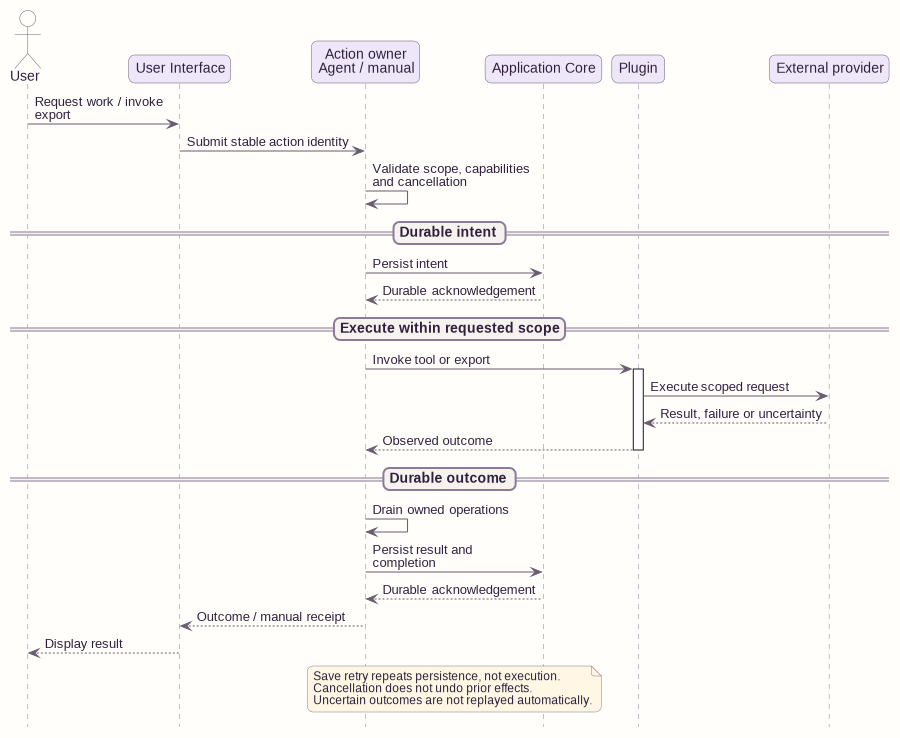
-
Agent Integration or a manual export request supplies its captured workspace, plugin and invocation identity to native operation admission. The host checks whether that specific request may execute.
-
The native owner validates scope, capabilities, current plugin state and cancellation, then persists intent before admitting an effect.
-
Plugin Runtime executes the tool or export and its host requests without asking the user to allow or deny them. Nested calls share the execution context of the originating root action, the top-level tool or exported-function invocation.
-
The native owner drains owned operations and records the observed result or uncertainty. A lost view or executor cannot turn a missing result into success.
-
Agent Integration or the manual-operation receipt exposes the outcome. Presentation does not own persistence or authorize redispatch.
Failure and recovery
Cancellation prevents new operation admission and waits for owned cleanup; it does not undo effects already triggered. An external call can fail or leave its outcome uncertain after interruption. Failure, cancellation or a missing result is not proof that no effect occurred. Persist observed outcomes without requiring a surviving frontend continuation. While the process lives, a failed save retains the unsaved outcome in memory; explicit persistence retry repeats saving, not generation or the external action. Conversation history follows Conversation storage and overwrite protection; no separate durable execution journal guarantees recovery of an outcome lost with the process. Reopening or reattaching never automatically replays an uncertain action. Later user-directed investigation remains with the agent and model, without a separate automatic outcome-recovery protocol or a guarantee of resolution.
6.2. Grouped plugin activation during ongoing work
The Plugins destination can start development of a new or existing plugin. In ordinary chat, the agent can switch the current conversation to development or start a separate one with the task and context. The same native Conversation Owner handles both modes. Specialized instructions, a development background and header label distinguish it from a normal conversation; message, Activity and tool-call rendering remain shared. Agent Integration works in the same workspace with ordinary capabilities and task-scope rules, discovers affected packages and prepares their source changes. A check receipt records the code and dependency revisions covered by the checks; it does not impose a workspace-copy or single-package access boundary. Existing active versions continue serving other conversations while source is prepared.
Related changes form one plugin change set that is checked and activated together. Automated checks of affected behavior, including UI behavior, use strictly synthetic data, test configurations and dependencies. Agentic investigation may read workspace content and accounts, but system instructions forbid incidental real external writes during trials; account access is not technically sandboxed. The Changes panel lists flat workspace-relative file paths and recorded source diffs. Standalone complete-plugin inspection remains available without executing disabled code.
Failed normal change-set checks leave the change set unactivated. For adopted copies, the required local security review includes adaptations; a warning and proposed corrections accompany failure, and the explicit override in REQ-0021 remains available. That override does not waive normal change-set checks. Once required checks pass, activation waits for affected running actions to finish without aborting or repeating them. Where adopted-copy review applies, its approval or warning override is also required; ordinary local workspace development has no additional security-review gate. Plugin activation publishes only checked code revisions and deliberately adapted dependencies, not trial data or test configuration. Ordinary workspace edits remain durable independently of activation or its outcome. The agent activates the group without another user click, including a previously disabled development target. Successful completion removes disposable candidate/check state and retains live source, recovery history and the development chat. Editable source stays in each package’s code directory. Checks and running instances resolve immutable revisions from its Git-owned code history. The activation sequence follows REQ-0033:
-
Native operation admission first blocks new affected root actions: top-level tool or exported-function invocations. Existing root actions and their nested calls finish without abort or replay.
-
After affected root actions finish, native operation admission also blocks new affected host requests. Independent host requests retain their own worker leases until actual completion and cleanup; activation waits for them too.
-
Plugin activation publication records a durable attempt and atomically replaces the active revision map, the workspace record selecting each active plugin’s immutable code revision.
-
Plugin Runtime stages the related registrations during refresh. Operation admission remains blocked through publication and refresh, and is released after the coordinated refresh succeeds.
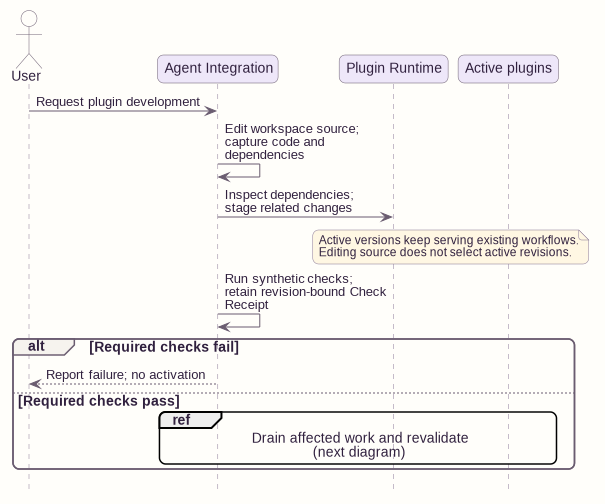
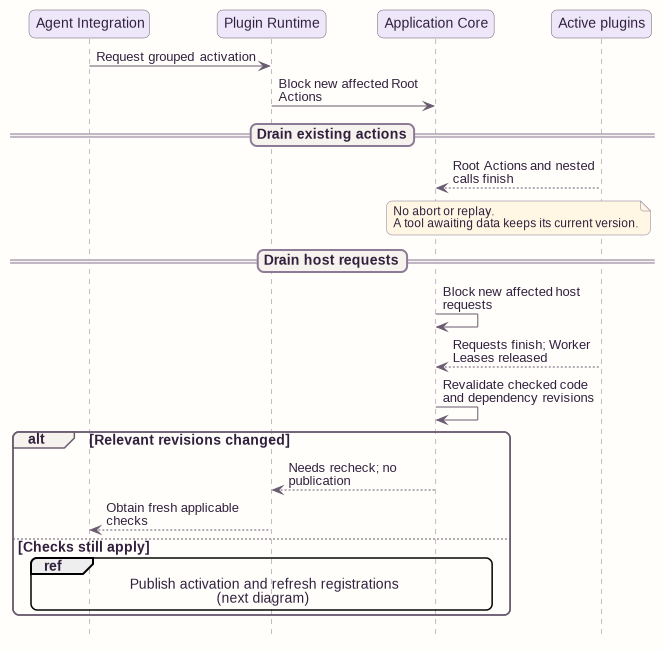
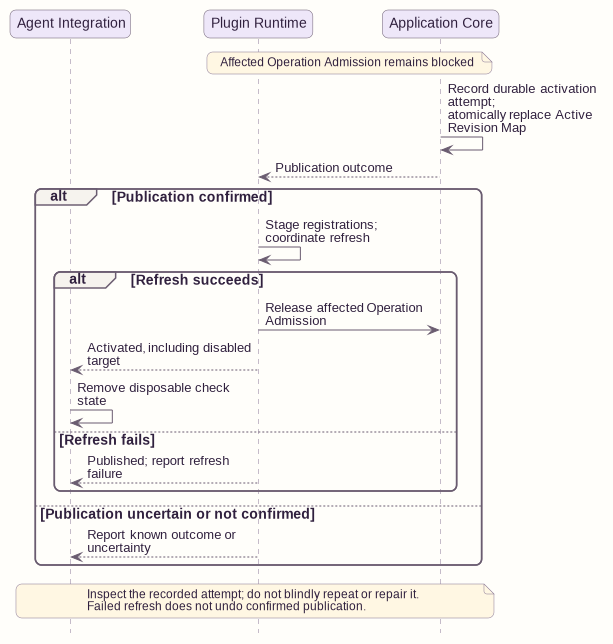
A tool waiting for missing data keeps its existing execution associated with the old version and delays activation until that action finishes. An update must not replace the execution behind an already presented question. A durable plugin activation publication attempt distinguishes published, not-published, needs-recheck and unknown outcomes. Inspection never blindly repeats plugin activation publication or automatically repairs uncertain state. A failed refresh or notification after confirmed plugin activation publication does not mean the old code is still active. Code and dependency revisions may change while the workspace continues operating. Relevant changes require fresh applicable checks before activation; passing checks for earlier revisions does not establish compatibility with the revisions present at activation. These are selected design boundaries, not evidence of native platform qualification. Verification of interrupted activation and dependency drift remains necessary. See Plugin development and adoption.
Incomplete developments remain in the conversation list without automatic expiry. The MVP exposes no development-storage display or manual cleanup capability. Internal check completion, release and resource disposal remove disposable test state, not durable workspace edits or active code. Closing the view or pane, or navigating away, does not stop the agent or present a discard/pause dialog. Normal and development conversations show ongoing work in the conversation list. Closing the workspace stops its development work under the existing closure procedure. Application quit stops all work; an interrupted development waits for explicit user input after reopening, rather than restarting invisibly. Recovery startup temporarily suspends installed plugins while preserving ordinary development checks and previews. Checked activation resumes its target only; unrelated plugins remain suspended until individual resumption or resume-all. Neither action replays interrupted work, and testing faulty code can freeze the application again.
6.3. Closing a workspace with active work
Trigger and preconditions
The user explicitly closes an open workspace, including by closing its last window. Switching the displayed workspace on mobile or closing only a plugin view does not trigger this flow. The Application Core coordinates closure through Workspace Lifecycle; Agent Integration and Plugin Runtime report and control their respective work. The scenario assumes a responsive application during normal operation.
Interaction
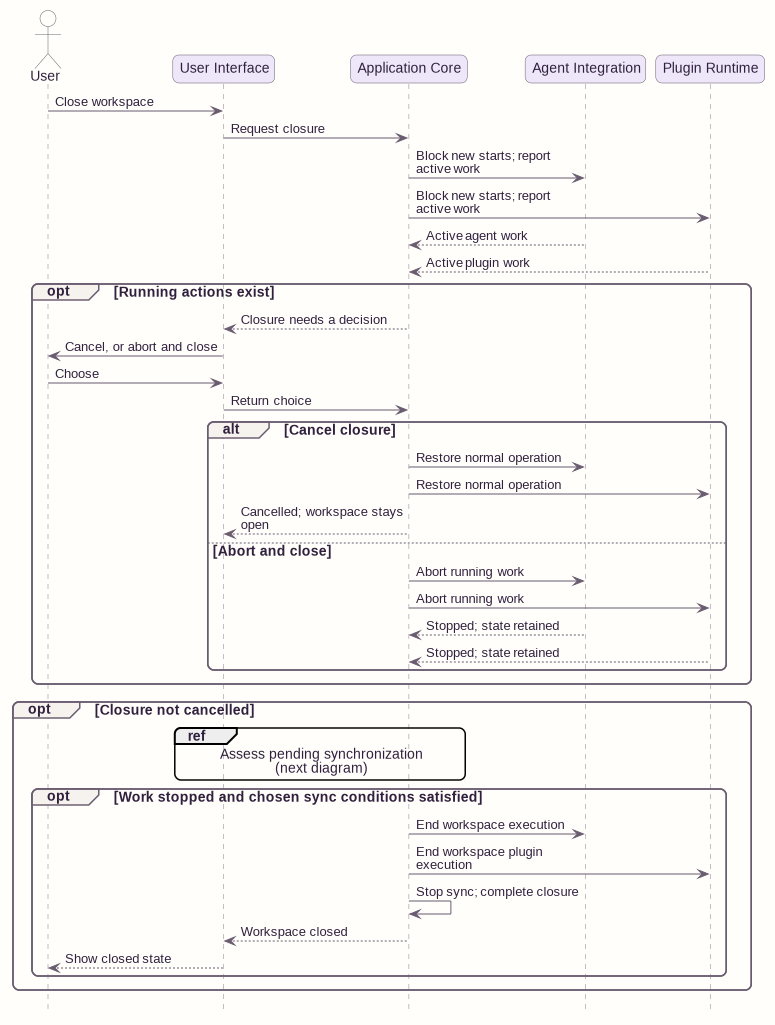
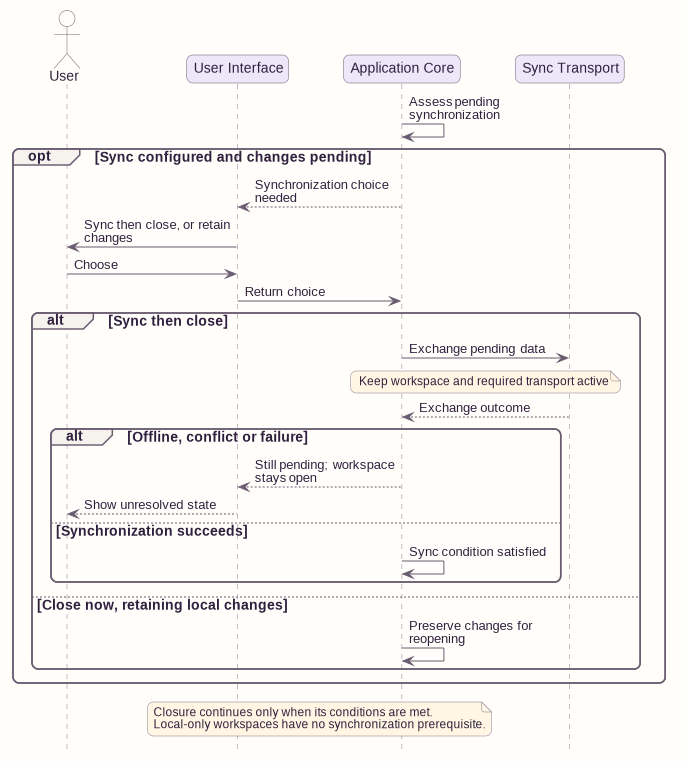
-
User Interface forwards the closure request to the Application Core through Workspace Lifecycle.
-
The core blocks new action starts in the affected workspace and obtains its active-work state from Agent Integration and Plugin Runtime.
-
If actions are running, the user chooses “Cancel” or “Abort now and close.” Cancellation discards the closure request and restores normal operation, including new starts and configured synchronization, without interrupting running work. The flow ends without scheduling automatic closure after that work finishes.
-
If the user proceeds, the core coordinates aborting running work. Aborting does not undo external effects already triggered.
-
If closure proceeds, the core assesses pending synchronization, including local changes retained after aborting work. A local-only workspace has no synchronization prerequisite.
-
If configured synchronization is pending, the user chooses to wait for successful synchronization or close while preserving local changes for reopening. Waiting keeps the workspace and the transport resources needed for synchronization active.
-
Once closure is still requested, running work has stopped and the chosen synchronization conditions are satisfied, the core completes closure. Agent work, including development conversations, plugin execution, automation and synchronization stop for this workspace; other open workspaces remain unaffected.
Failure and recovery
Offline operation, unresolved conflicts and exchange failures are not successful synchronization. When the user chose to wait, these conditions leave the workspace open with pending synchronization rather than reporting successful closure. Choosing closure with retained local changes does not discard those changes or claim that another device has received them.
Operating-system suspension and forced termination cannot guarantee the interactive closure procedure. An abort request also cannot guarantee interruption of synchronous plugin code blocking the shared runtime; the separate recovery startup path remains necessary. On reopening, interrupted conversations await interaction rather than silently resuming; normal configured synchronization and trigger policies remain separate. Shutdown across the full plugin and synchronization design, tracking of nested actions and presentation of combined close choices remain open.
6.4. Current client: workspace operations and closure
Critical workspace operations retain a workspace operation lease while they run, so closure waits for those operations to finish. This is distinct from the plugin worker leases used during activation. The shared registry is locked briefly to identify and authorize the session, rather than remaining locked during conversation storage. A slow save in one workspace therefore need not block registry access or storage in another workspace. Queued operations recheck the session after obtaining the lease: reopening the same workspace does not authorize requests from its previous session. This check preserves the runtime workspace binding, the native host’s association of the request with an authorized local session. The portable diagnostic workspace identifier correlates diagnostics; it does not grant this authorization.
The frontend resolves the workspace’s dictation-close decision before preparing file closure. Cancelling that decision performs no file snapshot, save or detach, leaving file sessions available for an explicit later attempt. Closure waits for already admitted operations in that workspace before completing the file and AI participants' close procedure. Successful closure persists removal from the remembered startup-open set while retaining the known-workspace entry. Failure to persist the workspace registry leaves the session available for recovery instead of reporting a successful close.
When file saving or draft inspection fails, the user can choose Close anyway…, then explicitly confirm the warning about unsaved changes.
Only that confirmation sends file detach with force: true, bypassing the file-save/snapshot validation rather than deleting recovery data.
Saved files, history and persisted recovery drafts remain; unsaved in-memory edits may be lost.
Cancelling retains pending writes and sessions.
Ownership checks, operation leases, running-action decisions, dictation and registry persistence still apply.
The confirmation does not bypass lifecycle admission, which controls whether closure may proceed.
This path is not offered during application quit or updater preparation.
Conversation storage also releases the shared active-turn lock during disk access, then checks the turn again before acknowledging its save. If the model response finishes during that write, a subsequent save is required before the completed response is considered durable. These are in-process coordination rules, not locks between devices or guarantees against writes by other applications. See file closure choices, native file preparation, workspace operation leases and AI turn coordination.
6.5. Current client: application quit and cancellation
When the user requests application quit, the current client performs these steps:
-
The native host checks whether update preparation already holds lifecycle admission, the gate controlling whether a lifecycle operation may start. If so, an ordinary quit attempt does not start.
-
Before collecting participating windows,
ai::ensure_quitsettles pending conversation storage and checks for running work, including plugin processes and pending login work. A storage failure or remaining work blocks quit before the window-readiness protocol begins. Pending logins are asked to cancel, and quit remains blocked while they finish. This preflight does not itself abort running agent or plugin actions. -
The native lifecycle coordinator identifies participating windows and workspaces, rechecks preflight and lifecycle admission, and admits only one quit attempt at a time. The host supplies participant identities even when a frontend has not yet loaded its initial workspace snapshot.
-
Each participating window prepares its retained file edits and acknowledges readiness. One ready window cannot approve exit for all other windows; with no participating windows, the native host can exit directly.
This current preflight is distinct from the intended active-work abort-and-close choices described earlier.
Every attempt has its own identity and ordering, so a delayed request or cancellation cannot replace a newer attempt. Cancellation restores the matching paused file sessions, and repeating an already completed cancellation is safe. The host retains the attempt’s status so the frontend can reconcile a lost reply or cancellation notification before a later workspace action. An unconfirmed cancellation remains retryable with a visible control; the frontend does not assume that rollback succeeded merely because a request was sent.
This protocol coordinates the existing file and AI participants and accounts for running plugin processes during preflight. It does not implement the full plugin shutdown or synchronization-readiness design. Forced process termination can bypass the protocol. Separately persisted recovery drafts, rather than successful quit coordination, protect edits across that interruption. See native lifecycle state, frontend coordination, quit preflight and Quality Requirements.
6.6. Conversation input, Stop and Recall
Participants are the user, Frontend views, Conversation Gateway & Registry, Conversation Owner and Native Host Adapters. The owner serializes submission, consumption, Recall and draft edits. Waiting input is already saved history, not text held in a separate pending-state file.
Submission and consumption
-
The frontend submits input to the owner. Save one user-message entry with its identity, attachments, references and steering/follow-up classification before acknowledging acceptance.
-
Input submitted during active work waits for its eligible boundary. It does not alter a request in flight or join an ongoing compaction request.
-
Before the next eligible main turn, select waiting steering and persist its consumption status without copying the message. Follow-up input waits until the current agent task, including its tool loop, completes; steering takes precedence.
-
Build the main context from consumed inputs on the selected path. A failed save blocks dispatch; it does not authorize submission under a new identity.
Agent task completion is an execution boundary, not completion of a managed Task. Queue status is reconstructible from history, while the live scheduler remains in memory.
Recall and draft editing
If consumption wins the race, Recall excludes that input. If Recall wins, save its recalled status so it cannot also be consumed; keep its original history entry. Merge still-waiting steering first, then follow-up input, then the current draft, retaining order, attachments and references. Recall does not resubmit input or start a run.
Draft edits and Recall are owner actions, not frontend transcript replacement. An edit based on a draft replaced by Recall fails rather than overwriting the merged text. Draft persistence need not provide crash recovery; unsaved draft text may be lost. Already submitted or recalled input remains identifiable in history even if an unsaved draft is lost.
Stop and reopening
Stop cancels the captured run without merging or resubmitting queued input. It does not undo effects already triggered. Cancellation before committed consumption leaves the input waiting; committed consumption is not inferred to be waiting merely because its response is absent.
Reopening rebuilds saved history and input status but does not start a model request or replay tools. The user initiates subsequent work. A call without a result remains an interrupted action with an unknown outcome, not proof of failure. Execution handles, unfinished response text and unsaved outcomes are not restored as a serialized run. See Conversation storage and overwrite protection for append failures and Conversation context and compaction for branch-local compaction.
7. Deployment View
Situate runs primarily on the user’s devices; optional services and release hosting have separate operating boundaries. This chapter maps software and data to those locations, then describes delivery and the developer environment. Placement requirements do not establish that a service is deployed or a native release is qualified.
7.1. Product environments
macOS is the released product platform, delivered through the website DMG and direct updater. Windows is the next delivery target and is not yet released. iOS, Linux desktop and Android remain deferred. See platform scope and distribution constraints.
Software placement and control
The following maps the building blocks to execution locations. Optional service rows describe required boundaries, not an operational service inventory.
| Software or dependency | Execution location | Control and communication boundary |
|---|---|---|
Situate Application: UI, Application Core and Agent Integration |
The user’s macOS device. Vue views run in the application webview; the native host owns conversation execution, storage access and platform integration. |
The application uses operating-system permissions for local access. Manual local work requires neither an AI endpoint nor a synchronization service. Platform scope does not imply qualification of every feature. |
Installed plugins |
Execution contexts on the user’s device, within the owning open workspace’s lifecycle. |
Plugins are trusted code, not sandboxed adversaries. They can call external email, calendar and document APIs through configured access. A closed workspace has no always-running service. Mobile suspension remains a deferred-platform consideration. |
User-configured model endpoints |
A local process, self-hosted system or remote provider selected for that workspace on that device. |
The endpoint remains outside Situate’s product boundary, even on the same device. Native adapters communicate with it; the frontend does not take custody of provider credentials. |
Situate Synchronization Service (optional) |
Situate-operated EU-hosted infrastructure; concrete topology remains unspecified. |
Exchanges end-to-end encrypted workspace data between the user’s devices. Neither service nor operator may decrypt content. Versioning, merging and recovery remain client responsibilities. |
Situate AI Router (optional) |
Situate-operated EU-hosted infrastructure; concrete topology remains unspecified. |
Routes authorized model requests to providers, which may process outside the EU subject to the legal constraints. Authorized plaintext AI processing does not grant general access to stored workspaces or the ability to decrypt synchronized content. |
Direct-release hosting |
The selected Hetzner host, with Nginx behind Caddy HTTPS. |
Serves static update metadata and signed application artifacts, not workspace storage or an agent runtime. The former preview hostname redirects to production. See the target host lifecycle. |
The native conversation owner requests model work through Model Access, an internal host capability. Native adapters perform Provider Transport: authentication, requests and streamed responses to the selected endpoint. See REQ-0015, REQ-0016 and hosting and processing constraints. Synchronization placement follows REQ-0013; no service topology is selected here.
Storage and configuration boundaries
| Data or configuration | Location | Portability and recovery boundary |
|---|---|---|
Workspace content, conversations, plugins and histories |
The workspace directory on the user’s device. MVP versioned writes target macOS filesystem workspaces; retained mobile adapters are outside current product support. |
Copying a closed workspace can produce a consistent backup; safe live snapshots remain open. External document-provider workspaces remain read-only until versioned writes are implemented and verified. A directory copy does not prove successful restoration. |
Conversation history and metadata |
|
Portable saved history, branch ancestry and selected entry; no separate pending-state file. Execution handles and unsaved drafts remain in memory. Closed-workspace copying includes conversation directories and existing attachment storage; it does not restore a running agent. See Conversation storage and overwrite protection. |
Operational AI settings and credentials |
Outside the portable workspace, scoped to workspace and device; provider secrets use OS secure storage. |
No synchronization mode, workspace copy or restoration transfers these settings. A local association with the authorized workspace location, the Device-local Workspace Namespace, is not a portable credential grant. |
Diagnostic logs and update packages |
Application-owned device-local storage outside workspaces and their histories. |
Logs are bounded installation-local records, not synchronized workspace content. Update-cache retention and verification are described below; neither cache is a workspace backup. |
A portable Diagnostic Workspace Identifier correlates logs across copies and devices; it does not grant access or share runtime state. The native host separately associates requests with an authorized local session through a Runtime Workspace Binding. See storage and history, write scope and client diagnostics.
Service deployment topology, cryptographic protocols, supported OS versions and safe live-backup procedures remain unresolved. The deferred marketplace has no selected hosting topology; it is not a prerequisite for local plugin management.
7.2. Delivery and operations
The continuous release workflow describes the selected target automation. The tools and operator gates below remain current until that automation and its native qualification are enabled.
Infrastructure state and execution
ADR-0014 selects HCP Terraform for authoritative infrastructure state, separate from the Hetzner application host and developer disk. The production workspace uses Local execution: Terraform runs on the operator’s machine, while HCP stores state versions and coordinates locking. The target GitHub Actions runner uses the same workspace, not a second state backend. Infrastructure CI applies are not enabled today.
The production wrapper checks the organization, immutable workspace ID, execution mode and current state version before adoption. Plans are bound to that identity and their exact bytes; local inspection plans cannot be reused. Workspace setup, resource ownership handoff and restore verification remain operator gates, not consequences of adding configuration. Keep independent encrypted state exports and recoverable HCP account access; hosted history is not protection against account loss or workspace deletion. The production runbook describes credentials, operation boundaries and recovery.
Immutable production hosting (target)
ADR-0019 defines the replacement lifecycle for the Hetzner VM that serves the website and direct releases. The existing host remains authoritative until a separately approved cutover. The current checkout no longer exposes the in-place deployment commands. The immutable hosting runbook covers image qualification and the separately reviewed Terraform stages.
| Boundary | Lifecycle |
|---|---|
Host image |
The operating system, container runtime, Caddy, Nginx and serving configuration change by replacing the VM with one built from a tested image ID. First boot supplies instance-specific access and mounts; it does not assemble the serving stack. |
Website and direct releases |
Static website versions and their activation pointer change independently of the VM. A separate volume carries site content, signed app packages, publication state and TLS state. Only one host can attach the volume at a time; encrypted backups remain separate. Signing keys are not hosted on the VM. |
Traffic and TLS |
Apex A and AAAA records select the serving host. Fence the previous host before moving storage so clients with cached DNS cannot receive stale data. The domain, redirect behavior and public release URLs stay the same. |
After the one-time migration and explicit activation, changes to production infrastructure inputs merged to protected main trigger deployment automatically. Website-only, app-only and documentation-only changes do not trigger host replacement.
The cutover diagram shows the order of checks, traffic switch, and retirement.
The GitHub-hosted job stops on failure. The isolated image rehearsal finishes before the job opens the production recovery record, as described in ADR-0023.
Once production staging starts, the operator must restore a consistent topology before clearing an unresolved record under ADR-0020.
If the previous VM cannot serve the latest committed state, keep traffic paused rather than restore a stale snapshot; see Host replacement can serve a stale release feed.

Distribution variants and update authority
ADR-0011 selects build-time distribution variants instead of runtime installation-origin detection.
The Apple release builder embeds SITUATE_DISTRIBUTION=direct|external before signing; only an explicit macOS direct build enables the native updater.
The current MVP covers macOS direct distribution only. iOS App Store delivery is deferred and is not a current build, submission or release gate.
Homebrew and other package-manager channels remain deferred, not prerequisites for either release.
The authoritative behavior is recorded in REQ-0068 and REQ-0071.
A distribution variant is a release configuration of the same application source and build pipeline, not a separate product platform or source fork. Each supported variant embeds its distribution identity before code signing. The native host derives update authority from that identity before any app-update network request; the UI consumes the same policy. Direct variants enable the built-in update area, manual checks, scheduling, downloads and installation. Externally managed variants disable these functions rather than merely hiding the installation button. Actual workspace and plugin incompatibility explanations remain independent of update authority. Unknown or missing release configuration must not silently enable the direct updater.
Do not infer distribution identity from installation paths, package-manager presence, receipts or external marker files. Distribution identity describes the artifact’s selected update policy, not a verified history of who copied it onto the device. A future Homebrew recipe must therefore reference the Homebrew artifact, never the website artifact. Moving that Homebrew app does not change its update authority; changing channels requires installing the appropriate variant. The concrete replacement workflow remains open.
Channel examples
| Channel | Build and packaging | Update authority |
|---|---|---|
macOS website DMG |
Build the direct variant, then Developer-ID sign and notarize it. Its DMG and updater archive carry the same direct-variant application payload. |
Situate’s built-in updater. |
macOS Homebrew cask (deferred) |
Build a separate Homebrew variant from the same source and pipeline; sign and notarize its own payload. The cask references that artifact, not the website DMG. No Homebrew build is introduced until the channel is selected for delivery. |
Homebrew; no built-in checks, downloads or update promotion. |
iOS App Store and TestFlight (deferred) |
Retained build/export tooling is reference material only; no iOS delivery pipeline is selected for the current scope. |
Apple’s distribution services; no built-in updater. |
Mac App Store (optional, not selected) |
Reuse application source with a store-specific export, signing and required sandbox configuration. Store eligibility of plugin execution and local process access needs separate assessment. |
App Store; no built-in updater. |
Windows website installer (deferred) |
Build the Windows direct variant and package it in the selected installer and direct-update format. |
Situate’s built-in updater when Windows returns to active scope. |
Windows package manager or Microsoft Store (not selected, deferred) |
Use an externally managed variant. Store/MSIX packaging may also require a separate wrapper and signing profile. Which managers can share an external variant remains open. |
The selected external manager; no origin detection or built-in updater. |
Linux direct package (format open, deferred) |
Use a direct variant in a selected directly updatable format; no format is selected now. |
Situate’s built-in updater if the selected format supports it. |
Linux package manager (not selected, deferred) |
Use externally managed variants and native wrappers such as deb or rpm where selected. Compatible payloads may be reused across wrappers; sandbox-based formats can require further adaptation. |
The selected external manager; no built-in updater. |
Android store (deferred) |
Build the Android application with store-appropriate packaging when Android returns to active scope. |
The selected store; no built-in updater. |
Separate variants share application code and release automation, but add artifact production, signing, checksums and verification work. A shared pipeline must make the variant explicit and preserve it in release manifests and artifact names to prevent channel mix-ups. The Apple release builder defaults to external update authority and requires an explicit direct-distribution selection for website releases. No package-manager identity needs to be selected or implemented for the MVP.
Direct updater
The native Rust Tauri updater plugin handles direct macOS artifact downloads, version-bound signature verification and installation.
Situate bounds feed metadata to 1 MiB and a 30-second deadline, enforces HTTPS redirects, and passes accepted metadata through the plugin’s version and target validation.
Situate owns scheduling, application-lifetime update state, UI and reversible shutdown coordination rather than implementing a separate installer.
The host integration resides in client/app/src-tauri/src/updates/; the plugin and signing-tool pins must remain compatible with version-bound signatures.
Host tests and successful compilation do not establish signed native installation or relaunch qualification.
Tauri documents a macOS application archive and a separate update signature; its required update signature is additional to Apple code signing and notarization.
The release pipeline must create the updater container from the final signed, notarized and stapled direct-variant payload and verify that order before release publication.
The direct update feed must publish only direct-variant payloads, preserving update authority across updates.
Scheduling, quiet notification and user-confirmed restart follow REQ-0068. Installation confirmation is bound to the selected verified artifact and rechecked before replacement. The native coordinator reserves the gate for application closure and installation, called Lifecycle Admission, so competing lifecycle operations cannot start during preparation. It prepares every application window, including windows without an open workspace. This gate is distinct from Operation Admission, which validates individual requests for execution.
If actions are running, the user must postpone installation or explicitly abort them. Each window prepares its file edits, drafts, layouts and dictation state; replacement can begin only after every participant confirms readiness. File sessions are finally closed only after successful replacement. Cancellation or a failure known to leave the bundle unchanged restores prepared sessions without replaying aborted actions. The workspace-only Close anyway… escape path is unavailable during update preparation. See application quit coordination for the related window-preparation protocol; update installation additionally validates the selected artifact and replacement outcome. Native lifecycle and signed two-version update qualification are release gates.
Installation failure and recovery
If an installation attempt fails and the application bundle is known unchanged, release reversible preparation, keep the original installation usable and retain the verified package for a later user-requested attempt. Do not automatically replay actions that were explicitly aborted for the update. If bundle replacement or relaunch has an uncertain outcome, preserve recovery evidence and explain the known state and recovery steps without an automatic install retry or restart. Require explicit user action and renewed package/installation-state validation before another installation attempt. Where manual recovery is required, use a trusted installer of the same or a newer version without deleting or resetting workspaces. Do not introduce an application-owned automatic rollback mechanism or promise that the original bundle remains intact after uncertain replacement.
Update-check scheduling and retry
Follow REQ-0068 for the retained 24-hour successful-check interval, bounded retry schedule, check deadline and connectivity recovery. Coalesce automatic and manual checks into one in-flight request; manual checks remain independent of automatic waiting periods. Persist successful checks only, and keep download retry state separate so that download failure after successful discovery does not impose a new 24-hour wait. The update-check deadline is not an overall artifact-download deadline. Automatic check failures do not open dialogs or interrupt ongoing work.
Update download retention
Keep update packages in an application-owned, private device-local cache outside workspaces and their histories. Retain at most one verified package plus one in-progress download/verification candidate. Completed packages remain available across application restarts, with signature/version verification before reuse. Replace an older cached package only after verifying its replacement, and remove the installed package after a confirmed successful upgrade.
Restart interrupted downloads from the beginning; resumable partial downloads are not part of this delivery. Use REQ-0068’s independent download retry schedule without waiting for the next daily check. Account for the pinned updater’s peak memory and temporary disk use even when retaining completed packages on disk.
Update signing keys
Use one dedicated updater-signing keypair for direct macOS updates, separate from Apple code-signing credentials. The operator stores the private key in 1Password and verifies account/key recovery before distributing updater-enabled builds. Only the public key is embedded in the application and may be committed to the repository. Supply private signing inputs through explicitly supported environment variables or a private key file; release scripts must not invoke 1Password, require its CLI or fetch secrets automatically. Confine private-key access to signing and exclude it from broad build environments, Terraform, logs and distribution artifacts.
Do not introduce a key server or automatic rotation service for this delivery. Loss without recovery can prevent installed applications from accepting future updates; recovery may require manual installation of a new trusted build. Document compromise and loss handling before the first updater-enabled release without promising transparent key replacement.
Direct release hosting
Serve the static JSON update feed, versioned DMGs and updater archives from the existing Hetzner host, using Nginx behind the Caddy HTTPS proxy at getsituate.com.
Use a new release namespace separate from prototype metadata; no prototype migration or continuing prototype-client compatibility is required.
No additional application backend, object storage or CDN is introduced for this delivery.
Serve the new release paths without download counting, tracking identifiers or analytics integration.
Upload and verify all immutable artifacts before activating metadata that advertises a release.
Website download metadata and the updater feed must identify the same complete published release.
Keep mutable metadata revalidated and versioned artifact URLs immutable; website deployment and rollback must not delete artifacts or rewind the app feed.
The implemented publisher verifies and stages immutable releases, activates website/feed metadata through one atomic pointer and reconciles uncertain release publication only for the same version and identical bytes.
See release publication and service and traffic activation for the separate operator commands and recovery procedures.
The production publisher remains restricted to https://getsituate.com/releases/ and the production embedded feed endpoint.
The retired preview host name https://reboot.getsituate.com redirects permanently to the production apex, preserving paths and query strings; it does not serve test artifacts.
This hosting selection does not authorize release publication.
Faulty release handling
Correct a faulty application release by publishing a fix with a higher version number. Do not introduce an application-version rollback or downgrade workflow, rewind the direct update feed or website download metadata to an older release, or replace published artifact bytes under the same version. An operator may pause availability while preparing the fix without advertising an older application version. Reconciliation of an interrupted release publication may reuse only the same approved version and identical artifacts, not activate an older release.
No additional package-revocation system is included in this delivery. Changing or pausing feed metadata does not reliably revoke a package that has already been downloaded and validly signed. Operational recovery of website/runtime deployments remains separate and must not rewind application-release metadata.
Verification and unresolved decisions
Verify each released artifact against its declared variant and update authority. Externally managed variants must not contact the direct update feed, download app updates or expose manual update checks. Direct updates must retain direct authority after installation; package-manager upgrades must retain external authority. Verify signature validity for each delivered variant and ensure that release recipes reference the correct artifacts. Moving an app or having a package manager installed must not change its embedded policy. These are verification needs, not claims of completed native qualification.
Release-publication reconciliation and signing-key compromise/loss guidance are documented in the release publication guide; exercising recovery remains an operator release gate. An explicit channel-replacement workflow remains open. The Homebrew variant and its release checks are deferred until Homebrew delivery is selected.
External references
-
Homebrew Cask Cookbook: cask recipes select downloadable artifacts and app installation destinations.
-
Apple macOS distribution: store and Developer ID distribution have different delivery and sandbox requirements.
-
Apple distribution methods: App Store Connect covers TestFlight and App Store delivery; Developer ID covers external macOS delivery.
-
Tauri updater: signed update artifacts, desktop configuration and macOS archive format.
7.3. Continuous macOS release workflow
This is the selected delivery design, not an operational pipeline. The current CI gates, release preparation and Apple distribution commands remain the implementation references until the transition is qualified. GitHub Actions currently runs quality and tooling workflows; Apple app builds and publication remain operator-invoked.
The target is automatic creation of qualified macOS GitHub Releases followed by a separate host-publication workflow, with no additional routine release approval after a protected merge. The host publisher consumes the exact GitHub Release assets; GitHub Release completion and website/update availability are distinct outcomes. The pipeline builds and delivers macOS only. iOS and all other product platforms are deferred; no mobile candidates, store submissions or device gates are included. User-controlled installation remains asynchronous. REQ-0069 and REQ-0070 govern mixed-version use; a shared release date cannot replace compatibility.
Execution locations and trust boundaries
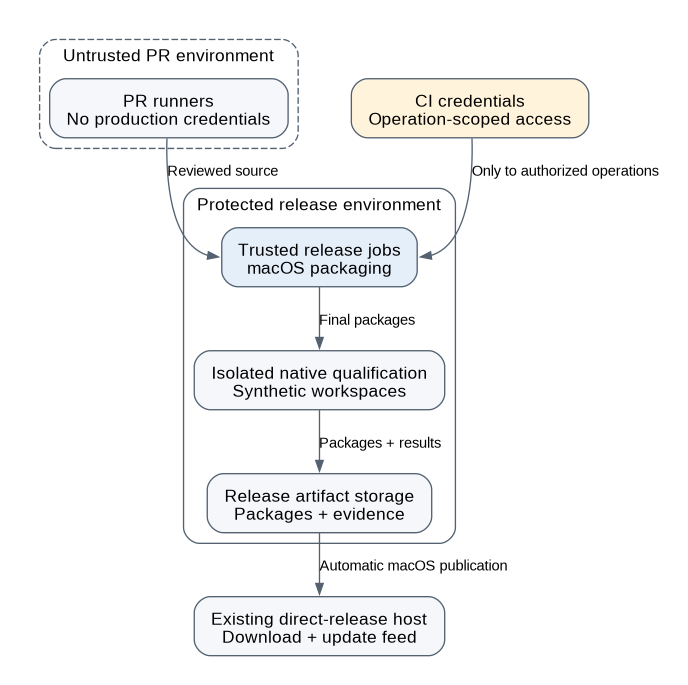
-
GitHub Actions is one execution adapter for version-controlled scripts. macOS jobs use
macos-latestand record resolved image, architecture and toolchain identity; additional runner/OS/architecture matrices are outside this increment. Portable checks use the same digest-pinned Linux tool image locally and in CI. Only macOS-specific host behavior and Apple tooling execute natively. Docker-steering integration tests remain host orchestration; ordinary tool containers receive neither a Docker socket nor a privileged nested daemon. -
Qualification uses disposable synthetic workspaces, not personal data or credentials.
-
Supply credentials through supported CI environment variables only to authorized operations, never to dependency installation or ordinary tests. No automatic secret-manager access is introduced.
-
Distribute intended public packages only; signing material and private notarization/publication diagnostics stay outside them.
-
The existing host uses restricted publication access and verified SSH keys. Website deployment does not own its app-release pointer.
-
GitHub Releases hold intended public packages and generated release inputs. Existing host storage retains publication state and private recovery evidence; no additional paid runner capacity or dedicated native hosts are selected.
Shared scripts and local release execution
Under the local execution constraint, every operation executed in Actions is also executable and testable through repository scripts on a suitably provisioned local host. Workflow definitions declare events, dependencies, runner placement and permissions, then invoke scripts; they contain no independent verification, packaging, publication or recovery implementation. A commit-pinned checkout action is the sole bootstrap exception; all subsequent executable operations are repository scripts. The same workflow definition drives CI, the CLI and the development terminal, including stage order, mandatory gates, evidence and interruption handling. The development terminal’s existing release sequence must be replaced, not retained beside the shared workflow.
Authorized local macOS delivery must remain possible without GitHub Actions, including an Actions outage with reviewed source and dependencies already available. Reservations, release locks, packages, review evidence and recovery records cannot depend exclusively on Actions storage, concurrency or APIs. CI and local execution share the same durable release authority. Local operator authorization replaces the CI trigger authorization, not qualification; missing or failed gates still block delivery. Git tag/release creation and uncached release-asset retrieval require Git/GitHub access; independence from Actions does not promise independence from all GitHub services. Apple notarization, production-endpoint qualification and publication remain network-dependent operations. Use the same source/translation review scripts locally and in CI, with their existing approval/hash semantics, rather than a separate approval service.
Triggers and qualification
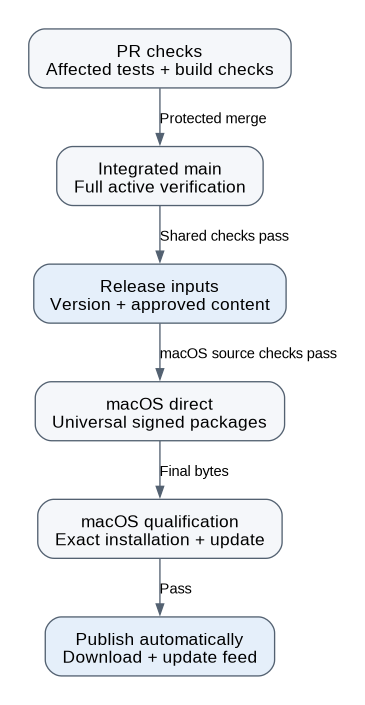
PR checks validate the declaration, source review, translations and affected tests/builds through the shared suite registry. PR packages are not production releases. After merge, determine affected checks and app-release impact before scheduling verification for the integrated source; PR results alone are insufficient. Pure developer-tool or documentation changes run their relevant checks without starting client verification or an app release. An app-release candidate still requires the complete macOS verification plan, including relevant shared suites, for its exact integrated inputs. Under the platform-specific verification constraint, target platform, execution host and test profile are separate inputs. macOS is the only active product target; its component suites report individual results. A Linux-hosted shared check contributes to that plan without becoming Linux product qualification, and missing native macOS execution cannot produce a complete passing result.
Failed shared or macOS qualification blocks publication. Missing prerequisites or evidence, failed cleanup and cancellation are not passing skips. Documentation/tooling-only changes need not publish an app, but an empty changelog does not establish that a release is unnecessary. Test app-impact selection independently of changelog contents.
Workshop/design sweeps, screenshot comparisons, coverage and paid live-provider tests retain their explicit scope. The CI guide describes the verification lanes and their execution hosts. Externally changing vulnerability monitoring runs independently against main, not as a required PR or release status; upstream advisories are addressed in separate fix PRs. Secret scanning and source-bound dependency/license policy remain required. Scheduled npm monitoring alongside Dependabot is proposed; cadence and runner-budget limits remain to be finalized.
Release identity and content
ADR-0017 selects YYYY.M.N public versions with separate platform build identifiers.
ADR-0018 requires a new changelog declaration for PRs that change the client. If a client change merits no user-facing entry, use an empty declaration with an internal reason.
CI checks the declaration requirement before merge; release assembly collects committed declarations.
Reserve the version centrally after merge and bind source, configuration and approved content as shown in ADR-0017. Parallel PRs do not edit shared version pins; builds assemble approved content without generating prose. Retain historical catalogs and undelivered changes; failed builds do not consume them.
The existing builders require consistent committed npm, Cargo and Tauri versions and a clean revision; their replacement contract must support immutable generated version/catalog inputs bound to the original reviewed source. Do not create a release commit or update tracked pins/fragments during release creation. Git-derived fragment membership and immutable release tags are the preferred identity mechanism; exact tag metadata, atomic reservation and Apple build-number mapping remain implementation design work. A reserved tag is not proof of completed packages or public delivery. Completed GitHub Release history determines assigned content; host publication evidence independently governs website/update availability and host-channel race baselines. Public GitHub Releases are also published app versions: compatibility and migration qualification must include their verified source/manifests, including releases never promoted to the host, alongside legacy host publication evidence. If a GitHub Release is not promoted to the host, later releases retain its finalized history rather than losing those notes.
Final packages and promotion
Build the macOS direct variant as a universal application, Developer-ID sign it, notarize and staple it, then produce the DMG and separately signed updater archive from the same final app. Verify hashes, version-bound updater signatures, application identity, architecture, Gatekeeper assessment and equality of the application bundles in both containers. Qualify download/first launch and the signed two-version update, including retained data, unsaved changes, multiwindow preparation and restart behavior. Instrumented native smoke builds cannot substitute for these exact artifacts.
The update test must retain the embedded production HTTPS endpoint and TLS validation without advertising the unqualified candidate as the current public update. On immutable hosting, the existing TLS proxy serves the candidate through a separate loopback port, reached through a restricted SSH forward from the runner. The release account stages the candidate files without access to Docker or TLS keys; see ADR-0022: Serve release qualification on host loopback. Release creation requires a successful production deployment whose hosting inputs match the candidate’s. App-only revisions can use the already verified generation without running Terraform. Before release work and before artifact qualification, macOS verifies the running image’s provenance and private HTTPS response over authenticated SSH. An unresolved hosting operation or an undeployed hosting change blocks release creation; the artifact qualification itself is unchanged. Changing the embedded endpoint or manually replacing the app does not establish production updater qualification.
After final qualification, complete a GitHub Release containing sealed packages, generated inputs and public qualification evidence; exclude keys, private journals and raw diagnostics. A separate publication workflow reads the exact repository/release/tag/asset identities, verifies hashes and source/evidence bindings, then uploads the same bytes without rebuilding or re-signing. Retain the macOS publisher’s immutable package verification and atomic common download/feed activation, as described in release publication. Workflow chaining must account for event suppression by the default workflow token; the implementation plan proposes a trusted successful-workflow completion trigger with explicit release identity, not selection of a mutable latest release.
Ordering, evidence and recovery
Independent selected checks and preliminary builds may run in parallel after relevance planning, with isolated outputs and native-desktop ownership.
There is no global fast-check barrier before unrelated native or browser jobs; all required results still gate publication.
Serialize final migration-baseline qualification, macOS release creation and publication effects so a concurrent publication cannot silently invalidate a candidate’s checked history; independent source verification does not hold that queue.
Before reserving a version, verify that the candidate still matches protected main.
Eligible source results may be reused only with independently verified producer execution/workflow identity, whole-tree equality, matching execution contracts and actual host identity. Retain original tested revisions and explicit reuse bindings; history-sensitive and unknown checks execute afresh.
Read baselines from trusted immutable publication evidence, not a comparison revision chosen by the candidate change.
Revalidate a candidate against current publication evidence before publication without changing its artifacts.
Reject stale publication baselines and prevent an older completed candidate from replacing a newer public version.
Protect the release branch and workflow configuration, require selected merge checks and restrict release credentials to trusted events. These repository/environment controls must be provisioned separately; a workflow definition alone does not enforce them. A reviewed merge becomes the standing release authorization only after those controls and the automated gates are enabled. Until then, the existing operator approvals remain in force.
Record source and any derived release revision, public version, build identifier, variant, content digest, toolchain identity, artifact hashes and qualification outcomes. Keep build, qualification, notarization and public-availability states distinct, including an explicit unknown outcome. Use runner-local storage for unpublished builds. Retain finalized release packages, generated inputs and qualification evidence without automatic deletion; exclude private material from public assets. Independent backup, restore, signing-key and account-access recovery exercises are deferred operational work; their evidence is not required for release creation or publication. Legacy operational recovery metadata remains readable without gating delivery. Hosted runs are independent attempts; a failed run does not retain a claim over the next one. The Git tag, completed GitHub Release, and production feed pointer record the state of three distinct steps. See ADR-0025: Run macOS delivery as fresh attempts. Do not treat artifact-storage presence or a successful upload as proof of public availability.
Overtaken PR checks may be cancelled. Do not automatically cancel an active notarization or publication because a newer commit arrived. Reserve a new identity before building again. An earlier submission is not repeated under the same identity, and existing public versions never accept different bytes. Correct a faulty release with a higher version; pausing availability must not advertise an older app.
Transition gates
Before enabling unattended publication:
-
Implement and test the shared script workflow, minimal Actions adapters and replacement development-terminal flow; qualify local delivery and cross-executor recovery without GitHub Actions.
-
Implement and test CalVer reservation, compatible version ordering, PR declarations, localized assembly and immutable release inputs.
-
Provision protected main/release tags, least-privilege environment access and signing credentials. Use
macos-latest; report limits of actual native coverage without adding another qualification matrix. -
Automate exact-artifact macOS installation/update tests.
-
Exercise interrupted notarization and publication recovery, and retain evidence without disclosing credentials or private diagnostics.
-
Implement separate GitHub Release creation/asset-consuming publication, selected retention and affected-input policies, independent dependency monitoring and authorized runner-cost limits.
No existing compatibility reader, historical catalog, migration baseline or native macOS release gate is removed by this design.
7.4. Development environment
Client development uses a macOS workstation with Xcode for the macOS target. iOS runtimes, provisioning and device verification are not current prerequisites. The developer controls the checkout, local dependencies and test data; this environment is separate from release hosting and optional product services.
| Environment | Software and placement | Setup and evidence boundary |
|---|---|---|
Local client development |
The client has its own npm and Cargo workspaces under |
Follow the client guide for prerequisites, commands and Apple builds. Client development does not require Pi, Herdr, a backend or model credentials; AI features require suitable configured access. |
Browser and shared checks |
Repository tooling runs on the development host or a shared CI host. Linux may host platform-independent checks without becoming a product target. |
The test guide defines profiles and prerequisites. Browser assertions and shared tests do not replace native macOS qualification. |
Native macOS verification and release packaging |
macOS/Xcode builds macOS packages and runs native checks on an isolated macOS host or VM. |
The Apple distribution guide covers signing and export inputs. Building a package does not authorize upload or release publication, or prove signed installation and relaunch. |
Use the developer setup guide for workstation tooling and local environment files.
Keep dependencies local to each worktree and use the coordinated repository commands described in the test guide.
Scripts consume only their supported environment variables or the private repository-root .env, parsed as data rather than executed; explicit environment values take precedence.
Do not put credentials in tracked configuration, fixtures or build artifacts, or require scripts to fetch them from a secret manager.
Local dictation development uses the model source described in local dictation models, separately from release model provisioning.
8. Cross-cutting Concepts
These concepts define the selected architecture; decision status and implementation evidence remain separate. Conversation storage follows ADR-0016: Append conversation history and derive branch context. They do not establish delivery of the broader plugin, synchronization or mobile execution strategy.
8.1. Workspace compatibility and migrations
Status: accepted design, implemented by the native opening gate and the independent situate-migrations package. Exact published-binary provenance and native macOS release qualification remain separate verification requirements. iOS qualification is deferred. See the testing guide for migration checks.
The workspace core is one compatibility unit: either it opens after migration or it remains closed. Plugins have separate code, data-format and app-capability checks; an incompatible plugin does not by itself block the core. See REQ-0069 and REQ-0070.
Compatibility boundary and migration position
The mixed-version compatibility boundary covers synchronizable workspace data, whether or not synchronization is currently enabled. Device-local layout, settings and provider connections are excluded; upgrades must preserve them through migration where needed, but older apps need not read their upgraded formats. A device-local format change alone must not raise the portable workspace’s minimumAppVersion. Public plugin-interface compatibility remains governed by REQ-0070.
Persist two values centrally in .situate; no separate core format version or target-format setting is needed.
The values live in .situate/migrations.json.
The first migration creates this file without changing other managed records or increasing their minimum app version.
| Field | Meaning |
|---|---|
|
Lowest app release that can safely open and edit this workspace. Compare semantic versions, not strings. Migration does not automatically raise it; an incompatible change raises it deliberately. |
|
Stable ID of the last successful migration in one linear sequence. No per-step execution history is required. An explicit initial position represents a workspace with no applied migrations. |
The app owns one central, ordered registry of migration IDs and implementations.
Append new migrations after all published entries. Do not reuse an ID or insert a step before a published entry.
Corrections normally require a new migration. The only exception is the validation-only correction to m0002_conversation_history: it leaves unrelated siblings untouched, still rejects corrupt conversation records and valid-ID symlinks, and does not change conversion or the data format.
Release verification accepts only the exact original-to-corrected implementation bytes at that path.
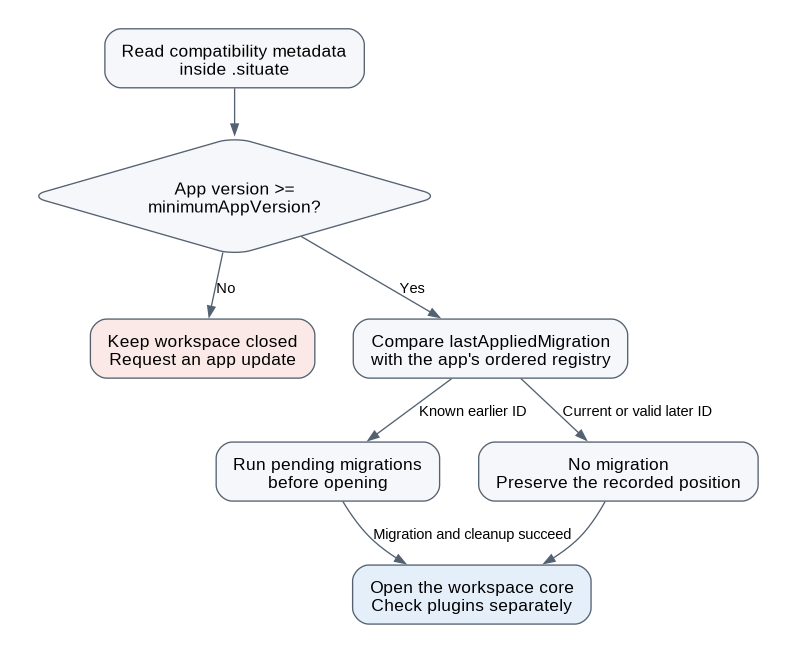
An app below minimumAppVersion refuses normal opening before processing workspace content or writing it and requests an update.
Other workspaces remain usable.
An app meeting the minimum applies its remaining migrations before opening.
When a compatible older app encounters a valid later migration ID outside its registry, it preserves that position: it neither downgrades the workspace nor repeats its own earlier migrations.
Malformed metadata or a missing required migration path is an error, not an initial workspace.
Keep old and new representations compatible wherever practical. Older writers must preserve unknown information; when two fields represent the same value, define which is authoritative and how later edits from older apps are reconciled. Raising the minimum is not routine cleanup after six months. REQ-0069 permits an earlier incompatible change only through an explicit decision for that change when transition effort is disproportionate; this does not waive public plugin-interface compatibility under REQ-0070.
Opening and recovery
Run migrations when opening a workspace, not at application startup. Keep normal core access, plugin execution and synchronization stopped until migration and its durable completion succeed. Serialize local opens and writes for the affected workspace throughout backup, migration and restoration. Editing the workspace outside Situate during this operation is unsupported; the runner does not reconcile or detect concurrent external changes.
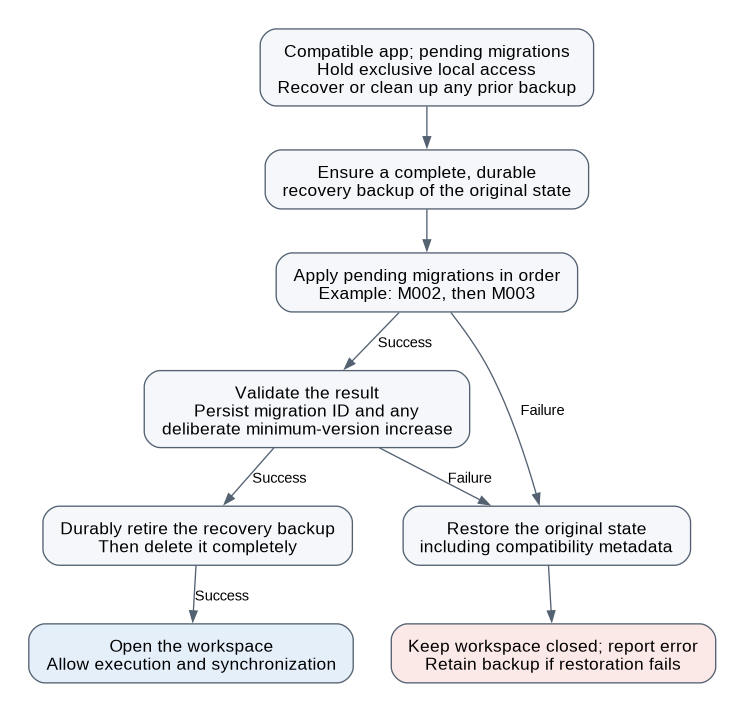
Backup, restoration or cleanup failure also leaves the workspace closed. The backup state determines recovery after an interruption.
All migration writes stay inside .situate, which contains Situate-managed state, not user-authored working files.
Back up the complete managed state that can be changed, including compatibility metadata, conversations, pending work, plugin state and histories; exclude the backup and temporary migration artifacts themselves.
Do not modify or restore user files outside .situate, device-local app settings, credentials or external services.
Migration must not execute plugins, resume conversations or replay tools.
For a chain M001 → M002 → M003, failure in the final step restores the state before M002, including its original migration position, rather than retaining a partially upgraded workspace.
After successful validation, persist the new migration position and any deliberate minimum-version increase before completing the attempt.
Delete the backup before normal opening.

Migration cannot start from a temporary backup. A recoverable backup triggers full restoration and a silent retry even if conversion succeeded before interruption; only durable retirement ends that recovery rule. A retired archive is no longer a recovery source; finish deleting it before opening. No per-step migration progress is recorded.
Publish and retire the recovery backup through atomic, durably acknowledged state transitions before starting migration or deleting backup contents, respectively.
Keep the recoverable backup intact while restoring; an interrupted restoration is repeated from that same complete source.
A failed restoration leaves the workspace closed and the backup retained.
A failed migration restores the original state and reports an error; retry automatically on a later open, not in an unbounded loop.
An unreadable or incomplete recovery source must never replace workspace state or become empty data.
Recovery state lives in .situate/.migrations/: workspace.lock, backup.tar.tmp, backup.tar and retired.tar.
Each backup is one uncompressed TAR archive containing payload/ entries and a final manifest.json.
The manifest records file sizes, normal permission bits and SHA-256 content digests.
Validate the complete archive against its manifest before publication and before destructive restoration, without comparing it with a second scan of the live directory tree.
Only the named archive files participate in recovery and cleanup; unrelated entries in the control directory are left untouched.
The runner rejects oversized manifests, unsafe paths, duplicate entries and unsupported entry types.
Archives use private file permissions (0600 on POSIX); restoration makes the managed directory private (0700) before extracting files.
Restore normal permission bits, but create files under the current user without restoring owner/group identities, ACLs or extended attributes.
Archive entries contain independent file bytes, not links to live state.
Metadata-free legacy markers are admitted without resetting their contents; malformed compatibility metadata is not treated as absence. Fresh staged workspaces initialize the current migration position before publication; existing markers, including the current iOS creation path, pass through the metadata bootstrap. Native session and in-flight authorization lifetimes retain shared workspace ownership; pending conversion requires exclusive local ownership.
Synchronization and release verification
Synchronization starts only after local migration completes. Another device may still edit its older copy during this time; the local backup is not a distributed lock or a rollback of remote changes. Synchronization must check incoming compatibility metadata and data before applying them, converting supported older writes or retaining incompatible input without unsafe processing. The synchronization protocol, conflict handling and compatibility changes received while open remain to be designed; transport alone does not own these rules. Recovery backups and temporary migration artifacts must not be synchronized as ordinary workspace state.
Existing readers do not gain a minimum-version check retroactively. Before enabling an incompatible writer, verify that every affected published reader refuses it safely; merely adding the metadata is insufficient. Existing per-record versions and protections remain in place until their supported readers and writers have a tested transition; see Conversation storage and overwrite protection and Filesystem durability and flush failures.
Qualify with synthetic released-format fixtures: skipped releases, old/new write round trips, retained unknown fields, newer migration IDs on compatible older apps, and refusal below the minimum.
Interrupt backup creation, restoration, every migration step, completion, retirement and deletion; also cover disk-full and flush failures.
Verify exact original-state recovery, unchanged files outside .situate, no repeated external effects and independence of other workspaces.
Migration-path retention beyond the support window remains a release-policy decision, not an indefinite commitment.
8.2. Conversation storage and overwrite protection
Under ADR-0016, each conversation owns one directory inside its workspace:
.situate/conversations/<conversation-id>/
  metadata.json
  history.jsonl
  archive.json       (optional)
The archive marker is a JSON boolean. Older conversations without the file are active. Archiving atomically replaces only this marker; it does not change the history or metadata revision, stop a run, or exclude the conversation from context tools.
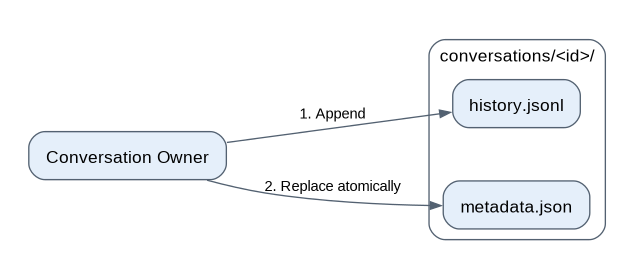
History, metadata and execution
Each history entry has a stable ID, parent ID and entry type. Original messages, submitted inputs, tool calls, available results and compactions share this history; each original is stored once. Metadata uses format version 3; history entries use version 1.
| Entry type | Stored information |
|---|---|
|
Original message; submitted input also carries its logical ID, kind, initial state, attachments and references, without another copy of its text. |
|
State change for an existing logical input, such as consumption or Recall. |
|
Observed process history and run updates. A new tool-completion event references its original result message through |
|
Accepted-action receipt for idempotency; input-backed actions reference their original through |
|
Summary, |
|
Opaque imported fields that are retained without becoming execution instructions. |
Parent links define ancestry independently of physical append order. Two branches can share earlier entries without copying them. The UI reads originals on the selected path; model context is a derived projection.
Metadata holds the title, timestamps and selected entry ID, not a second transcript. The native Conversation Owner serializes writes; views cannot replace history with their snapshots. Submitted inputs are saved immediately as user messages, even while waiting for an eligible model turn. Consumption and Recall change their status, not the identity or stored text of the original input; retain enough history to distinguish waiting, consumed and recalled input after reopening.
Active execution, task handles and unsaved outcomes remain in memory, without a separate pending-state file or durable execution journal.
An unsaved response suffix or draft may be lost after a crash.
Migration retains an existing draft as metadata legacyDraft; successful submission clears that seed so it is not restored as a new draft afterward.
Opaque history fields remain stored even when a private typed projection uses only known fields.
Write ordering and interruption
Append history before replacing metadata that references it. Write replacement metadata through a temporary file and atomic rename. If metadata publication fails, the previous selection remains usable; an additional history entry is retained, not rolled back. Retry must recognize an already appended entry by ID rather than append another copy or repeat an effect.
A regular-file append can be short or leave an incomplete final entry. Preserve the trailing bytes before repairing that append boundary; complete preceding history remains usable. Never append behind an unrepaired partial entry. Malformed complete entries, broken ancestry and unsupported formats fail explicitly rather than being skipped, overwritten or converted into empty history.
Use operating-system flush/sync facilities and distinguish accepted writes from durable acknowledgement. Flush completed history before replacing metadata; flush the replacement metadata file and synchronize its containing directory before durable acknowledgement. An explicit retry reflushes and recognizes the original entry IDs instead of repeating generation or effects. Disk-full, write and flush failures are visible save failures, not permission to continue effects as if saving had succeeded. A successful read-back alone does not establish durability after a failed flush.
Reopening does not automatically resume execution or replay tools. A saved call without an available result has an unknown outcome: it does not prove that no effects occurred. Later user-directed work can inspect current state, without guaranteed reconstruction, exactly-once execution or automatic external rollback. See REQ-0005.
Growth, references and format evolution
There is no fixed total conversation-size ceiling and no compaction-based file rotation.
Read incrementally and load older UI history on demand; continuing must not require keeping the entire tree in memory.
An opaque owner-held ConversationCache shares only ephemeral lookup hints across freshly authorized storage operations; it retains no workspace directory or access guard.
The index uses a private anonymous temporary file, fixed hash heads and a bounded hot cache; cold ancestry traversal spools offsets, not payloads.
Each index retains at most 1,024 hot nodes and the shared cache retains at most eight conversation indexes. Hints are bound to the held directory, workspace scope and history file identity/length/modification time.
Missing, inconsistent or corrupted hints rebuild from history; they cannot establish that an entry or action is absent.
This cache is neither a history authority nor portable workspace data and is not backed up or synchronized.
The read_conversation tool captures selected ancestry and input/run eligibility in a rewindable offset spool.
It releases storage/cache locks before hydration, reuses the spool for chronological serialization, and verifies revision and file generation before returning UTF-8 byte windows.
Compaction does not bound history bytes or individual results.
Structured content references remain workspace-relative in storage. Native readers bind them to the authorized local workspace session without rewriting their selectors or embedded user text; see Git-derived file references. Attachments retain their existing durable identities and storage boundary. Native presentation reconstructs attached text and image references from the saved input without adding resolved payload copies to history. Credentials and operational AI settings remain device-local, outside portable conversation history.
Migration 2 converts published version-2 conversations through the existing workspace migration runner, not a second backup or activation protocol. It inventories unopened conversations too, validates their converted data and uses the runner’s whole-chain recovery backup before retiring the old authority. Under the specific ADR-0016 compatibility exception, converted workspaces require app 0.1.6 or newer; there is no dual writer or reverse conversion. Rejecting an unsupported format does not establish mixed-version compatibility. A minimum-version field cannot make apps predating the compatibility gate refuse safely; those binaries are unsupported for migrated workspaces. Former Pi prototype files are not the published v2 input format and are not implicitly imported.
8.3. Conversation context and compaction
The native Conversation Owner derives model context from one ancestry path in conversation history. Native adapters supply current instructions and tool schemas through Model Access. Neither a model request nor a frontend snapshot is another history authority. This supports REQ-0004 without rewriting originals.
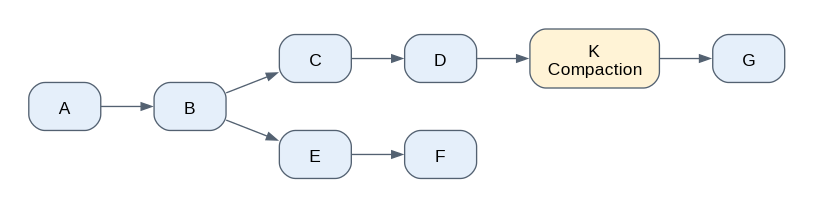
K summarizes A and B and retains originals beginning at C (firstKeptEntryId).
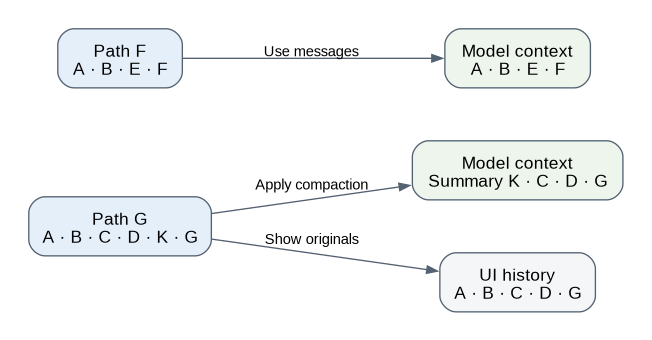
Branch-relative selection
Follow parent links from the selected entry to the root.
Use only the latest compaction on that path: its summary, pre-compaction entries beginning at firstKeptEntryId, then later entries.
A compaction before which a new branch diverges cannot affect that branch.
The ID boundary can refer anywhere on the selected ancestry path; it is not a file offset or mutable message count.
Keep complete tool-call/result groups in the recent suffix. The latest active user request remains verbatim even if it precedes that suffix. Waiting or recalled inputs remain visible history but do not enter a main model request until selected for consumption. System instructions and tools are assembled separately from original user and assistant content.
Masking and summarization
Context preparation may mask older large successful outputs of recognized repeatable observation tools, such as reads, listings and searches, and replace older tool images with omission notices. Failures and action receipts are not text-masked; an omission must not imply that an effect should be repeated. Masking never alters the stored original.
Estimate the budget using messages, current instructions, tool schemas, image allowances and an output reserve. This is not an exact provider tokenizer or an acceptance guarantee. If needed, summarize older originals in bounded chunks with the previous applicable summary. Compaction uses summary-specific instructions and no tools. Preserve the active request, decisions, file identities, observed effects, uncertainty and open questions; source content is data, not executable instructions. Attachment references remain references; inline images become placeholders.
Compaction publication
Append a compaction entry only for a normally completed, nonempty summary with no tool calls. Select its context only after successful saving. Failure or cancellation leaves the previous usable context selected; compaction can be attempted again without replaying tools. A complete entry left behind by a failed metadata update remains history, not a reason to delete or rewrite older entries.
Input arriving during compaction is saved as ordinary submitted input but does not join the summary request or an already prepared main request. See Conversation input, Stop and Recall for consumption and Recall. Compaction bounds model context only; file growth and incremental history access follow Conversation storage and overwrite protection.
8.4. Document rendering and resource boundaries
Documents are data, not trusted plugin templates. The Rust Markdown renderer escapes raw HTML as text and hides HTML comments, including task metadata, without changing the source. The Vue reader filters the generated HTML to passive elements and attributes and inserts it without compiling document content as a Vue template. Reading plugin source through the file view likewise does not activate that code; plugin execution has a separate trust boundary. See the Rust renderer and the Vue reader.
The native file host resolves local image resources within the workspace; historical document views read local images from the selected Git revision, not the current working files.
Plugin source inspection instead resolves local images within that plugin’s code/ directory, not its sibling configuration or data directories.
Internet-hosted images are fetched automatically for display without an approval prompt or a per-domain permission gate.
Rendering can therefore contact remote image hosts; remote images are not guaranteed to be available offline or preserved by the document’s historical revision.
These resource rules are implemented in the native file host and follow REQ-0042.
Display and model processing are separate flows. Sending a document reference to a model resolves its source text without fetching linked images; displaying those images does not implicitly include their bytes in the model request. See native conversation input resolution.
8.5. Portable writes and provider reads
New writable content paths follow a stricter naming policy to reduce portability problems, including rejection of control characters and trailing dots or spaces. This is not a complete cross-filesystem compatibility guarantee; reserved names and other filesystem-specific restrictions still apply. Provider reads have a separate policy: existing provider filenames need not be renamed merely because they would not be accepted for a new portable file. Both policies exclude traversal and technical workspace internals.
Path validation does not grant access to a workspace or replace operating-system permissions, native handle validation or symbolic-link protections. Shared fixtures define the expected distinctions for Rust, Swift and Kotlin adapters. They support consistency checks but do not prove real device permission or provider behavior. See path contracts and Client package boundaries.
8.6. Git-derived file references
A live file reference selects current content through an original workspace-relative path and a Git commit anchor. Confirmed Situate-managed moves determine the file’s current path; the anchor does not freeze its bytes. Markdown and other files use this same model, without embedded file UUIDs. Task UUIDs remain separate.
C1: reference selects Documents/report.pdf
C2: confirmed move Documents/report.pdf -> Archive/report.pdf
C3: content update at Archive/report.pdf
Result: current content at Archive/report.pdf, not the C1 bytes
Status: implemented in the core and host; native macOS qualification remains separate; iOS is deferred. ADR-0010 establishes Git-owned history and cache-free reference reconstruction. ADR-0012 extends the model to Markdown and removes embedded file UUIDs. Stored selectors and runtime authorization have separate boundaries, described below. The product boundaries are history and interrupted operations, live and historical references, identity and portable workspaces.
Storage and reconstruction
The resolver reconstructs reference continuity from versioned Git operation records, without an independently authoritative journal or persistent reference cache. An operation first records a durable boundary commit describing its expected effects. Only a validated immediate child can record its completion. Workspace opening records an interrupted observation when a boundary has no valid completion, without continuing its filesystem effects.
History records define the Git facts; lineage reconstruction validates their ancestry and resolves anchored paths. Tree validation checks declared effects using Git tree IDs without writing objects during reads. The live-reference module captures references and reads their selected text; the structural-operation module owns writes and explicit reversal. The text-write module applies the same boundary/completion protocol to text saves, conflict resolution, creation and draft restoration.
Confirmed structural history is authoritative only in Git. It does not remove retained drafts, conversation persistence, operating-system authorization, ordinary file-write staging or explicit user-requested reversal.
Ownership
| Owner or data | Responsibility |
|---|---|
Core Git history |
Retained content snapshots, explicit confirmed operation records and any durable continuity facts needed for reference reconstruction. Record interpretation belongs to the core, not to a synchronization transport. |
Working files |
Current content, including uncommitted or externally edited bytes. Git authority over confirmed history does not make the working tree identical to the latest commit. |
Core write path |
Authorize through the host, check current preconditions, secure the prior version, perform bounded safe writes, publish matching Git state and operation metadata, and distinguish complete from partial/uncertain results. |
Reference resolver |
Read and validate Git history and stored anchors; compute a current target, known deletion or unresolved result without mutating content or repairing history as a side effect of reading. |
Optional derived cache |
Accelerate the same computation. It is disposable and scoped to the admitted workspace, selected Git head, supported history/metadata format and resolver version. It must not hold the only continuity barrier or operation record. |
UI and agent callers |
Consume explicit outcomes and unresolved references. Do not infer success from a timeout, bind a stale reference by path, or retry interrupted mutations automatically during restoration. |
Native filesystem/provider adapters |
Provide supported file operations and permissions. They do not independently infer move history or own reference identity. |
A copied workspace may share its Diagnostic Workspace Identifier and Git history with another local copy. That identifier correlates diagnostics; neither it, a cache key nor a reference grants access to the other copy. Each copy retains its own Runtime Workspace Binding: association with an authorized local workspace session. Independent working-tree changes remain separate.
Authoritative commit facts
A completed structural-operation record and its result tree must belong to the same published Git commit.
The record must identify the operation and the affected portable paths sufficiently to distinguish moves, copies, deletions, restorations and path reuse.
Folder operations must cover descendant paths using path-component boundaries, not arbitrary string prefixes.
Structural facts distinguish moves, deletions and creations. Copies and restorations create a path lineage rather than transferring or reviving an old file reference; the history summary identifies the user-facing action. A write operation changes or creates one regular file at path; it neither moves a reference nor revives a previously deleted lineage.
A createBatch operation lists new regular-file destinations under existing parents. Its shared boundary and completed result must describe exactly those creations, excluding unrelated external changes. It does not transfer existing path lineages or promise atomic file publication across destinations.
The writer validates that the recorded effect is consistent with the relevant parent/result trees and the operation it actually performed. A partial reference rewrite, failed Git reference publication or conflicting external change cannot be relabeled as a fully completed operation. A whole-workspace snapshot may also contain unrelated external edits; the record must delimit the operation’s actual effects rather than attribute every tree difference to Situate. Detected external changes require separate history entries under REQ-0022, not merely a label inside the operation commit. If the effects cannot be separated safely, the writer must preserve the uncertain result rather than assert a fully attributable completion. Unreferenced Git objects and a prepared intent are not a published successful result. Git reference publication can precede a failing final history flush, so a reported history failure does not prove that no result commit is reachable. The writer and restart reader must distinguish failure before Git reference publication, a visible result whose durability has not been acknowledged, and a corrupt/unverifiable result, without repeating the file operation. Metadata is validated data, never executable instructions; unknown versions, malformed paths or conflicting records must not be silently ignored where they could change a reference target.
Git’s rename detection, equal blob hashes and matching filenames are not identity evidence on their own. Two PDFs can share bytes while remaining separate documents. Direct modification of internal history by other Git clients is not a supported editing interface; ordinary external content editing remains supported.
Commit format
Commit messages contain a human-facing summary followed by \n\nSituate-History: ` and a version-1 JSON envelope. `parent_tree and result_tree must match the actual Git trees; unknown fields, versions, malformed paths and noncanonical object IDs are rejected. Public history replies expose the validated summary, not this envelope.
| Fact | Meaning |
|---|---|
|
An independently observed content snapshot. |
|
Managed state without declared structural identity semantics, including the initial snapshot. |
|
A durable, same-tree pre-operation boundary. It records a |
|
The actual sole parent is the named boundary commit, and the result tree matches that boundary’s validated effect. Only this immediate child can complete the boundary. |
|
Observed state after an unmatched boundary, with uncertain provenance. It is recorded even when the content tree is unchanged. |
Boundary commits cannot be captured as live reference anchors or selected as reversible changes. Public history omits them while retaining interrupted observations. A later completion cannot bypass an intervening observation or interruption to close an old gap.
Reference anchors and reconstruction
At runtime, a live file reference, including Markdown, contains a workspaceId supplied by the Runtime Workspace Binding, the original path and an anchorRevision: a canonical lowercase 40-character Git commit ID. There is no fileId selector. Historical references retain revision instead.
The anchor must describe the selected file: reference capture must establish that association under the content-store boundary and recheck the caller’s expected saved version.
It must not blindly attach the current HEAD to an uncommitted file at a reused path. The existing blob/content-based expected revision is a concurrency precondition, not the Git commit anchor; the two must remain distinct in contracts.
Capturing a new selection is not an automatic rebinding operation for a stored reference.
The anchor starts forward interpretation of confirmed structural changes; it does not freeze the displayed content at that revision. An explicit historical reference still selects its exact revision and path. Markdown and other files use the same anchor and continuity rules, without embedded file IDs or a global file-ID registry. Task UUIDs remain separate and unchanged. No PDF modification or binary-to-text conversion is introduced.
A copy does not transfer an existing reference from the original to the copy. Confirmed deletion terminates the old path lineage; a later creation at the same pathname does not revive it. Restoration creates a new file lineage and does not reactivate old live references. A new explicit selection can reference the restored file. Historical access remains available, and restored task IDs retain their separate identity semantics.
Reconstruction must handle history order explicitly, not by timestamp order or an arbitrary walk through a Git DAG. Missing anchors, incomplete/shallow history, replaced ancestry, unsupported merges, ambiguous records and applicable continuity gaps yield an unresolved/unsupported result rather than a guessed path. The supported traversal is linear. Merge commits, shallow repositories, replacement refs and grafts are rejected rather than selecting an arbitrary parent; synchronization transport cannot pick a semantic winner. Even a historically resolved path still requires current workspace authorization, path checks and availability validation before reading or opening its contents.
The defining invariant is that, for the same retained history and reference, cached and cache-free resolution agree. A fresh process receiving only a closed workspace’s authoritative data can reproduce the result without another device’s cache or filesystem inode numbers. Requests are bounded by 10,000 commits, 16 MiB of commit metadata and 100,000 changed-node work units. The work counter does not include every unchanged sibling entry inspected or hashed; it is not an aggregate entry-scan or execution-time guarantee. Each envelope is limited to 64 KiB; tree expansion and individual tree objects have separate depth, entry and byte limits. Exceeding a limit fails explicitly, never returning a partially resolved target. These limits are safety bounds, not performance acceptance measurements.
Workspace opening and Operation Admission for writes validate the current published Git state rather than replaying the entire history. Operation Admission accepts a validated request for execution; it is not a completion or durability acknowledgement.
Normal write flow
-
Validate the request and current source/destination state under the existing workspace ownership and operation-serialization boundary.
-
Durably retain the relevant pre-operation content and publish a same-tree boundary with the exact expected result before file publication exposes changed destination bytes. Failure before that synchronization leaves the mutation unstarted.
-
Perform safe filesystem changes and supported reference rewrites. Retain no-clobber, concurrency, path, permission, bounded-staging and synchronization guarantees.
-
Validate filesystem postconditions and publish the matching result tree as the immediate completed child of the boundary. Separable external changes receive a subsequent independent observation. Acknowledgement follows the existing durability boundary, not merely commit-object creation.
-
Report completion. A failed acknowledgement does not turn a durably committed operation into an instruction to run the mutation again; reads reconstruct from Git.
Text-file publication pins the staged file identity and rechecks replacement sources after flushing the boundary commit. It verifies the published bytes, identity and mode through the current root-relative path. Creation and draft restoration retain no-clobber file publication. Failure after file publication retains the draft and reports the history/partial outcome. An unchanged save first settles prior pending evidence, verifies its retained Git association and current file identity, and synchronizes the file, parent directory and history before draft cleanup. It neither renames the file nor creates an empty action; cleanup failure remains distinct from history durability failure.
Known references follow confirmed moves whether or not their conversation or view is currently mounted. This does not require rewriting every conversation for each move, changing its compare-and-swap revision, or loading every UI view.
Interruption and uncertainty
| Boundary | Restart behavior |
|---|---|
Before mutation |
The secured prior state remains usable. Do not start the abandoned mutation automatically. |
After some filesystem changes but before a confirmed result commit |
Preserve the working files and retained prior history. Do not infer a successful move from a diff, complete remaining reference rewrites, or reset the workspace to |
After Git reference advancement but with failed or uncertain final synchronization |
Inspect and validate the retained history and preserve the partial/uncertain acknowledgement state. A valid reachable result may already describe the completed filesystem effects; never replay them merely because the caller received a failure. Do not trust an incomplete or invalid commit as continuity evidence. |
After a durable result commit but before acknowledgement |
The Git result remains authoritative. Rebuild derived state without repeating the filesystem mutation. A later explicit retry rechecks the actual source and destination. |
After a committed result but before or during cache update |
Discard or repair only derived cache state from Git. No content replay is needed. |
An absent completion record does not prove that the filesystem was untouched.
A path can disappear and later be reused after an interrupted operation; uncertainty must survive subsequent history recording rather than silently rebinding an old reference.
Any durable continuity boundary affecting future resolution belongs in Git and must survive cache deletion, copying and restart.
The Git boundary itself detects unfinished work; there is no sidecar intent signal. Affected references crossing an unmatched boundary report uncertainty, not a confirmed deletion. This includes an unmatched write at the selected path, even with equal bytes or failure before file publication: a detected replacement cannot safely be forgotten after restart. A validated immediate write completion preserves ordinary live continuity. Before a new capture or mutation, the writer durably seals an unmatched head boundary with an interrupted observation. Resolution alone never performs this write.
If that observation cannot be recorded durably, capture and mutation remain unavailable. The original boundary continues to protect earlier references. An explicit new selection after sealing can capture a new anchor, but cannot repair older references implicitly.
Newly observed changes may be preserved in history without guessing their origin. An interrupted Situate operation must not be confidently attributed to an external editor merely because its normal completion record is missing. Safe reads, retained drafts and explicit manual history recovery remain available where their own preconditions hold. An explicit retry is a new operation against current state; it may report a missing source, an occupied destination or a conflict instead of repeating an old plan.
Unsupported development formats
The original unified-format replacement excluded data migration, backward-compatible readers and imported legacy bindings only for formats never shipped publicly. Situate is now publicly available; changes to published reference and history formats follow REQ-0069, including mixed-version data preservation and tested migration where needed. Queued inputs, drafts, stored runs, restored views and unopened conversations use the same file-reference model. File-ID enrichment, protected file-ID editing, file-ID resolution and UUID-filtered file history are not part of that model; task-ID handling remains separate. There is no journal or UUID fallback. The linked ADR-0012 and development plan describe the replacement scope; verification uses fresh synthetic workspaces, with obsolete development fixtures recreated separately.
The new format still requires explicit validation and conversation compare-and-swap protection.
Reject unsupported records instead of treating an epoch as a Git revision, recapturing a path or replacing unreadable data with empty state.
Unsupported development workspaces remain unchanged: no conversion, metadata cleanup, history rewriting, reset or deletion on format mismatch. An existing situate-id frontmatter field is ordinary user metadata, not a legacy identity to import. Fixture recreation is a separate, explicitly scoped development action.
The no-migration exception is limited to formats verified never to have shipped publicly; it does not waive upgrade verification or migration requirements for supported published formats.
Stored-reference portability
Structured references in conversation drafts, queued inputs, stored runs and built-in file-view presentation are stored as workspace-local selectors: kind, relative path and either live anchorRevision or historical revision. They contain no workspaceId. The containing workspace directory determines their owner; copying or moving that closed directory carries the selectors and their Git history together.
Native storage supplies the Runtime Workspace Binding when returning these selectors to callers. The wire API retains workspaceId and rejects foreign-scope writes and resolution requests. Layout projection includes every navigation entry in open and closed tabs, not only the mounted view. Binding preserves anchors, stored bytes and compare-and-swap revisions; it does not capture another source, rewrite paths or select a different workspace by identifier. Independent copies can resolve and evolve against their own files and history even when their Diagnostic Workspace Identifiers match.
Only the known structured reference fields are projected. User messages, tool/event data and opaque plugin presentation remain unchanged. Malformed selectors, duplicate owned fields and older stored references containing workspaceId fail closed rather than being converted or replaced with empty state. Existing interrupted-run recovery remains a separate operation that can legitimately persist a state change. The portable Diagnostic Workspace Identifier never selects or authorizes another copy.
Implementation and verification boundaries
The PDF example concerns path continuity and history, not a new PDF text-extraction or chat-attachment capability; test binary identity without assuming the current UTF-8 document API can read it.
Removing witness-based reconciliation does not remove every use of hardlinks, prove Android no-replace compatibility or authorize weaker file publication. Native macOS checks must establish the operations used on active product storage paths. iOS, Windows, Linux desktop and Android remain deferred; shared or browser tests do not qualify them. Provider-backed read-only access, ordinary editor draft restoration, Git durability fences, diagnostics privacy and the separate device-local log store are unchanged.
8.7. Filesystem durability and flush failures
Content saves and Git history writes must distinguish visible changes from acknowledged durable results. Here, filesystem synchronization means flushing local files and directories; it is not workspace transfer through a Synchronization Transport. A successful content write followed by a history flush failure must not be reported as a complete save; see Git-derived file references for partial and uncertain outcomes.
Directory synchronization uses held filesystem capabilities rather than reconstructing their original absolute paths.
Standalone directory synchronization clones the held directory handle and calls sync_all().
History synchronization on macOS and iOS batches files and directories: each held descriptor receives fsync, then one retained descriptor per filesystem receives sync_all() (F_FULLFSYNC).
The final barriers cover the preceding file and directory flushes; an unfinished or failed batch does not establish durability.
Filesystem identities come from held descriptors, so mounted child filesystems retain their own barriers.
Other platforms retain individual sync_all() calls.
Git object creation uses the repository’s core.fsyncObjectFiles setting to flush object bytes before file publication.
Existing immutable objects are reused without reopening them for a new file flush.
Before Git reference publication, the core finishes the object-directory synchronization batch; afterward it finishes a separate batch for repository control files and directories.
Control files are opened relative to held directories without following symbolic links.
Acquisition, member-flush and final-barrier errors remain failures.
Initial history is created in a staging directory, then published as .situate/history.git before the containing .situate/ workspace marker directory is flushed.
Opening an existing writable history first completes its recursive synchronization batch, including retained objects written by older versions.
Opening a writable workspace also flushes that marker directory, even when the history repository already exists.
This is an initialization durability fence: a repository made visible by an interrupted publication is not treated as durably initialized merely because it exists.
A failed marker flush fails the open rather than acknowledging completed initialization.
See directory flushing, Git object and reference publication and history file flushing.
These are implementation mechanisms, not formal power-loss qualification or a guarantee against physical storage damage. Native macOS verification must cover the active storage paths. iOS qualification is deferred. Read-only provider access does not gain write support from these mechanisms.
Deferred-platform constraints
Windows, Linux desktop and Android remain deferred product targets.
Their existing implementations have additional handle and filesystem constraints; shared tests do not qualify these platforms.
Linux directory capabilities opened with O_PATH are reopened relative to the held handle before fsync.
Windows directory flushes also acquire a writable handle relative to the held capability; open and flush errors remain failures.
On Windows, a new writable flush handle cannot be opened for a file carrying the READONLY attribute.
The history-file flush helper rejects such files without changing their attributes.
Attributes belong to the file object and affect every hardlink alias, including aliases outside the history directory; checking the link count cannot prevent a new alias from being created concurrently.
Writable history files are flushed through verified, held handles, and acquisition or flush errors remain failures.
Immutable Git object reuse avoids both reopening the object for a flush and libgit2’s freshening behavior, which can clear READONLY.
A read-only immutable object therefore does not by itself make history flushing fail; a control file that cannot be flushed still causes failure.
During directory moves, Windows reference patches retain file-ID handles rather than relative-open readers, which can prevent ancestor renames. The original reader remains pinned until the new handle’s regular-file type, volume and complete 128-bit identity have been verified; later patch checks also compare the complete identity. Only changed files inside the moved subtree use this mechanism. If the filesystem does not support it, patch preparation fails before the directory is renamed.
8.8. Encrypted Git synchronization proposal
Status: proposed mechanisms supporting ADR-0015, which proposes client-encrypted incremental Git packs. Neither the transport nor this concept is an implemented service or finalized protocol. Cryptographic construction, data reconciliation and native macOS feasibility remain unverified; iOS investigation is deferred.
The governing requirements are REQ-0013 and REQ-0008. They require operator-independent content encryption, local availability and initial replication of workspace content and retained history. Connected external document originals need not be copied into the workspace. This proposal does not establish pricing, storage packages, service levels or a deployment provider.
Transport direction
ADR-0015 records the proposed transport choice, rationale, alternatives and decision limits. Clients would exchange Git packs encrypted after compression and encrypted indexes for object lookup and dependencies; the service would manage ciphertext, authorization and publication without interpreting plaintext Git history. The Application Core continues to own validation, merging and recovery for every transport through Sync Transport. The following mechanisms remain proposals rather than consequences already settled by that transport choice.
Proposed transfer model and protection boundaries
An encrypted manifest would bind the required repository roots and supported state exports into one synchronization revision. This is a transfer-consistent selection, not one global Git commit or proof that all component states are semantically consistent. The synchronization head would identify the service’s currently published revision, not a device’s working files or its currently displayed conversation branch.
A candidate publication model is to finalize immutable ciphertext durably before conditionally advancing that head. The update would check the expected prior head and workspace authorization state, and retain a publication identifier to reconcile a lost reply without creating a second publication. A rejected update would leave local edits intact and require another reconciliation. Downloads would be authenticated, decrypted and validated on the receiving device before integration. Exact record formats, transaction boundaries, transfer resumption and cleanup ordering are not settled.
The following boundaries constrain that design:
-
Content keys and plaintext stay on authorized devices, separate from the Situate AI Router’s authorized model-processing flow. Encryption does not hide account relationships, transfer sizes or timing, and does not protect plaintext from a compromised endpoint or malicious trusted plugin.
-
Device grants apply to individual workspaces; account recovery covers the account’s officially synchronized workspaces. Account login alone must not unlock content. Enrollment, revocation and recovery replacement must preserve this separation without operator key substitution.
-
Device-local AI Settings, provider credentials, diagnostic logs and device/session diagnostic identifiers are not portable content. The portable Diagnostic Workspace Identifier is for correlation, not service authorization or a Runtime Workspace Binding.
-
Git-owned operation facts and stored reference anchors must survive transfer under Git-derived file references, ADR-0010 and ADR-0012. Resuming data transfer must not replay, finish or roll back interrupted working-file mutations.
-
Receiving plugin code does not activate it. Same-version source divergence, data migration and checked activation retain the boundaries in REQ-0033.
Synchronization operates only while the workspace is open, subject to platform limits. Durable service acceptance would not mean that every device has received or integrated the revision, or that a separate backup has completed. The service cannot verify encrypted Git dependency closure or a client’s claimed uncompressed content size independently; signatures identify a declaration’s author, not its truth.
Conversation-tree reconciliation candidate
A candidate model for independently continued conversations is to retain both continuations as branches of one conversation tree, rather than overwrite one or invent a sequential order between them. The same representation could support deliberate branching from an earlier conversation point under REQ-0022.
For example, two devices might continue a shared travel-planning conversation by independently comparing trains and hotels. Both paths would retain their common prefix and their own subsequent messages and recorded actions. Choosing a conversation branch would select conversational context, not restore a separate workspace snapshot. File changes remain shared workspace changes, and already performed external effects cannot be deduplicated or undone merely by combining conversation records.
This is not yet a selected reconciliation algorithm or a completed UI decision. Stable branch ancestry, divergence detection, draft and queued-input handling, active-run ownership, branch presentation and interaction with the workspace-wide conflict pause remain open. Local numeric record revisions alone do not establish shared ancestry. The current requirement to continue on another device at a completed turn does not require live run migration or simultaneous processing of one conversation under REQ-0011.
Design risks and required evidence
The main uncertainty is local integration and recovery, not ciphertext storage alone. Reusing Git’s representation does not establish correct cross-device reconciliation, secure key provisioning or production readiness.
| Concern | Concrete gap or failure case | Evidence needed before relying on the design |
|---|---|---|
Merge-aware history and file references |
The current commit writer and history validator reject multiple parents. A managed move on one device and an edit on another need more than a text merge to preserve anchored references. |
A core prototype covering both parents' confirmed operation facts, divergent moves, deletion/path reuse and interrupted integration. Neither arbitrary parent selection nor guessed continuity is acceptable; safe refusal alone does not satisfy supported cross-device reference continuity. |
Conversations, settings and plugin state |
The conversation store uses local compare-and-swap revisions. Two devices can reach the same counter with different content. A stable export also does not prove that plugin code and data are compatible. |
An export inventory with owner, ancestry/base, dependencies, reconciliation rule and import checkpoint. Demonstrate completed-conversation continuation, settings and plugin code/data consistency without a universal semantic-conflict engine. |
Account recovery and device grants |
A device connected only to workspace A cannot use A’s grant to rewrap workspace B’s keys. Concurrent workspace creation or key rotation can invalidate an earlier inventory during recovery-key replacement. |
A reviewed enrollment/recovery/revocation state model, completeness checks against a defined account state, replay and race tests, and independent cryptographic review. New-device freshness without a trusted checkpoint needs an explicit threat-model limit. |
Mobile pack and index growth |
Small edits can accumulate many packs, large indexes and external delta dependencies. Full initial replication includes earlier attachments. |
Compare bounded self-contained incremental packs with thin packs using synthetic histories on macOS; mobile measurements are deferred. Measure memory, temporary disk use, transferred bytes, index growth and interruption recovery before fixing limits. Thin packs and later pack compaction are optimizations, not prerequisites. |
Resource abuse and service economics |
Encrypted logical-size declarations cannot bound physical storage, abandoned uploads or transfer costs, including with modified clients. |
An abuse model, bounded reservations and server-observable safeguards, with cost estimates including staging, backups and mediated transfers. Any customer-visible limits or service commitments require a product decision rather than silently redefining an allowance. |
Publication, deletion and backup restoration |
A cleanup job could delete staged data while publication references it; restoring older metadata could reactivate a deleted server copy. |
Fault-injection tests for payload finalization, conditional publication, lost replies and cleanup races. Define deletion records that survive database rollback and verify restoration before enabling access. Backup retention, acceptable data loss and restoration time remain undecided. |
Released-format compatibility and decision boundaries
The protocol must integrate with Workspace compatibility and migrations, not create a second migration authority. Local synchronization starts only after the opening gate succeeds; incoming data must be checked before incompatible processing or writes, including when a workspace is already open. Migration recovery archives, locks and temporary artifacts must not be transported as ordinary workspace state. Local recovery is not a distributed lock and must not roll back another device’s edits.
Persisted-format changes follow REQ-0069, including supported mixed-version preservation, tested migrations and any explicitly approved format-specific exception. Plugin interfaces retain their separate policy under REQ-0070. Neither policy establishes a service API lifetime or indefinite migration-chain retention.
Before a detailed implementation commitment, resolve merge semantics, the export inventory and reconciliation rules, and the account recovery model. Prototype measurements should inform pack, chunk and dependency limits; deployment and storage choices must support the resulting durability contract. Changes to user-visible conflict behavior, supported scope, customer limits, spending or recovery commitments need a product decision. Cryptographic security, native feasibility and restoration correctness still need evidence after a design is chosen.
Technical references
-
Git pack transfer protocol: ordinary server-side object negotiation and pack construction.
-
Git pack format: compressed objects, delta representations and dependency constraints.
8.9. Native AI execution and browser dependencies
Conversation execution runs in the native host, where situate-agent embeds Rig.
The Conversation Owner retains execution state and persists outcomes independently of frontend views; the frontend displays its projections rather than running the agent loop.
This replaces the former browser-based Pi runtime, not merely its code-loading strategy.
See ADR-0013 for the decision and Agent Integration: Native conversation execution for ownership and interfaces.
The owner requests model work through Model Access, an internal capability supplied by native host adapters. Those adapters retain credential custody and implement Provider Transport: communication with the selected model endpoint. Neither frontend code loading nor view attachment changes workspace authorization or which conversation data a request may send. Native execution does not imply local model weights or offline model availability.
The production build still rejects Node-only dependencies in browser output. The initial frontend bundle can include AI settings and other interface code; there is no claim that all AI-related code is deferred. The Initial JavaScript budget measures frontend JavaScript, not the native Rig runtime or model weights. See frontend conversation projections and browser dependency checks.
8.10. Initial JavaScript budget
Production frontend builds measure the JavaScript needed by their entry points, including shared static dependencies once and excluding lazily loaded chunks. They also report the total emitted JavaScript size. The initial code must stay within the uncompressed budget defined in the bundle check; exceeding the gzip threshold produces a warning without failing the build.
The uncompressed budget is a coarse safeguard against unexpected code growth, not a measured startup-performance limit. It requires deliberate review when legitimate functionality changes the startup cost; exceeding it fails the production build rather than removing code or features automatically. The gzip size is informational for the locally packaged macOS and iOS applications, whose startup does not require downloading frontend assets over the internet. They do not constrain workspace content, conversation length, model size or the whole installer. The report follows static imports only; dynamic imports triggered during startup are not included in the initial graph. Smaller initial code is a useful performance safeguard, not a measurement or guarantee of startup latency; first use of a deferred feature can incur additional loading work. Changes to loading boundaries should be evaluated against native startup and first-use measurements, not gzip size alone.
8.11. Client diagnostics
Status: accepted design with a local client implementation; production plugin integration and device-specific verification remain separate. ADR-0008 records the collection architecture. ADR-0009 replaces its user-identity and launch-local workspace-alias choices with the portable Diagnostic Workspace Identifier. This random value correlates diagnostics across devices and workspace copies. GOAL-0006 and REQ-0064 through REQ-0067 govern coverage, replacement, retention and data limits. An initial 256 MiB installation-wide log limit, asynchronous logging that does not interrupt application work, no application-level log encryption, and separate workspace, device and session correlation identifiers are confirmed constraints. The implementation uses the resource limits below. They are safety bounds, not measured optimal settings or real-time guarantees.
Ownership and boundaries
Use one application-owned diagnostic event contract, with JavaScript and Rust bindings, rather than expose a vendor SDK throughout the client. The JavaScript binding supports plain JavaScript plugins; TypeScript declarations aid host development but are not a plugin-authoring prerequisite. The native host owns the collector, destination selection and the sole local-file writer. Log storage operates at installation scope, including startup before a workspace opens, and does not use workspace storage or Git history. The Diagnostic Workspace Identifier is portable metadata supplied when the host opens and validates a workspace; consuming it does not make log files workspace content. The Runtime Workspace Binding instead associates a request or loaded record with an authorized local session. The Device-local Workspace Namespace associates local AI settings with a workspace location; a diagnostic identifier is not that credential namespace. Initialize native collection before workspace restoration and plugin loading; a producer awaiting host readiness retains only its bounded local queue.
| Boundary | Responsibility |
|---|---|
Application, Agent Integration and native operations |
Emit semantic events at interaction and operation boundaries. Preserve causal context when crossing asynchronous or frontend/native boundaries; do not pass whole application objects to the logger. |
Shared UI components |
Accept an injected interaction-recording capability or expose semantic actions to their owner. Do not import application internals, Tauri or a destination SDK. The application supplies content-neutral action identifiers. |
Plugin Runtime and SDK |
Bind a logger to the plugin’s origin, version and workspace context. Plugins emit through the same contract and constraints as built-in code; they do not select log files or destinations. |
JavaScript binding |
Validate allowed event fields, add producer sequence and timing, and enqueue bounded batches. Browser tests and the workshop can inject an in-memory destination without loading the native host. |
Rust collector and writer |
Revalidate incoming batches, attach host-owned context, assign receipt order, enforce queue and disk bounds, filter destinations and serialize file writes. Native operations enter the same collector without round-tripping through a WebView. |
Future destinations |
Consume validated events behind the collector boundary, with their own filters and bounded delivery policy. An unavailable destination must not block local recording. No external destination is implemented initially. |
Core code depends on the diagnostic contract, not Tauri handles or file paths. The host composes the implementation and provides the appropriate binding to core operations. One logical API does not mean importing one language-specific library everywhere. An internal no-op implementation supports isolated tests and unavailable logging; it is not a user-facing runtime setting.
The native bridge composes the collector before workspace restoration; the frontend facade starts before mounting the application.
Frontend batches contain at most 64 KiB of UTF-8 bytes, checked before event deserialization. Desktop and iOS deliver raw bodies; Android delivers Tauri’s JSON array of byte values because its IPC transport does not support raw bodies. Only arrays of at most 65,536 integers in the range 0–255 are accepted on that path; structured event objects and other JSON representations are rejected. Tauri parses the transport envelope before command dispatch, so this limit does not bound framework-level JSON parsing. Both transports use the same event validation and window/session authorization.
File, model, tool and OpenAI browser sign-in requests carry optional diagnostic context separately from their authorized application request.
OpenAI browser sign-in records operation.progress with component=openai_login: allowlisted stages and error codes distinguish the callback, token exchange, identity verification, grant validation and connection persistence. HTTP status is recorded without URLs or response bodies; checkpoint durations are elapsed milliseconds since the operation began, not individual request durations.
The dependency direction follows current client package boundaries.
The production Plugin Runtime and its logger injection remain part of the broader unimplemented plugin integration.
Event contract and causality
Use versioned structured events and UTF-8 JSON Lines on disk: one complete JSON object per line. There is no arbitrary message string or unrestricted object field in the standard API. An event catalog defines each event’s identifier, level, category and allowed attributes; both language bindings validate the same contract using shared fixtures. Changes that reinterpret existing fields require a schema version change rather than silently changing their meaning.
| Fields | Meaning and limits |
|---|---|
|
Contract version and catalog-defined event semantics. Built-in identifiers are static and independent of UI language or user content. |
|
Producer and native collector acceptance times in epoch milliseconds, producer-local order and collector delivery order. Delivery order is not proof of causal execution order. Wall-clock changes do not determine durations. |
|
The Diagnostic Workspace Identifier generated at creation and retained in portable workspace metadata, plus a device identifier generated once and retained locally. Synchronization, complete copies and restoration preserve the Diagnostic Workspace Identifier. Application events without workspace context omit |
|
Fresh random application-launch and producer identities. A restarted WebView has a new producer identity; the application’s session identity remains until application restart. |
|
Host-bound origin and build/platform metadata. Unix desktop versions describe the numeric kernel release; unavailable versions are |
|
Explicit causal context and whether work originates from a user, an agent or a background trigger. IDs are diagnostic correlation values, not authorization credentials or durable content identities. |
|
Monotonic elapsed duration, defined result state and event-specific validated scalars. No nested arbitrary payload, exception serialization or stringified object. |
A user action or independent background operation starts a trace; nested operations create child spans. Pass the captured context explicitly through promises, IPC requests, callbacks and plugin calls rather than keep one mutable global current operation. Concurrent actions in different panes or workspaces must not inherit one another’s context. Retries have distinct attempt spans; a completed write is not repeated merely because its diagnostic event is missing. Each IPC boundary validates correlation values separately from its existing window and workspace authorization. An event timestamp or caller-supplied workspace reference is not an access grant.
The host supplies the validated Diagnostic Workspace Identifier separately from the Runtime Workspace Binding and keeps plugin alias mappings in memory. Resolve the context before producer enqueue; do not temporarily buffer private names or paths for later redaction. Diagnostic Workspace Identifiers and device identifiers persist across application launches; plugin aliases remain launch-local. Plugin aliases connect load and execution events within a launch, but identifying a personal plugin after that launch may require separately supplied context.
Generate Diagnostic Workspace Identifiers and device identifiers randomly rather than hash a workspace path, email address, account name, serial number or hardware fingerprint. The host supplies them; producers cannot override bound workspace or device context on each event. Workspace creation persists its Diagnostic Workspace Identifier with portable metadata so every synchronization transport can preserve it without a user account. Complete copies and restorations keep that identifier; deliberately independent workspaces receive a new one without changing the original. An ordinary directory copy is not sufficient evidence of that intent. The explicit operation for making a copy independent remains undecided. Two local copies with the same Diagnostic Workspace Identifier retain separate Runtime Workspace Bindings; diagnostic correlation does not merge mutable state or grant access.
Keep device identity outside synchronized workspace state so copying a workspace does not clone a device identity.
Logging reads admitted context and never initializes or repairs workspace metadata as a side effect of emitting an event.
The portable document is .situate/workspace.json, containing only version: 1 and a canonical random UUIDv4 id, with a 1 KiB read limit.
When the host opens a writable native legacy workspace, it initializes missing diagnostic metadata once through exclusive file publication; concurrent opens retain the winning document.
Desktop and iOS adapters use hard links. The Android app-owned-directory adapter stages and synchronizes the complete document, then publishes that file through a descriptor-relative renameat2(RENAME_NOREPLACE) JNI primitive; it never replaces an existing target. This avoids requiring hard-link permission in the Android sandbox. Kernel, filesystem and seccomp compatibility remain platform constraints; bypassing the API-30 libc symbol does not establish runtime compatibility on older Android versions.
Read-only, malformed or unsupported metadata remains untouched. Workspaces without an available Diagnostic Workspace Identifier remain usable but do not receive workspace-scoped diagnostic producers.
Android document-provider workspaces without metadata cannot initialize the Diagnostic Workspace Identifier because the Storage Access Framework (SAF) has no exclusive named-create primitive. New provider workspaces receive metadata during creation under the existing provider trust boundary.
Legacy copies opened independently can receive different Diagnostic Workspace Identifiers before the metadata is transferred; diagnostics does not infer that they previously shared content.
Device identity survives while its local application data survives. Missing device metadata creates a new identifier; corrupt metadata disables diagnostic initialization without replacement. Reinstalling with retained application data retains identity; deleting that data does not.
Stable identifiers and activity sequences are pseudonymous, not a guarantee of anonymous data.
There is no user_id in the diagnostic contract and no account mapping or association of different workspaces with a person.
Levels and instrumentation
Use error, warn, info, debug and trace, with the default local threshold including trace.
Category selection is independent of severity.
Thresholds belong to implementation configuration and destination filters, not a user-facing settings control during a running session.
| Level | Use |
|---|---|
|
An operation fails or an unhandled failure is observed. Record a stable failure code and safe technical context, not an exception’s original message. |
|
Degraded operation, an expected retry, a detected interruption or known diagnostic loss. |
|
Application lifecycle, important operation starts, successful completion and ordinary user cancellation. A routine rejection without degradation also uses |
|
Selected technical transitions, attempt boundaries and internal decisions necessary to explain an operation. |
|
Individual control activations, navigation and fine-grained technical steps. Do not record pointer movement, text-entry keystrokes, DOM snapshots or every model-stream token. |
Instrument shared control activation with explicit static action identifiers, including pointer and keyboard activation, and record domain execution separately. Custom controls and plugin views need equivalent explicit instrumentation; a global DOM listener cannot infer their meaning safely. Do not collect labels, text content, CSS selectors derived from data, coordinates or rendered HTML. A control activation establishes intent, not successful completion. Navigation records a view type and causal context, not a private tab name, document title or route containing a path.
Record operation start and one observed terminal outcome, with elapsed time where available.
The boundary that owns an operation records its terminal outcome; intermediate layers propagate the result and context rather than log the same failure again. Nested operations retain distinct spans.
A user-requested cancellation is not an operational failure. A rejected operation with a conflict or availability error uses warn; a routine decision not to proceed is info.
Unfinished execution is an interruption, not evidence of user cancellation. An observed native unwind is a failure classified as panic; neither classification promises that a crash record reaches disk.
The same causal context joins UI intent, native persistence, agent/model activity and plugin operations.
External calls record an adapter/operation classification and result code, not a raw URL, headers, query string or response body.
Shell tool calls likewise omit command text, arguments, environment and stdout/stderr.
No automatic forwarding of console, arbitrary dependency logs, panic payloads or raw provider errors is enabled.
Third-party integrations need explicit adapters producing approved technical fields.
The optional macOS model failure recording writes directly to a private file in application data, outside the diagnostic collector. It buffers only response bytes for model streams started while recording is on and replaces the previous recording on failure. It is not included in diagnostic log collection or analytics.
The frontend installs Vue, script-error, resource-error and unhandled-rejection handlers before mounting the application. View boundaries that consume Vue errors record the failure before showing their fallback.
These handlers emit runtime.failed with a finite boundary and error code; they do not inspect exception messages, stacks, rejection payloads or component objects. Unknown failures use unknown.
Global callbacks without explicit causal or workspace context emit application-scoped events rather than infer a context from the currently visible pane.
Overlapping callbacks for the same object in one microtask interval are coalesced with bounded temporary identity tracking. Logging failure does not recursively invoke failure reporting or suppress browser defaults.
Native operation guards distinguish explicit completion, unfinished execution and an unwind observed while dropping the guard. Login worker supervisors observe task completion so a worker panic does not leave sign-in waiters pending indefinitely. Selected settings commands and watcher I/O transitions emit safe runtime-failure classifications at their result-owning boundaries. This is not blanket capture of every native thread or command. There is no application-wide panic hook: the current producer may allocate and validate, so it is not treated as a hook-safe emergency reporting path. Abort, process termination and failures before collector readiness can leave no retained failure event.
Diagnostic data admission and plugin trust
Diagnostic data admission accepts validated events into the bounded logging pipeline; it does not authorize agent or plugin execution through Operation Admission.
Apply a field allowlist before an event enters a JavaScript queue, and again in the native collector before storage or routing.
Permit bounded numbers, booleans, declared enumerations and host-issued opaque references; do not treat a field named message, id or error as inherently safe.
Reject unknown events, attributes and malformed values without echoing their contents into a diagnostic error.
A bounded loss counter may record the rejection reason and trusted origin.
Oversized events are dropped as a whole rather than truncate JSON or preserve an arbitrary prefix of unsafe data.
Pattern-based secret redaction can be a secondary check but is not the data boundary.
For failures, normalize to known error classes/codes. Unknown errors record an unknown-failure classification and related operation context, not their original text. Stack capture, where supported, retains only validated shipped-code locations tied to a build; it excludes absolute local paths, source excerpts and local variables. An unclassifiable frame is omitted. This loses some immediate debugging detail and requires tests against representative failures rather than a claim of complete diagnosis from every exception.
The v1 catalog is static, with finite scalar enums; arbitrary plugin event/schema registration is not implemented. A production plugin runtime must make any additional definitions declarative and namespaced under its bound plugin origin, with bounded schema size and field counts. Standard lifecycle events remain host-defined; plugin-specific definitions cannot enable arbitrary payload logging or override host context. The plugin logger is supplied as a bound host capability; plugin code does not provide its own origin or workspace on each call. A declaration alone does not prove that plugin-supplied values are non-sensitive. Installed plugins remain trusted code under the plugin trust boundary; this contract does not sandbox a malicious plugin or prevent it from sending data through other APIs. Schemas, generated plugin code and fixtures must be reviewed for the same data restrictions. Do not advertise logs as anonymous: timing, behavior and technical metadata can still be sensitive or indirectly identifying.
Local files and retention
Resolve an OS-local application data directory through the native host and store files in a dedicated diagnostics child directory, never under a selected workspace.
Desktop logs use Tauri’s app_log_dir()/diagnostics; device identity uses app_local_data_dir()/diagnostics/device-id.
Android uses internal noBackupFilesDir/diagnostics; iOS uses Application Support diagnostics with backup exclusion requested. Both put segments in a logs child.
Actual device backup, retrieval and suspension behavior still require device verification; host source tests cannot establish them.
Do not fall back to a workspace, a synchronized directory or the current working directory when that location is unavailable.
Use private filesystem permissions where supported. Local files have no additional application-level encryption, as confirmed for this scope; OS access controls and device protection do not constitute an application-level secrecy guarantee.
Operating-system backups and crash-reporting facilities are distinct from Situate workspace synchronization.
One native writer owns the installation log directory under an exclusive OS file lock. Additional application processes that cannot acquire it continue without a file writer; they must not rotate or append the owner’s files. This is a logging-writer policy, not a new application single-instance restriction. Diagnostic queue admission and I/O are separate so the lock does not serialize application work.
The initial storage limit is 256 MiB of logical log-file bytes per installation under REQ-0066. Segments are limited to 4 MiB with at most sixty-four files, including the active file. The capacity estimate below compares the selected limit with 64 MiB. It estimates several days of detailed activity under its assumptions, not a guaranteed retention period. Count all retained diagnostic files across sessions and schema versions, not one allowance per workspace, process or plugin. No compression, archive copies or persisted upload spool are introduced. A future spool must receive an explicit storage policy rather than silently escape this budget.
Rotate before the next complete record would exceed a segment, deleting the oldest eligible segment before allocating a replacement. Startup scans the owned directory, accounts for existing files and establishes the bound before recording new events. File names and deletion candidates are host-generated and validated; do not follow symlinks or delete arbitrary files to recover budget. Unexpected files or failures to delete/rotate disable further file writes when the limit cannot be maintained. A restart does not reset accounting or create another storage allowance.
Recover a partially written final line only while holding the writer lock, by truncating that incomplete suffix before further append. Previously completed lines remain readable independently; a corrupt file is not replayed as application state. Rotation can remove the beginning of a trace while its end remains, and no minimum retention duration or complete-trace retention is promised. The budget is for logical diagnostic file bytes, not filesystem allocation overhead, backups or a guarantee of free disk space.
Capacity and lookback estimate
This is a planning calculation, not measured application usage or a retention commitment. Compact UTF-8 JSON serialization of a synthetic operation event with the envelope, workspace/device/session identifiers, causal context, version, platform and small scalar attributes occupies roughly 0.7–0.8 KiB, depending on plugin context. Use 1 KiB per event as a working average, with 0.5–2 KiB as a sensitivity range rather than a measured distribution. Large allowed events and stack metadata can increase the average.
| Mean serialized event size | Events in 64 MiB | Events in 256 MiB |
|---|---|---|
0.5 KiB |
131,072 |
524,288 |
1 KiB |
65,536 |
262,144 |
2 KiB |
32,768 |
131,072 |
For the following scenarios, assume two active hours per day, no events during the remaining hours, 1 KiB per event, and no compression. Event rates include all components together, not clicks alone. One interaction can create an activation event and multiple operation, IPC, plugin and completion events. The rates are illustrative hypotheses, not claims about typical users.
| Scenario | Mean events/second while active | MiB/day | Days at 64 MiB | Days at 256 MiB |
|---|---|---|---|---|
Light technical activity |
1 |
7.0 |
9.1 |
36.4 |
Detailed interaction and operations |
5 |
35.2 |
1.8 |
7.3 |
Sustained busy automation |
20 |
140.6 |
0.46 |
1.82 |
At 20 events/second, 64 MiB holds about 55 minutes of active work, less than one assumed two-hour usage day. Background activity matters even with a closed view: one event every ten seconds for the remaining twenty-two hours adds 7,920 events, or about 7.7 MiB per day. Combined with the five-event/second scenario, this reduces lookback to about 1.5 days at 64 MiB or 6.0 days at 256 MiB. If the application is closed or suspended without execution, those background events do not occur. Doubling average event size or total event volume halves the lookback.
These are nominal full-budget capacities. Whole-segment rotation removes up to roughly one segment of history at a time; partially filled segments, lifecycle rotation and omitted records can further reduce useful retained coverage. The 16 KiB per-event ceiling is a safety limit, not an expected average. Verify the planning assumptions behind the initial limit by measuring bytes/event and events/minute in synthetic interactive, agent-heavy, synchronization and idle runs, including bursts and supported mobile platforms. No particular number of days is guaranteed by a size-only budget.
Bounded transport and failure behavior
Application work must not depend on diagnostic delivery or storage. This asynchronous failure-isolation rule is confirmed. Producer calls perform bounded validation and a non-blocking enqueue; they never await file I/O or network delivery. Run file serialization, writing, flushing and rotation in a background worker, not on the UI thread or while holding application mutation locks. A dedicated native writer thread owns serialization and I/O; no additional OS process is started. Catch recoverable pipeline failures at the logging boundary rather than propagate them into the calling feature. Minimal event capture, validation, IPC encoding and diagnostic data admission still consume CPU and memory; shared disk and scheduling also have costs. Asynchrony cannot guarantee literally zero resource influence, so bounds and performance verification remain necessary. All producer queues, host queues, in-flight batches and individual records have explicit byte limits. A JavaScript producer sends at most one native batch at a time, preventing a slow bridge from creating an unbounded number of pending promises. Do not automatically retransmit a batch with an uncertain reply or start replacement requests while its native call remains unresolved; the bounded producer queue absorbs or drops subsequent activity. The native host validates serialized batch size before admitting individual events and reports diagnostic data admission status, not a durability acknowledgement. Closed producers release their buffers; the native collector also bounds the number of registered producers and schemas.
| Parameter | Initial value and status | Purpose |
|---|---|---|
Local log files |
256 MiB total; 4 MiB segments |
Shared installation-wide disk bound, active file included; see capacity estimate |
Serialized event |
16 KiB maximum |
Bound validation, serialization and file-write work for one event |
JavaScript producer queue |
256 KiB per producer |
Bound backlog while the native bridge is slow or unavailable |
IPC batch |
64 KiB and 64 events; one IPC in flight per WebView, including registration and release |
Avoid per-event IPC without creating an unbounded transport backlog |
Native event queue |
2 MiB total |
Bound backlog independently of workspace and plugin count |
Batch dispatch |
At size threshold or after 250 ms while scheduled |
Balance IPC frequency and recent-event exposure to termination |
File-buffer flush |
At least once per second while the writer is scheduled; earlier for errors |
Reduce buffered loss without synchronously flushing every interaction |
Graceful shutdown drain |
At most one second |
Best-effort retention without making logging an indefinite quit prerequisite |
Each WebView admits at most sixteen producers, including draining producers: at most 4 MiB of serialized queued payload plus one in-flight batch and bounded object overhead. The native bridge admits sixty-four registrations installation-wide and at most sixteen per window. The collector admits 128 producers including native operations. The native queue charges a conservative fixed allocation per validated record, including in-flight records; count and byte bounds both apply. No dynamic schemas or unbounded per-event loss keys are retained. Use bounded field counts and lengths, not unrestricted serialization followed by a size check.
Under pressure, discard lower-priority queued events before higher-priority ones; if the bounded queue still cannot admit an event, drop it rather than delay application work. Maintain bounded counters by trusted origin, level and loss reason, and emit a synthetic loss summary when capacity returns. Do not recursively log failures of the logging pipeline. Repeated failures receive the same bounded diagnostic data admission policy; no additional deduplication or sampling is proposed initially because it could obscure event sequences. Even error records can be lost under sustained pressure, and loss counters in memory may disappear on termination.
On disk-full, permission, lock or rotation failures, suspend file writes and retain only the bounded queue and loss counters. Retry storage readiness no more often than every five seconds while the application remains active; do not create a tight retry loop or a hidden post-quit process. Resumption applies normal rotation before writing queued events and a loss summary. Do not redirect raw records to stderr, a workspace or a network endpoint as a fallback. Logging failure must not fail a content save, authorize an external action, block navigation or claim that an operation succeeded. The logger does not acquire workspace mutation or conversation locks while performing I/O.
Flush producer batches on orderly closure when possible, and attempt the bounded native drain after application work has quiesced. Do not call durable filesystem synchronization for every event. A queue acknowledgement or buffer flush is not a power-loss guarantee; recent data can be lost on crash, WebView termination, mobile suspension or an exhausted shutdown deadline. A retained session start without a retained normal end can be reported as an incomplete session, not proof of a crash or of its cause. No native crash dump, session replay or exactly-once diagnostic delivery is promised.
Future delivery boundary
Only the local-file destination ships initially. The collector contract permits an independently filtered in-memory test destination so replacement and fan-out can be verified without a real service. Keep destination-specific authentication, network retries and remote schemas out of event producers. No vendor dependency or general-purpose exporter framework is required to establish this boundary.
A later diagnostic report would select retained records by time and causal context; it cannot recover records removed by rotation or dropped under pressure. Continuous delivery would need a separate bounded queue, authorization/participation policy, remote retention policy and failure semantics. Neither is activated by the mere presence of a replaceable API. The current host command is write-only diagnostic data admission; it does not give plugins an installation-wide log-reading or export capability.
Product analytics is a separate data flow and must not export local diagnostic records. Persistent workspace/device pseudonyms enable cross-launch and cross-device workspace correlation, not person-level association across workspaces. Rotation, overload loss, launch-local plugin aliases and future participation choices still limit completeness and longitudinal analysis. A future analytics event contract and lawful data flow require separate decisions; adding a destination cannot retroactively make these records a complete usage dataset.
Verification and remaining decisions
Before delivery, verify the following with synthetic data and fault injection:
-
The same catalog fixtures validate in JavaScript and Rust; unknown and oversized fields are rejected without echoing content.
-
Sentinel content, credentials, private paths and error text never enter queues or file/test destinations, including from plugin and provider errors.
-
Concurrent actions in multiple panes and workspaces retain distinct causal contexts across IPC and plugin calls; clock changes do not corrupt durations.
-
Independent workspace creation assigns distinct Diagnostic Workspace Identifiers; complete copies, restoration and transport preserve them while retaining destination device/session context. Two local copies do not share runtime state merely because their Diagnostic Workspace Identifiers match.
-
Control activation is distinct from operation success, including keyboard activation, failed handlers and cancelled operations.
-
A slow or unavailable native bridge, flooded producer and blocked writer cannot grow queues or pending batches without bound; loss summaries expose known omissions.
-
Rotation during long sessions and after restart respects a reduced test budget, including partial lines, existing segments, multiple processes, deletion failure and symlink attempts.
-
Storage failure leaves content operations and quit behavior independent; no workspace files, histories or network endpoints receive fallback logs.
-
Replacing the writer with an in-memory destination does not change producers, and filtering one destination does not change another’s accepted event set.
-
Desktop and mobile builds verify private directory resolution, file locking, lifecycle flush behavior and log retrieval through developer tooling. Browser tests alone cannot establish these properties.
The v1 catalog defines the shared event contract; the testing guide describes focused diagnostic checks. An explicit operation for making a copied workspace independent remains unspecified. Production plugin/synchronization integration is deferred with those runtimes. Mobile device retrieval, backup behavior, suspension and non-host desktop behavior must be verified on their target platforms; finite queue tests do not establish zero resource overhead or a user-facing latency guarantee.
8.12. Product analytics
Situate stores product analytics under pseudonyms to understand how people use the app within and across installations. On configured macOS builds, app analytics is on by default. The user can turn it off in Settings or the workspace chooser. The destination is the same PostHog project used by the website, but browser and app identities remain separate unless an attribution mechanism is explicitly adopted.
Installation and workspace identities
| Identifier | Lifecycle | What it measures |
|---|---|---|
Installation ID |
The app generates a random value and retains it in local application data, outside workspaces and workspace synchronization. It survives restarts and updates while that data is retained. An independent installation gets its own ID. |
Activity across workspaces in one installation, including how many new workspaces were created there. This does not count distinct people or physical devices. |
Analytics workspace ID |
The app uses a stable pseudonym for each logical workspace. A complete copy, restore, or synchronization preserves its identity; a newly created independent workspace gets a different one. The native host hashes the random Diagnostic Workspace Identifier in a separate analytics namespace without sending the diagnostic identifier itself. |
Use of the same workspace across observed installations. An explicit platform property, when included in the event schema, distinguishes usage by platform. |
App events carry the installation ID. An event carries the workspace ID only when it concerns that workspace and needs workspace-level correlation. Workspace creation is not measured by the daily activity event.
Inferring cross-installation use
If two installations report activity for the same workspace, they can be analyzed together as a possible single-user group. That inference fits Situate’s personal organizational core, but the observation only establishes that both installations used the same logical workspace. A workspace shared with another person or passed on as a complete copy can produce the same match. Conversely, two installations used by the same person may never report activity for a common workspace.
Keep installation IDs distinct in PostHog. Treat workspace overlap as evidence for analysis, not as a reason to merge person profiles or to use the result for authentication or access control. Label any person-level estimate as inferred and keep observed installation counts separate. Do not assume that indirect matches establish common ownership: if A and B share one workspace and B and C share another, there is no observed overlap between A and C. Detecting shared workspaces is outside the initial scope.
Data boundary and open decisions
Persistent pseudonyms and the activity linked to them are not anonymous. Do not derive analytics IDs from names, email addresses, account IDs, workspace paths, or hardware identifiers. Send only explicitly selected events and properties, without workspace content or local diagnostic records. Local diagnostics remain a separate data flow.
Daily activity
The first trusted interaction in a focused app window reserves one app_daily_active event per installation and UTC day. This works across midnight without restarting the app; foreground time alone does not count. Events include a UTC timestamp, app version, platform and operating system version. A missing workspace context is represented by a null workspace ID. No local time is transmitted; if a future event needs local-time analysis, it can add an optional local_hour (0–23) taken at the time of the interaction.
The native host stores the reservation before attempting delivery. An unsuccessful or interrupted send can undercount activity but does not trigger a resend or block app use. Turning analytics off stops further sends and cancels pending requests where possible; it cannot retract data already received by PostHog. The app and website use independent preferences.
External processing remains subject to the hosting and data-processing constraints. Website-to-app attribution requires a separate design: the current website event records a download click, while the app can observe its first launch, not a completed download or installation.
8.13. Connected document collection
Status: accepted product boundaries; storage schemas, processing mechanisms and platform qualification remain technical design work, not implemented guarantees. The authoritative scope is initial document access, with REQ-0054 through REQ-0060. The direct source reference describes source access through chat and its execution boundaries.
First iteration: direct source access
Reuse the existing plugin-development, service-export, dependency, tool and invocation-bound host mechanisms. Sources are authored in situ by the LLM against a plugin-defined versioned export convention, not supplied as built-in local-folder or Paperless connectors. Generic registration remains unchanged; authoring guidance and reusable conformance checks describe the convention, while source/consumer plugins own domain validation. This does not introduce a mandatory core-owned document schema or a second source registry. Capabilities declare supported list/search/metadata/content/original operations, agreed scope, source-qualified references, provenance, bounds and failure outcomes. Source-native search and existing OCR/text are usable without a Situate index or local extraction pipeline. A folder source may expose fewer capabilities; missing OCR is not a reason to reject otherwise supported direct access.
Current HTTP host calls return bounded UTF-8 responses, and workspace file helpers are not arbitrary external-folder or binary-reading APIs. Use actually available device capabilities; unsupported original access is explicit rather than silently adding a download/cache subsystem. Source operations inherit workspace authorization, plugin lifecycle, cancellation and device-local credentials. Do not add a second source loader or require Library, categorization, synchronization or a durable full-source mirror. Synthetic contract tests support development; real LLM-assisted source creation and chat use remain required before merge.
Later collection scope
The following ownership, processing and presentation rules describe the later collection increment, not prerequisites of direct source access. They retain the approved target without asserting delivery.
Ownership and persistence
Source plugins supply access, reliable identity/revision information where available, agreed subsets and categorization rules. Originals stay in their sources; the collection does not introduce a universal source-write interface or restrict an agent’s existing filesystem/tool capabilities. Actions stay within the user’s request and configured access without per-action approval. Account/provider authorization, OS permissions and destructive content protections remain separate.
Document records, provenance, tags and saved searches have an authoritative, openly editable file representation in a separate workspace area. Prepared text is durable portable content; search indexes are reconstructible projections, not the only readable authority. Changes made outside the UI must be validated and reflected in the collection without silently replacing malformed input. The precise schema, transaction and reconciliation mechanism remains open.
The document area is separate from notes and plugin code. A dedicated Git repository for authoritative document metadata is an option for synchronization, not an accepted storage mechanism or a user-facing history commitment. The desired separation of note and plugin/connector/source-code histories needs reconciliation with the existing workspace/Git design before implementation. Do not infer that nested repositories, independent commit boundaries or cross-repository synchronization already work. Reconstructible indexes and preview caches are not versioned; future embeddings are outside initial delivery. Older technical metadata versions may remain, but must not silently repopulate active results after removal.
Preparation and model access
Initial search is full-text only: there is no embedding runtime, vector index or semantic retrieval dependency. Situate supplies reusable local text extraction and OCR for source plugins, reusing source-provided text when it belongs to the current revision. PDF and images are the initial baseline; wider format and language coverage requires qualification. Xberg (identified as formerly Kreuzberg) is a library candidate, not a selected dependency: verify its identity, current license, redistribution terms, supported targets, format coverage and OCR dependencies before adoption. No external extraction fallback is authorized.
Categorization is separate from extraction and uses the user’s configured, authorized LLM, potentially remote, under the source’s transmission and cost authorization. A provider-independent fixed tag format permits a future classifier adapter without requiring one now. Invalid-format output gets one retry; repeated failure leaves automatic tags unapplied and exposes a categorization error. A valid empty result succeeds. Long text may use an identified bounded excerpt, without truncating the full-text index or introducing multi-stage summarization. The schema, excerpt strategy and provider-error policy beyond format failure remain design tasks.
Initial categorization applies once per newly identified document. Content changes refresh text but not tags; ordinary refresh does not reconcile tag assignments. Manual tag changes during a run invalidate its result without automatic retry. Rule changes invalidate old-rule in-flight results, leave completed records unchanged and apply to not-yet-started work. Publication therefore needs checks against current document revision, tag edits, source scope and rule version; the concrete concurrency protocol remains open.
Runtime and device boundaries
An open workspace checks sources on opening, periodically and on request; capable connectors can also use notifications. Closed workspaces do not process sources. Preparation is incremental and resumable, with separate extraction and categorization states; categorization failure does not block browsing or full-text search. Progress and pause are exposed rather than requiring the whole collection to finish first.
A source is admitted only on a device capable of accessing and locally preparing it. Mobile capability is determined by technical qualification, not assumed from a simulated layout. Other devices may consume synchronized prepared content without originals; device-local access and original availability remain separate from metadata presence. Cross-device job ownership, interruption checkpoints, consistent synchronization and removal propagation remain unresolved mechanisms.
Reliable source identity preserves references across moves and revisions. Copies remain distinct even when bytes match; uncertain identity never justifies retargeting a reference. Local-folder and Paperless integrations are the initial qualification cases, using synthetic data at tens-of-thousands scale. Latency, resource and retrieval-quality budgets still need measurement and agreement.
Availability and removal
Temporary outages preserve prepared information with known freshness and original unavailability exposed. Confirmed deletion, scope exclusion, explicit access revocation or permanent source removal ends active collection/search/assistant use and clears affected preview copies. References become unavailable rather than resolving to another document. Transient errors alone are not deletion evidence. Unavailable devices apply removal when they receive it; immediate remote erasure is not promised. Neither existing conversations nor older technical metadata versions are automatically purged.
Original previews and thumbnails use a bounded, device-local, non-versioned cache, without synchronization or guaranteed offline availability. A cached preview can be shown during an outage with its known state identified. Cache limits, eviction, safe rendering, supported PDF/image variants and accessibility need platform qualification.
Presentation integration
The selected Library view exposes tags and saved searches persistently on large surfaces and through compact navigation on phones. It uses the same searchable collection as the assistant and preserves source and available page provenance. Results are fetched in portions, with admission-time ordering by default and relevance ordering for text queries. Workshop fixtures demonstrate interactions, not the production source contract, search engine or PDF renderer. See document design notes for the selected design and simulation differences.
9. Architecture Decisions
| Decision | Subject | Decision status and implementation |
|---|---|---|
Named tab layouts, per-pane navigation and UI orchestration; refined in User Interface and summarized in Responsive layout and view placement. |
Accepted; layout transitions, persistence, coordinator and built-in views implemented; plugin integration and native verification remain |
|
Application-owned diagnostic event contract, bounded native collection and device-local files; detailed in Client diagnostics. |
Accepted; identity scope superseded by ADR-0009; local pipeline implemented, target verification remains |
|
Portable diagnostic workspace identifier instead of user identity; copy/restore continuity and device-local session context. |
Accepted; portable metadata and diagnostic context cache implemented, target verification remains |
|
ADR-0002 |
Proposed |
|
Git-owned confirmed file history, reconstructible reference projection and no automatic completion of interrupted file operations; detailed in Git-derived file references. |
Accepted; Markdown UUID scope superseded by ADR-0012; Git history and portable stored selectors implemented, target qualification outstanding |
|
Build-time distribution variants select direct or external update authority without runtime installation-origin detection; detailed in Delivery and operations. |
Accepted; Apple build-time policy implemented; signed update/relaunch qualification remains; Homebrew delivery deferred |
|
One Git-anchored reference model for every file, no embedded file UUIDs, retained task IDs and general file publication for reusable import. |
Accepted; implemented; native qualification remains separate |
|
Native ownership of conversation execution and persistence, UI projections, and an evaluation of Rust-native Pi cores, Rig and embedded JavaScript across target platforms. |
Accepted; complete Pi replacement with Rig selected; native owner and product adapters integrated; no production Pi fallback; aggregate and release qualification remain |
|
HCP Terraform hosts production infrastructure state; local execution, remote locking and independently recoverable exports. |
Accepted; HCP backend and eleven-resource adoption verified without infrastructure changes; independent export restoration and replacement-machine recovery remain |
|
Client-encrypted incremental Git packs for the official synchronization transport; candidate mechanisms and open verification in Encrypted Git synchronization proposal. |
Proposed; not implemented or security-verified |
|
Append-only per-conversation JSONL history, branch-local compaction and in-memory execution without a separate pending-state file. |
Accepted; implementation, flush points and compatible rollout remain |
|
Calendar-versioned app releases with separate platform build identifiers; target delivery in Continuous macOS release workflow. |
Accepted; automatic allocation, build integration and distribution qualification remain |
|
Versionless changelog declarations for client changes and localized release assembly. |
Accepted; CI validates declarations and release assembly collects them. |
|
Replace the production VM from versioned images while keeping website deployments and app publication independent. |
Accepted; recovery revised by ADR-0020; production cutover remains pending |
|
GitHub-hosted production deployments stop on failure and block further runs until operator recovery. |
Accepted; recovery boundary refined by ADR-0023 |
|
Publish checked static website builds to the immutable host’s persistent website store. |
Accepted; requires production key enrollment. |
|
Serve private macOS candidates through the existing TLS proxy on host loopback. |
Accepted; production rollout pending |
|
Open production recovery after the isolated image rehearsal and before Terraform staging. |
Accepted |
|
Gate delivery on the verified serving generation, without running Terraform for unchanged hosting inputs. |
Accepted; live workflow verification pending |
|
Start new macOS release attempts without resuming interrupted builds. |
Accepted |
9.1. ADR-0001: Coordinate named tab layouts and per-pane navigation
- Status
-
accepted
- Date
-
2026-10-06
- Implementation
-
layout transitions, workspace persistence, coordinator and built-in views implemented; plugin integration and native verification remain
Context
REQ-0011 requires named topic tabs that preserve working arrangements when switching topics. REQ-0026 requires movable and resizable panes, responsive presentation, per-pane navigation history and plugin and agent view navigation. Host and plugin views use Vue and the same shared component implementations. The previous shell’s visibility flags selected built-in views but did not model independent pane histories or multiple tab layouts.
Layout must not own content or execution: hiding or closing a view is not workspace closure. REQ-0030 also requires content-reference actions to open the standard chat through the same layout rather than a separate file-specific UI.
Decision
Use an application shell and explicit UI Coordinator with unidirectional state transitions. Represent each tab’s layout as a composite tree of split nodes and pane leaves. Each pane has one active view instance and an independent navigation history and cursor. Separate tab/layout state, pane navigation, registered view definitions and presentation sessions from mounted Vue components and domain state.
Built-in UI, plugins and agents use semantic host navigation capabilities rather than private stores or DOM instructions. The renderer projects the existing layout into tiled, maximized or narrow presentation without destroying its arrangement. Tabs belong to exactly one workspace and do not introduce another content or execution scope. Ordinary view opening uses the focused pane; new tabs, splits and maximization are explicit layout actions. With no open tab, navigation creates a single destination. Conversation-list navigation reveals an existing current target, including in an inactive tab. Back and forward instead restore within the addressed pane, allowing multiple views of one conversation without duplicating its execution. Store versioned presentation state through core storage as device-local state scoped to the workspace. Restoration uses the same device’s layout; synchronization and workspace transfer exclude it. Conversation records separately own drafts. Conversation model overrides and the workspace model default are device-local AI settings, stored outside portable conversation records and workspace history.
The original record assigned model overrides to conversation records. That assignment is corrected by the workspace-and-device ownership in REQ-0015 and REQ-0038, also described in ADR-0002. Layout ownership follows the device-local boundary in REQ-0011; the earlier portable-layout decision is superseded. Draft ownership is unchanged.
See the User Interface level-3 decomposition for responsibilities, state ownership, dependencies and verification boundaries.
Alternatives
-
Extend the current shell with local flags and component events. This remains suitable for a small fixed set of mutually exclusive views, but distributing tab layouts and independent histories across components would obscure state ownership and make programmatic navigation harder to verify.
-
Use a router as the primary UI state. A router can represent navigation targets, but simultaneous panes still require independent histories and a layout model; a single current route is insufficient. Routing can later support target addressing without owning the layout.
-
Adopt a docking framework’s model and lifecycle as the application contract. This may reduce interaction implementation work, but plugin contracts and mobile presentation would inherit its assumptions. A rendering dependency can be evaluated later behind the host-owned model; none is selected here.
In maximized presentation, a current-pane title and named switch list preserve horizontal content space and distinguish pane selection from the topic-tab strip. A persistent vertical rail consumes the space freed by maximization, especially in portrait; another scrollable strip risks confusing panes with topics and obscuring long labels. The switch list requires an extra activation, so its disclosure, complete labels, keyboard navigation and focus restoration are part of the interaction contract rather than evidence of a usability advantage.
The selected structure makes layout and history transitions independently testable while leaving Vue responsible for rendering and existing modules responsible for content and execution. It does not require a particular store library, global event bus or separate process.
Consequences and limits
The application must explicitly manage view-session restoration, focus, resource cleanup and coordination of asynchronous domain effects. The coordinator must remain an orchestration boundary, not absorb file, conversation or plugin domain logic. Unmounting historical or hidden views must not lose drafts or terminate independent work.
Closing the last pane leaves an empty chooser; closing the last tab or all tabs opens one fresh empty tab with a focused pane. Closed tabs can be reopened with their layout and histories. Pane history has no initial product-imposed limit. Unavailable targets remain identifiable in history instead of silently navigating elsewhere. Restart restoration includes tab order and names, pane geometry, active selection, histories, pins and supported view state. Synchronization transport and reconciliation of simultaneous layout edits are not implemented by this decision. Transfers and presentation assignment between windows of the same workspace remain undecided. Extension regions and conflicting shell customizations remain open under REQ-0028.
The client implements pure layout transitions, workspace persistence, the coordinator and rendered built-in views. The registry contract does not supply the production plugin loader or synchronization transport. Verification needs include independent histories, retained tab state, non-destructive responsive projection, shared built-in/plugin navigation and lifecycle separation. Browser profiles do not establish physical-device gestures, native picker usability or operating-system drag behavior.
9.2. ADR-0008: Collect structured client diagnostics through an application-owned API
- Status
-
accepted
- Date
-
2026-10-10
- Implementation
-
local pipeline implemented; see the client diagnostics concept for current scope and verification limits
- Identity scope
-
superseded by ADR-0009
The user identifier and launch-local workspace aliases below describe the original identity decision, not the current event contract. ADR-0009 replaces them with a diagnostic workspace identifier retained in portable metadata. Device/session identity and the remaining collection, privacy, retention and failure-isolation architecture stay in force.
Context
REQ-0064 requires detailed local reconstruction of client activity, including interactions and related application/plugin operations. REQ-0065 requires a shared API and replaceable implementations without committing to an external service. REQ-0066 requires one installation-wide storage budget and exclusion from workspace synchronization and history. REQ-0067 excludes personal content from standard logs and credentials from all logs.
The current client uses Vue/JavaScript in WebViews, a Rust/Tauri host and a Rust core. Workspaces and operations can coexist; a single mutable current-operation variable or one log allowance per workspace would not meet the required correlation and storage boundaries. The production plugin runtime is not yet complete, but its plain-JavaScript contract must be able to consume the same logging capability as built-in code.
A conventional arbitrary-message logger does not by itself enforce the agreed data limits. Free-form errors, plugin labels, URLs, file paths and object serialization can disclose personal information even without explicit document-content logging.
Confirmed constraints
Logging runs asynchronously and must not interrupt or become a prerequisite for application work. Under pressure, continued application operation takes precedence over retaining every diagnostic event. No additional application-level log encryption is planned. Use a pseudonymous user identifier, a device identifier established once and retained locally, and a separate session identifier. These permit technical correlation without recording real-world identity or personal content; they do not establish anonymity. The initial storage limit is 256 MiB per installation, including active and rotated files across all workspaces and plugins, under REQ-0066. This is a size bound, not a retention-duration guarantee. Identity provisioning and reset semantics still need design.
Decision
Use an application-owned structured event contract with JavaScript and Rust bindings. The native host composes a bounded asynchronous collector and one exclusively locked rotating file writer outside all workspaces. Producers emit catalog-defined events with explicit causal context and constrained attributes; validation occurs before frontend buffering and again at native diagnostic data admission. This accepts validated events into the logging pipeline; it does not authorize application operations. The default local destination records all levels through trace into UTF-8 JSON Lines. Destination implementations and their filters remain separate from producer calls.
Record semantic control activations rather than generic DOM/session capture. Use persistent random user/device pseudonyms and fresh launch/session identifiers; keep workspace and personal plugin references launch-local rather than log their names or paths. Do not derive pseudonyms from emails, hardware identifiers or other personal values. Cross-device user-ID provisioning remains open. Normalize errors to known codes and safe shipped-code locations rather than retain arbitrary exception text. Do not automatically forward console output or third-party library logs.
Prefer continued application operation over lossless diagnostics: bounded non-blocking queues, explicit loss summaries when possible, finite rotation and best-effort shutdown draining. No per-event durable synchronization, remote exporter, upload spool, in-app viewer or runtime user-level control is included. The proposed operating parameters, failure behavior and verification cases are specified in the client diagnostics concept.
Alternatives
| Option | Advantages | Reason not selected |
|---|---|---|
Adopt a Tauri logging plugin and its JavaScript/Rust logging interfaces as the public contract |
Existing native integration, conventional levels and destinations can reduce initial work. |
An ordinary message-oriented contract still needs diagnostic field validation, causal context, aggregate bounds and plugin attribution. A maintained logging/file library can be evaluated behind the application contract, but no dependency is selected or claimed unsuitable without review. |
Adopt OpenTelemetry SDKs and OTLP as the application contract now |
Standard trace concepts and collector/exporter interoperability suit eventual cross-service diagnostics. |
The initial need is bounded local files with no selected receiver. SDK lifecycle, cross-language integration and exporter configuration add work while diagnostic data admission and rotation still require product-specific policy. Later mapping is possible; this is not a claim that OpenTelemetry requires a server or is incompatible with local use. |
Write independent frontend, native and per-plugin logs |
Local implementations can be simple and isolated. |
Aggregate storage limits, causal correlation and replacing destinations become distributed responsibilities. WebViews do not provide the same native file access on every platform. |
Collect generic clicks, DOM snapshots and arbitrary error objects, then redact before export |
Broad capture can aid reproduction and reduce explicit instrumentation work. |
Personal content would already enter local logs, contrary to the standard-logging boundary. Redaction at export is too late, and generic capture cannot reliably distinguish intent from operation outcomes. |
Synchronously persist every event before continuing application work |
Reduces some windows of diagnostic loss. |
Makes interaction latency, content operations and shutdown depend on diagnostic storage. It still does not establish universal power-loss survival. The confirmed priority is continued application work, with diagnostic loss rather than blocking under pressure. |
Consequences and limits
The project owns a small cross-language event contract, instrumentation conventions and tests, not a general-purpose observability platform. Typed events, bounded queues, partial-write recovery, locking and aggregate rotation require implementation and verification work. Any selected library remains subject to dependency and licensing review and must satisfy the contract rather than weaken it.
A schema allowlist reduces accidental disclosure but cannot prove anonymity or constrain malicious trusted plugins through every available API. Persistent user/device pseudonyms allow cross-launch correlation and therefore require privacy treatment rather than an anonymity claim. Launch-local workspace/plugin aliases and omission of raw error text still limit diagnosis, particularly after losing separately supplied plugin context. Unencrypted local files rely on platform access controls and remain sensitive.
Overload, storage failure and termination can lose even error events; rotation can leave incomplete traces. A loss summary is best effort, not an audit guarantee, and logs never replace durable content or process history. Multiple application processes do not each receive a storage allowance; a process without the writer lock operates without local file recording. Mobile directory, backup, locking and suspension behavior need device-level verification.
The decision adds no external data flow, service costs or approved analytics dataset. Future destinations require their own security, participation, delivery and retention decisions.
Acceptance and verification
At acceptance, implementation was outstanding; the accepted architecture included the initial 256 MiB storage limit, asynchronous failure isolation, absence of additional log encryption and user/device/session correlation. The local pipeline is now implemented. ADR-0009 replaces the original identity scope and describes current provisioning and lifecycle limits; target-device verification remains open. Candidate operating parameters require sizing and verification during development; acceptance does not turn planning estimates into measured performance guarantees. Verification covers the shared contract, privacy, concurrency, storage failures and platform behavior as detailed in the concept.
9.3. ADR-0009: Correlate diagnostics by portable workspace identity
- Status
-
accepted
- Date
-
2026-10-10
- Implementation
-
portable metadata and diagnostic context cache implemented; target-device verification remains
- Supersedes
-
The user-identity and launch-local workspace-alias portions of ADR-0008. Its remaining diagnostic architecture stays accepted.
Context
Client diagnosis needs to connect activity involving the same workspace across sessions and devices, without requiring a user account or a selected synchronization service. A separately generated user identifier on each device would not identify one person across those devices. Providing an actual cross-device user identity would introduce account association beyond the local logging scope.
Decision
Generate a random opaque diagnostic workspace identifier during workspace creation and retain it in portable workspace metadata. It correlates diagnostic events; it is not a credential namespace or runtime authorization handle. Use that identifier in workspace-related diagnostic events instead of a user identifier or a newly assigned workspace alias on every launch. Synchronization transports preserve this metadata, including whole-directory transfer; the official service is not required for identity continuity. Do not derive the identifier from a name, path, account or credential.
Complete copies and restorations retain the diagnostic workspace identifier and are recognized as copies of the same workspace for diagnostic correlation. Creating a deliberately independent workspace requires a new identifier without changing the original. Do not infer that intent from an ordinary directory copy, path change or a second device opening the workspace. This identity rule does not select a new duplication interface or promise consistency of arbitrary live copies.
Device identity is generated once and kept outside synchronized workspace state; each application launch has a fresh session identity. Events without workspace context, including startup before the host opens and authorizes a workspace, omit the diagnostic workspace identifier. Log files remain device-local and do not enter workspace history or synchronization. No user identifier, person lookup or cross-workspace person association is added.
The host binds the validated diagnostic workspace identifier to diagnostic context separately from its runtime workspace binding, which associates requests with an authorized local workspace session. Two local copies sharing an identifier must not share mutable runtime state, credentials or access rights merely because diagnostics can correlate them. Logging consumes admitted context; it does not create or repair workspace metadata while emitting an event.
Alternatives
-
Keep a persistent user pseudonym per installation. This supports local continuity but conflates an installation with a person and cannot establish the requested cross-device association.
-
Require an account-backed user identifier. This could connect a person across devices but makes a local diagnostic capability depend on account and service policy that is not in scope.
-
Retain launch-local workspace aliases. These avoid stable content association but cannot recognize the same workspace on another device or after restart.
-
Regenerate identity for every copy. This distinguishes all physical copies but breaks backup, restoration and synchronization continuity; it also assumes independence without a user decision.
Consequences and verification
Diagnostic workspace identifiers are portable metadata even though logs are not. Different workspaces belonging to one person are not identified as belonging to that person. Divergent copies can share a diagnostic workspace identifier until deliberately made independent; device, session, producer and operation context distinguish their diagnostic activity without merging their application state. These are pseudonymous records, not a guarantee of anonymity. The data exclusions in REQ-0067 remain unchanged.
Verify distinct identities at independent creation, stability across rename/reopen, preservation through complete copy/restore and transport, different device/session context, and application events with no workspace. When opening a workspace, the native host initializes only missing diagnostic metadata, through exclusive file publication. Corrupt or read-only metadata remains untouched and does not produce workspace-scoped logs. Existing Android SAF workspaces without metadata remain identity-unavailable because that provider API lacks exclusive named creation. Independently initialized legacy copies can acquire different identities before metadata transfer. Device identity follows retained local application data, not a hardware fingerprint. Missing data creates a new identifier; corrupt data disables diagnostics without replacement. The concept and development plan describe these lifecycle limits. The explicit operation for making a copied workspace independent remains unspecified.
The client diagnostics concept describes the current event contract and collection boundary.
9.4. ADR-0002: Device-local AI configuration and provider credentials
- Status
-
proposed
- Date
-
2026-10-07
- Scope
-
Device-local ownership, durable provider access and separation from portable conversation content. Product ownership is established by the requirements; this record does not establish an independent security review or platform qualification.
Product boundary
REQ-0015 selects OpenAI API-key/direct ChatGPT access, Anthropic/OpenRouter API keys and custom/local endpoints. Matching the former integration’s conversational provider and authentication coverage is a long-term goal, not an MVP acceptance criterion. Classifiers, external credential sources and arbitrary provider extensions are excluded from this integration.
All operational AI settings belong to the combination of workspace and device:
-
Connections, names, authentication methods, endpoint addresses and selected access.
-
Credentials, refresh ownership, discovery observations and destination-specific HTTP consent.
-
Per-connection model defaults, per-model thinking preferences and conversation-specific overrides.
These records persist outside the portable workspace and its histories. Neither official nor custom synchronization transfers them, including reusable API keys. A new device configures access independently; an unconfigured device is not a broken workspace or synchronization error. Reading and editing local content do not require AI setup.
Authentication, renewal and model requests for user-provided access go directly to the chosen provider. Situate services neither store these credentials nor broker their renewal or use. Managed Situate AI remains a separate account entitlement and never silently replaces the chosen access.
REQ-0038 retains portable content, plugin configuration and content and execution histories while excluding device-local layout and operational AI configuration. A device-local association registry identifies the authorized canonical workspace location; copying workspace files does not copy that association or grant another location’s credentials.
Local storage
The connection store owns stable connection identities, configuration revisions, selected access and connection-scoped preferences. The device-local registry assigns an opaque device-local workspace namespace to each authorized canonical workspace location. This associates local AI records with that location; it is neither the portable diagnostic workspace identifier nor a runtime authorization handle.
Reopening that location restores its configuration; another device or a copied or moved location starts with ordinary setup, without automatically transferring credentials. No AI namespace or connection manifest is written to the portable workspace.
Secrets use encrypted app-private storage protected by OS-held keys. XChaCha20-Poly1305 authenticates the device-local workspace namespace and complete connection record, including configuration revision and endpoint. A fresh 32-byte key is stored and read back before publishing replacement ciphertext. Previous keys are retired only after durable replacement.
Credential changes are serialized by device-local workspace namespace rather than view visibility. The credential-replacement journal preserves recoverable replacement ciphertext across cross-store failures. Recovery rejects conflicting configuration rather than resurrecting a removed connection or overwriting another destination. A renewal captures and authenticates the exact connection record before dispatch; an already rotated grant must not be discarded merely because its chat was cancelled.
Unknown, corrupt or undecryptable records are errors, not permission to overwrite them. There is no plaintext fallback. The original credential-migration and legacy-session exception applies only to prototype formats verified never to have shipped publicly; their records are not automatically imported or deleted. Published device-local provider configuration and credentials require compatible storage or a tested, recoverable migration on app upgrade. This does not transfer credentials between devices or into portable workspaces.
| Platform | Local protection and qualification boundary |
|---|---|
macOS |
Non-synchronizing Keychain items. Production signing, upgrades and locked-store behavior require qualification. |
iOS |
Non-synchronizing |
Windows |
Current-user Credential Manager generic credentials with local-computer persistence. Native runtime and profile/backup behavior require qualification. |
Android |
Keystore keys protect wrapping-key records with AES-GCM in app-private no-backup storage. Emulator evidence does not establish physical hardware protection or backup behavior. |
Linux |
Secret Service with explicit absent-service, locked-collection and duplicate-item handling. Hardware and per-application isolation are not universal guarantees. |
Ordinary reopening and renewal use the authorized OS session without a separate Situate password or routine biometric confirmation. OS lock, first unlock, denial and key loss can still require interaction. A compromised application process or other code with equivalent privileges is outside this boundary’s isolation guarantees.
The native provider plugin rejects JavaScript invocation of wrapping-key and authentication-browser operations. UI collects user-entered secrets transiently but does not receive renewed grants or secret request headers in normal status/events.
Connection and request ownership
Multiple accounts of the same provider have independent IDs and credentials. Names identify them to the user but are not authentication identities. Renaming must not reconnect or rotate access. Adding a connection does not replace an existing selection; removing the selected connection clears it rather than selecting another account.
Resolve a conversation’s local connection override before loading credentials. Without an override it inherits the workspace’s selected connection on this device. Changing that default does not rebind an explicit conversation selection. Forgetting or removing its connection blocks subsequent use while retaining the draft and choice for explicit recovery.
New connection defaults retain Recommended as a preference. Resolution uses an explicitly ranked catalog filtered for the connection, authentication method and required capabilities. Account-filtered lists, provider observations, static compatibility and unknown discovery are distinct evidence. A listed model is not an entitlement or credit check. No billable request is made to choose a default; discovery failures and catalog updates do not replace explicit choices.
Model and thinking changes are independent of response persistence. A confirmed selection affects the next request; a running request keeps its captured connection, model and thinking level. An uncertain save blocks new submission until readback or retry establishes the stored choice. Completing or stopping a response does not settle a pending preference save.
Conversation contents, tool results and required interruption state remain portable. Operational preferences and per-message provider/model attribution do not. The original Pi integration adapted SDK messages at the execution boundary rather than using them as the portable storage contract. ADR-0013 replaces that integration with native Rig execution and a Situate-owned conversation format. Continuing synchronized content uses the destination device’s own selection.
Native session-generation tokens enforce the runtime workspace binding: authorization belongs to the initiating open workspace session and window. Returning from the browser is not authentication success. Closing and reopening the same workspace invalidates an old attempt. Mobile switching can leave the originating workspace open, but continuation still requires its original workspace operation lease and session authority. This lease retains the workspace operation through completion and cleanup; it is not the plugin worker lease used to drain independent host requests before activation.
Authentication and transport
Direct ChatGPT grants remain bound to the authorized account and destination. Signed identity verification, callback correlation, cancellation and durable renewal remain native responsibilities.
Each device signs in independently where the provider supports it. Device-local storage alone does not prove simultaneous-session support. A method known to displace another device’s session must explain that limitation before authentication and cannot offer takeover as ordinary independent-device setup. Do not copy a rotating refresh token for concurrent renewal.
Known restrictions require the method-specific warning, source, consequences and explicit own-risk acknowledgement defined by REQ-0015. Acknowledgement does not grant provider permission or override technical denial. Fictional workshop restrictions are not provider policy evidence.
Custom HTTP requires consent for the exact normalized destination before transmission. Changing the destination invalidates consent. This permission does not authorize insecure redirects, credential forwarding or a TLS certificate-validation bypass. HTTPS retains normal validation.
Content synchronization and recovery
REQ-0013 assigns end-to-end encryption, authorized-device provisioning and account recovery to official content synchronization. One user-held account recovery key covers officially synchronized workspaces; account login or the operator alone cannot decrypt them.
That recovery boundary does not provision external provider credentials or operational AI settings. Changing a content transport, authorizing a sync device or recovering content must not change a device’s local AI configuration. Provider sign-in, provider device-code approval and synchronization-device authorization are separate operations.
Content recovery protocols, key hierarchy, rotation and historical-key custody remain separate design work. The local provider envelope format is not a synchronization or recovery protocol.
Alternatives
| Alternative | Disposition |
|---|---|
Portable non-secret connection configuration with local secrets |
Would transfer endpoints and future model choices, contrary to the accepted device-local boundary. |
Encrypted provider credential provisioning through official sync |
Encryption does not solve independent rotating sessions and does not match the requirement to configure each device separately. |
Process-global Pi authentication storage |
Does not provide workspace isolation or native credential custody. |
Universal portable vault or additional unlock password |
Not required for local AI access and introduces unrelated recovery and routine-unlock interactions. |
Server credential or token-renewal broker |
Excluded for user-provided provider access. |
Unresolved security rationale
The storage description specifies the encryption envelope, fresh-key replacement and credential-replacement journal, but does not record a comparative rationale for those mechanisms. The qualification record describes their implementation and fixture evidence, not why they were selected over other storage designs. The security rationale and storage-alternative evaluation remain unresolved. Implementation evidence does not establish an independent security review or change this record’s proposed status.
Verification and release boundaries
Verify independent workspace/device stores, copied identities, reopening, multiple accounts, default/override resolution, save/readback uncertainty, cancelled renewal and stale callbacks. Check serialized workspace content for endpoints, credentials, operational preferences and provider/model attribution. Use synthetic credentials and provider fixtures.
A complete journey includes setup, durable save, model resolution, request, reopen, renewal and removal on every claimed platform. Browser fixtures cannot establish native secure-store behavior or actual provider acceptance. Mobile suspension, OS permissions, production signing, backup behavior and independent provider sessions require separate evidence.
The qualification record separates source, deterministic fixtures, simulator/emulator components and remaining live/platform gaps. Partial releases must identify unresolved required methods and platforms; neither source coverage nor a host test pass establishes the complete MVP.
9.5. ADR-0010: Derive file references from Git-owned change history
- Status
-
accepted; Markdown file-UUID scope superseded by ADR-0012
- Date
-
2026-10-11
- Implementation
-
Git facts, reference anchors and workspace-local stored selectors implemented; target-platform qualification remains separate
ADR-0012 extends Git-anchored file references to Markdown and removes embedded file UUIDs. The original decision below records the earlier scope; its Git authority, file publication, Git reference publication and interruption rules remain applicable.
Context
The path-backed content store maintains Git snapshots and a separate move/delete journal used by live path references. The journal also persists hardlink witnesses to reconcile interrupted filesystem operations. Some completed moves are already described in Git commit metadata, but reference resolution follows the independently maintained journal. This duplicates authority over completed structural changes and couples ordinary file operations to hardlink support, which is unavailable on the tested Android application-owned Documents storage.
This decision’s original direct-replacement scope concerned unpublished development formats. Situate is now publicly available. The exception applies only to formats verified never to have shipped publicly; later changes to published history and reference formats follow REQ-0069.
REQ-0022 requires traceable, recoverable content and explicit handling of interrupted file operations, not automatic completion after restart. REQ-0030 and REQ-0035 require known references to follow completed managed moves without guessing unrelated targets. REQ-0038 keeps content, history and necessary reference information inside the portable workspace.
Decision
Make the core-managed Git history the sole durable authority for confirmed content history and the structural-operation information needed to resolve file references. Publish explicit, versioned operation metadata in the same commit as its matching result tree. Only operations actually completed and validated by the writer may be recorded as completed; an intended operation, a content hash or Git’s rename-similarity inference is not sufficient evidence.
Replace the independent move/delete journal with a derived reference projection. Its contents must be reproducible from retained Git history and the stored reference anchor. An optional cache may accelerate resolution, but deleting it must not change the result of a rebuild or lose the only record of an operation or uncertainty boundary. Markdown UUIDs and explicit historical references retain their existing meanings; non-Markdown files do not acquire embedded IDs or an additional authoritative identity registry.
Do not automatically replay, finish or roll back interrupted file operations on restart. Preserve the current working files and the durable pre-operation history, report uncertain or partial outcomes, and let a later user-directed action recheck the current state. An interruption is not proof that no effects occurred. References without sufficient continuity evidence remain unresolved rather than selecting the current occupant of an old path. Any durable continuity uncertainty that changes resolution must itself be reconstructible from Git, not exist only in a local cache.
This decision does not make working-tree changes and Git reference publication one atomic transaction. Safe file publication, no-clobber checks, concurrent-change detection, synchronization before acknowledgement, retained drafts and workspace authorization remain responsibilities of the write path. A transient in-progress signal may identify an interruption, but must not become a second authoritative move history or an instruction to resume work. The implementation uses same-tree Git boundary commits and their validated immediate completion children; unmatched boundaries remain durable continuity gaps. No transient sidecar is needed.
Alternatives
| Alternative | Benefit | Reason not selected |
|---|---|---|
Retain Git and the independent witness journal |
Preserves the existing automatic reconciliation mechanism. |
Duplicates authority over completed moves and retains hardlink dependencies, ordering between file and Git reference publication, and restart complexity for an automatic-reconciliation guarantee that is not required. |
Replace hardlink witnesses with another independent recovery journal |
Could preserve the same automatic behavior on more filesystems. |
Keeps the duplicated authority and requires another proof of cross-crash file identity instead of simplifying the product guarantee. |
Infer every move from ordinary Git tree differences |
Needs no explicit operation metadata. |
Equal bytes and rename similarity cannot distinguish a managed move, an independent copy, deletion and path reuse reliably. |
Relocate content/history or restrict normal structural operations on unsupported storage |
May avoid a particular filesystem limitation or fail safely. |
Relocation affects access and portability; restricting operations reduces the intended file-management functionality. Neither is selected as a substitute for correcting ownership. |
Consequences
The core has one durable history to validate, copy and use for reference reconstruction. The reference reader no longer needs durable physical-file witnesses for post-crash move inference. Partial operations can leave visible working-tree changes and unresolved references; this is explicit behavior, not a promise of all-or-nothing execution.
Git metadata needs a reviewed format, lineage rules and validation against commit trees. Reconstruction has runtime cost; a bounded, invalidatable cache is permitted, but is not required for correctness. A commit hash identifies a retained state, not a physical file or proof of authorship; unsupported or inconsistent history must not authorize a guessed reference target.
The original replacement of the development-era pathEpoch/pathJournalId format requires no data migration, compatibility readers, legacy mapping imports or mixed-version rollout only if that format never shipped publicly. This exception does not apply to subsequent changes to published formats.
Update all writers, readers, contracts and synthetic fixtures together, using fresh test workspaces rather than converting earlier development data.
Unsupported input still fails explicitly without being reinterpreted as a Git anchor or silently overwritten. Recreating obsolete development fixtures does not authorize automatic deletion or reset of arbitrary local data.
No storage relocation, Android minimum-version change, new synchronization protocol, Git-history rewriting, diagnostic identity change or weakening of file durability is authorized by this decision. The current filesystem, conversation-format and provider-access boundaries remain applicable.
Design and implementation
The Git-derived file-reference concept defines ownership, normal and interrupted flows, reconstruction and the pre-release replacement boundary. Acceptance requires equivalent reference results after a fresh Git-only rebuild, safe interrupted-operation behavior and correct new-format reference persistence; accepting this ADR does not establish those results.
9.6. ADR-0011: Select update authority through build-time distribution variants
- Status
-
accepted
- Date
-
2026-10-30
- Current platform scope
-
macOS only under REQ-0012; iOS statements below retain earlier design context or evidence, not current delivery gates
- Implementation
-
Apple build-time update policy implemented; signed native installation and relaunch qualification remain open; Homebrew delivery remains deferred
Context
REQ-0068 assigns app-update discovery, download and installation either to Situate for direct installations or to the external store or package manager. Externally managed installations must not run Situate’s own update checks or promote updates. REQ-0071 leaves package-manager support and concrete channels deferred.
A website DMG and a Homebrew cask could deliver the same signed macOS application, but its files and installation path would not reliably distinguish the installation route. Installer-maintained external markers would need installation-scoped ownership, upgrade, removal and channel-switch rules. The product has one developer and operator; maintaining additional release artifacts is preferable to introducing runtime origin detection and ambiguous ownership states.
Decision
Use explicit build-time distribution variants from the same application source and shared release pipeline. Embed distribution identity before signing and derive update authority from that identity in the native host. The website macOS variant enables Situate’s updater; a future Homebrew variant disables it, including automatic and manual checks, downloads and update promotion.
Do not use runtime acquisition-channel heuristics or external installation markers to choose update authority. Missing or unknown release configuration must not default to self-updating. The embedded identity selects policy; it does not prove the artifact’s acquisition history. Each distribution channel must publish the corresponding artifact.
Treat Homebrew as a distribution variant, not another operating-system platform or source fork. Do not implement or ship its variant until Homebrew delivery is selected. Existing platform, architecture, store-signing and packaging distinctions remain necessary independently of this decision. App Store and TestFlight delivery on iOS both use external update authority. This decision does not select additional stores, package managers or deferred platform delivery.
Alternatives
| Alternative | Benefit | Trade-off |
|---|---|---|
One signed macOS payload with runtime heuristics |
Minimizes produced artifacts. |
Identical bundles can occupy identical paths; manager presence does not prove ownership of the running app. |
One signed payload with explicit external installation metadata |
Can retain identical application payloads while recording manager ownership. |
Adds lifecycle and stale-marker handling outside the signed bundle, plus packaging integration to associate metadata with the right installation. |
Build-time distribution variants (selected) |
Deterministic update policy without origin detection, markers or user setup. |
Adds release artifacts, signing and verification work; a channel referencing the wrong artifact selects the wrong policy. |
Consequences
Each released variant needs explicit artifact identification and update-policy verification. macOS website and Homebrew artifacts are separately signed and notarized while sharing source and automation. The direct update feed must contain direct-variant payloads only. Externally managed variants remain external when moved or copied; channel changes require explicit installation of the corresponding variant, not automatic inference. The channel-replacement workflow remains open; the implemented build configuration is described below.
At acceptance, this decision selected no updater library or feed host. The delivery and operations view records subsequent updater and hosting choices; no automatic rollback mechanism is selected.
The Apple release builder now embeds SITUATE_DISTRIBUTION=direct|external before signing. The native update policy enables the updater only for an explicit macOS direct variant. Missing, unknown and external values do not enable it. This implements the build-time policy, not Homebrew delivery or a qualified signed update journey. Signed native installation, relaunch and lifecycle verification remain release gates.
Acceptance does not establish store eligibility or native verification.
The delivery and operations view describes channel examples and required checks.
9.7. ADR-0012: Unify file references without embedded file IDs
- Status
-
accepted
- Date
-
2026-11-03
- Current platform scope
-
macOS only under REQ-0012; iOS statements below retain earlier design context or evidence, not current delivery gates
- Implementation
-
unified file references, task-only identity preparation and general file publication implemented; native macOS qualification remains separate; iOS is deferred
- Amends
-
ADR-0010, replacing its preservation of Markdown file UUIDs
Context
Markdown files currently carry a situate-id UUID in YAML frontmatter, while other files use a path and Git commit anchor.
External writers can omit, change or duplicate a file UUID. Maintaining this convention requires content enrichment, protected-ID editing, copy/import identity remapping and ambiguous-ID repair.
A missing or duplicated UUID can prevent Markdown reference capture even though the content is otherwise usable.
ADR-0010 already places confirmed structural-operation facts in core-managed Git history and resolves anchored paths without an independently authoritative registry. Using that mechanism for Markdown removes a second file-reference model. Git does not itself assign stable file identities: blob hashes identify bytes, and rename detection estimates similarity rather than proving continuity. The chosen mechanism therefore depends on validated operation facts, not rename heuristics.
The governing requirements are REQ-0035, REQ-0030, REQ-0036 and REQ-0022. The original decision excluded compatibility with unpublished development formats. Situate is now publicly available; this exclusion applies only to formats verified never to have shipped publicly. Changes to published formats follow REQ-0069.
Decision
Use one Git-anchored live file-reference model for Markdown and other files. A reference retains its original workspace-relative path and capture commit; confirmed managed moves advance its derived current location. Ordinary content edits preserve continuity. Copies create a separate lineage. A known deletion terminates the old lineage; restoration or recreation does not revive its old live references, even at the same path with identical bytes. Historical references continue to select their exact retained commit and path. File-history inspection follows confirmed managed moves without a file UUID filter.
Stop generating, requiring, protecting, indexing and resolving the file-frontmatter key situate-id as system metadata.
Do not replace it with another embedded file ID, sidecar identity registry or durable cache authority.
Ordinary writes preserve user metadata, including an existing field named situate-id, without interpreting it as identity.
External content discovery records changes but does not insert file IDs or otherwise normalize content merely to make it referencable.
Missing anchors, observed deletions, interrupted operations and insufficient continuity evidence leave references unresolved. Do not silently recapture a stored path or choose a target from equal bytes, filenames or Git rename similarity. External moves need not preserve references; explicitly selecting a source creates a new reference rather than repairing an old one implicitly. The existing limits on observable external changes remain: Git snapshots cannot reconstruct an unobserved sequence of external replacement operations.
Retain situate-task-id UUIDs and their existing recognition, movement, copy, restoration, ambiguity and deliberate-edit rules.
Tasks can move between files and cannot be identified by a file lineage alone.
Only task identities require UUID generation, regeneration and identity-link remapping in user content.
Diagnostic workspace identifiers, runtime authorization, conversation IDs and plugin identities are unchanged.
Treat import as a source-preserving conversion workflow available in ordinary conversations, including new conversations after setup. Publish prepared content through general versioned write/edit capabilities, with a bounded general batch-creation capability where needed. Remove the import-only file-publication tools and the restriction requiring new imported Markdown to use them. Keep task-copy identity preparation and recognized link retargeting in shared native operations rather than relying on model-invented IDs or duplicated prompt logic. Import and ordinary editing preserve supplied content and metadata under REQ-0036. File-reference capture derives its information from Git history, while task-copy preparation changes task identities and recognized task links. Retain revision preconditions, no-clobber creation, authorization, history durability, bounded staging and accurate partial/uncertain outcomes. A batch is not an all-or-nothing transaction. Only verified published destinations count as results; an uncertain acknowledgement must not trigger automatic replay.
For formats verified never to have shipped publicly, replace producers, consumers and synthetic fixtures together without migration, compatibility readers or legacy-reference conversion. Leave those unsupported development workspaces as they are: no upgrade-time conversion, metadata cleanup, history rewriting, reset or deletion. Unsupported stored formats fail explicitly and retain overwrite protection; never replace unreadable state with empty records or recapture its paths. Fresh synthetic workspaces cover the original replacement. Later changes to published formats also require supported-release fixtures and upgrade verification, including tested migration where needed; the original exception does not waive those obligations.
Alternatives
| Alternative | Benefit | Cost or limitation |
|---|---|---|
Keep embedded file UUIDs |
Can rediscover an externally moved Markdown file when its UUID remains unique and intact. |
Retains enrichment, duplicate repair, protected editing and separate reference semantics; does not solve arbitrary external changes. |
Make file UUIDs optional with anchored-path fallback |
Accepts files without IDs while retaining UUID-based rediscovery for others. |
Maintains both models and adds transitions when IDs appear, disappear or become ambiguous. |
Use Git-anchored paths for every file |
Reuses existing operation facts and removes file-ID mutation and repair machinery. |
External moves can break references; restoration requires a new live selection. Selected. |
Infer continuity from content similarity or ordinary Git rename detection |
Can suggest likely external moves without modifying files. |
Cannot reliably distinguish copies, replacements and moves; unsuitable for automatically selecting a read or write target. |
Consequences and verification
Markdown and other files share reference capture, persistence, resolution, history traversal and interruption rules. File-ID normalization, warnings, ambiguity handling and remapping can be removed; task metadata parsing and task-ID protection remain. The Git operation protocol, retained drafts, safe file publication and authorization are still necessary and must not be weakened in the simplification.
Verify unchanged source bytes on normal creation, externally added Markdown without frontmatter, live updates, chained managed moves, folder operations, copies, deletion/path reuse and restoration with a fresh selection. Verify cache-free reconstruction after restart and a portable workspace copy, including references in unopened conversations, queued inputs, stored runs and inactive file-view presentations. Missing or unsupported evidence must not redirect a reference or replay a mutation. Historical inspection, selective reversal and draft recovery must remain usable without file UUIDs.
Import verification must cover a later ordinary chat, unchanged originals, task recognition and fresh task-copy IDs, links between copied items, metadata conversion, bounded batches, no-clobber destinations and partial/uncertain file publication. Reject obsolete selectors without converting or rewriting existing workspaces. Run the affected MVP checks and native macOS checks where applicable. iOS qualification is deferred; browser and shared-core results alone do not qualify native behavior.
The detailed reference rules are in Git-derived file references. Acceptance of this decision does not establish implementation or platform qualification.
9.8. ADR-0013: Own conversation execution in the native host
- Status
-
accepted; native conversation ownership and complete product replacement of Pi with Rig selected
- Date
-
2026-11-03
- Current platform scope
-
macOS only under REQ-0012; iOS statements below retain earlier design context or evidence, not current delivery gates
- Implementation
-
native owner, provider/tool adapters and frontend projections integrated; native application fixtures cover macOS and iOS Simulator paths; aggregate and release qualification remain open
- Storage refinement
-
ADR-0016 replaces the full-record v2 persistence representation with append-only conversation history; native execution ownership remains unchanged.
- Related decisions
Context
The former WebView conversation runtime owned the Pi agent, message processing, pending input and persistence scheduling. The current chat.ts instead projects native-owned state.
In that prototype, the native AI host separately owned acceptance of active turns, provider transport, tool authorization and the persistence lease.
Both sides therefore made execution-state decisions, although only the frontend could assemble and save the complete conversation result.
In the prototype, a frontend restart could lose its turn identity while the native process retained the active turn.
The frontend’s restoreRecord() marked a stored running run as interrupted without consulting that native owner.
The native reader deliberately avoided durable interruption recovery while a turn remained active, and save_history() rejected a save without that turn’s identity.
Network completion did not release the persistence lease; the frontend had to save and call ai_end.
Repeated saving could not resolve this ownership mismatch by itself.
The problem is not the existence of several representations of data. Persisted history, an executing agent’s request context and a view’s display cache serve different purposes. The problem is independent authority over execution, combined with a completion path that depends on one view runtime remaining alive. Moving the same mutable snapshot between processes, or adding a turn-status read alone, would not remove that dependency.
The governing boundaries are:
-
REQ-0011: execution belongs to the open workspace and running application, not a visible pane; reopening after application exit waits for user interaction rather than replaying interrupted work.
-
REQ-0012: at acceptance, macOS and iOS were the active MVP targets. The current scope is macOS-only; iOS, Windows, Linux desktop and Android are deferred goals, not additional implementation gates.
-
REQ-0015: keep device-local credential custody, supported access methods and explicit model selection. A replacement agent must not import its own global credentials or silently retry or switch providers.
-
REQ-0005 and GOAL-0004: retain action outcomes and task scope; interruption does not establish that an external effect did not happen.
-
Foundations: plain JavaScript/Vue plugins, core-managed versioned writes, portable conversation content and separate device-local AI settings remain in force. Delivery complexity must fit a single developer.
The replaced prototype embedded TypeScript Pi Agent Core. A Rust port is a separate implementation, not an official language binding or evidence of equivalent behavior. Rig replaces Pi as the agent foundation, not Situate’s ownership of task scope, history or uncertain outcomes. Ordinary actions now execute without per-action approval under GOAL-0004; account authorization and content protections remain separate. Historical Pi references do not describe the current runtime or establish Rig qualification.
Decision
One native conversation owner
Place conversation execution and persistence under an application-owned native conversation service, keyed by the authorized workspace session and conversation. The host’s runtime workspace binding associates each request with that local session; a portable identifier alone cannot authorize it. That service owns the agent loop, pending-input consumption, tool-effect recording, cancellation, persistence failures and terminal completion. The agent library is an implementation component of that owner, not another conversation store or independently authoritative runtime. Its model context and queues are derived from, or changed through, the same owner. The owner requests model work through Model Access, an internal capability supplied by native host adapters. Their Provider Transport communicates with the selected model endpoint; it is not a second conversation authority.
The UI sends domain actions and observes the owner’s state. It does not construct full conversation replacements, infer interruption from stored runs, release execution leases or hold the only capability needed to finish saving. All views of a conversation use the same execution owner. Native authorization still validates window access and the current workspace-session generation; a conversation identifier or event subscription is not an access grant.
Retain local UI state for focus, selection, scroll position, open dialogs and input not yet acknowledged by the host. A displayed conversation snapshot is a replaceable projection, not a second writable source of truth. Draft updates are field-specific native mutations against the current conversation, serialized with its other changes; they must not overwrite a newer transcript or require the UI to possess an execution token. This does not require a new database, a separate draft store or a second event-sourcing system.
On attachment, the UI obtains an authorized snapshot and a matching event position without a read/subscribe gap. Subsequent events carry ordering information; a gap or bounded-queue overflow triggers a fresh snapshot rather than speculative state transitions. Submission has a host-recognized identity so a lost acknowledgement cannot create a second run on resubmission. Disconnection does not grant permission to repeat a model request or effectful tool.
Completion and interruption
The host records accepted input and effectful tool intent before execution, then records observed results and terminal run state without requiring a UI acknowledgement. It may publish transient streaming progress without synchronously persisting every token, but must distinguish that progress from durable results. An awaited library callback is not by itself proof of durability: persistence failure must prevent the next admitted effect or request and remain visible and retryable in the native owner. Only successful completion of the required writes and resource cleanup releases the run. A save retry retries persistence, not generation or tool execution.
A UI reload does not discard native execution ownership or its pending persistence, and the replacement UI reconnects to the owner’s actual state. Native model requests and native tools can continue without observers. A dispatched JavaScript invocation may instead be interrupted if its WebView executor disappears; the native owner must record the observed result or uncertainty and must not replay that invocation on reconnection. The owner must retain results even with no subscribed UI. Workspace closure and application quit use the existing cancel-or-abort lifecycle and wait for owned cleanup, not merely for the display to detach. A late callback from a replaced workspace session cannot mutate its replacement.
Application termination or runtime failure can still interrupt work. Retain domain checkpoints and observed effect outcomes rather than depending on serialization of a JavaScript heap, a Rust future or a third-party session file. A process restart shows durable intermediate state and does not automatically replay an interrupted conversation. This ownership change does not provide exactly-once external effects, atomic rollback or a new automatic outcome-recovery protocol. Operating-system suspension of a surviving process remains distinct from a new application launch.
Runtime selection
Replace TypeScript Pi Agent Core and Pi AI completely in the production application with Rig-backed native execution. Rig is selected based on its broader historical contributor base, active release history and host-drivable agent-library design rather than proximity to Pi’s API alone. Use its minimal agent/core dependency surface with Situate-owned transport, persistence and tool execution, not the terminal agent, default memory helper or an upstream credential/session store. Pin the tested dependency version and keep the third-party notices and transitive license review separate from the project’s own licensing status.
The cutover required preserving conversation, provider, onboarding and plugin behavior; the TypeScript Pi path is no longer a production fallback. An isolated implementation spike may establish native execution and persistence properties without shipping a replacement that lacks required product capabilities. The original cutover plan required passing the cutover gates before removing the product’s Pi runtime dependencies. The source integration now has no production Pi fallback; aggregate and release qualification remain open, as described below. Development-time Pi coding-agent tooling is outside this replacement. Do not introduce a general multi-engine framework, an automatic runtime fallback or a second production conversation authority. No toolchain change is selected here. The replacement defines its own versioned domain format rather than preserving Pi’s conversation representation.
Prototype state boundary
For the original native replacement, only Pi prototype formats verified never to have shipped publicly are excluded: their sessions and chats, including drafts, queues, checkpoints and onboarding conversation links, are unsupported. Do not migrate, import, translate, reopen or resume that state, and do not retain legacy readers, Pi-shaped type replicas or compatibility adapters for it. Required product capabilities remain in scope, including plain JavaScript/Vue plugin authoring; prototype internal APIs and Pi-derived tool signatures need not remain compatible. This exception does not apply to formats or interfaces shipped in any public release. Published native conversation formats and retained state follow REQ-0069, and public plugin interfaces follow REQ-0070. This state break does not authorize deleting unrelated workspace content or credentials. Persistence, restart and interruption guarantees apply to records created by the new native runtime.
Maintenance and project continuity
Prefer a maintained agent library with a sustainable upstream contribution and release process over a port solely because its API resembles the current implementation. Assess recent releases, active contributors, review and issue handling, API-change policy, dependency maintenance and whether the required embedding surface is actually maintained. Stars, total contributors and commit volume are supporting signals, not guarantees of future support or code quality.
GitHub observations on 2026-11-03:
| Project | Listed contributor accounts, excluding bots | Observed activity |
|---|---|---|
Rig |
223 |
Release |
Official TypeScript Pi |
297 |
Release |
|
14 |
Recent commits and preview releases; active development, but a substantially smaller historical contributor base than Rig. |
|
1 |
Release |
For Rig, the default-branch commit query from 2026-08-05 through 2026-11-03 returned 386 commits, including eight attributed to bot accounts. Seven non-bot author accounts appeared, with one accounting for about 98% of the mapped non-bot commits. Commit attribution can hide review, co-authorship and other maintenance work; this is not a count of maintainers or proof of a bus factor. The broader historical contributor base makes Rig a stronger candidate than the small Rust ports, but current maintenance concentration and review responsiveness still need assessment. Do not infer broad current ownership from the total contributor count or infer iOS support from repository activity.
Alternatives and evidence
Source and documentation were inspected on 2026-11-03; the immutable references below identify the compared revisions, not an adoption pin. No candidate was built, benchmarked or run on a target device for this comparison. Top-level license observations do not replace a transitive dependency and redistribution review.
| Alternative | Benefit | Cost or limitation |
|---|---|---|
Official TypeScript Pi in system JavaScriptCore |
Retains the existing Pi implementation. Apple documents JavaScriptCore as a public in-process scripting framework on macOS/iOS; no additional Node process is needed. |
An engine is not a browser or Node environment. Bundle the pinned agent and its required dependencies, remove Vue/Tauri UI imports, and supply the actual timer, cancellation, stream and host-call APIs they use. Thread/run-loop integration, retain cycles, interruption and resource bounds need proof using public APIs. Later non-Apple targets need another engine/backend. |
Official TypeScript Pi in QuickJS-NG through |
Retains Pi behind a Rust embedding API with futures/promises, module loading, interruption and memory/stack controls. |
The same host APIs are still needed. The reviewed target matrix lists desktop targets but does not establish iOS or Android support; generated bindings alone would not qualify either. C compilation, Apple device builds, third-party notices and cancellation behavior need verification. This adds an engine to package and maintain. |
Rust Pi core: |
Library-first Pi-derived agent core, Tokio integration, injectable stream function, queued input, cancellation and awaited events/hooks. Reviewed source version 0.16.0 uses MIT with retained upstream attribution. The core does not require the project’s CLI or native plugin loader. |
An independent implementation with differing hooks and behavior. Existing Situate provider adapters, compaction, approvals, attachments, work history and development tools need an explicit mapping. The shared Tokio feature set includes process APIs; inspect the actual mobile dependency closure. Do not adopt its separate session stores, automatic crash resumption, built-in tools or native plugin ABI. |
Rust Pi core: |
Separate agent and provider crates, injectable |
The workspace is marked |
|
A Rust Pi-derived agent with a documented in-process SDK. |
The reviewed license is MIT with an OpenAI/Anthropic rider, not standard MIT: it restricts access and use by specified parties. Do not adopt it as an unrestricted MIT dependency; permission/legal review is a blocking prerequisite. Its manifest also includes a separate async runtime and unconditional QuickJS. This is not a JavaScript-free drop-in replacement. |
Rig’s Rust library ( |
MIT-licensed provider/tool contracts and an inspectable, serializable sans-I/O |
Not Pi. Steering, compaction, tool semantics and provider behavior require replacement integration and explicit foundation review. Its high-level memory helper saves after successful completion and saves nothing on failed/cancelled runs; it cannot substitute for Situate’s intermediate effect recording. Serialized library run state is version-sensitive and can contain provider bodies. Avoid adopting it as the portable storage format. Native iOS qualification is not established. |
Keep the agent in the UI; add lease expiry, a reconnect token or a hidden WebView |
Less immediate relocation work; some symptoms could be reduced. |
A token/status fix alone leaves result processing and saving dependent on the UI. Expiring a lease cannot prove that native effects stopped. A separate execution WebView would need its own proven lifecycle and persistence ownership; a hidden chat window is not that proof. Not the proposed direction. |
Rust-native execution does not remove JavaScript from Situate’s plugin model. Plain JavaScript tools/services still need supervised execution independent of their visible views, regardless of the agent language. A workspace-level WebView executor can be a fallible tool dependency without being the conversation authority, but forwarding today’s closures unchanged is insufficient. Native code must bind invocations and acknowledgements to the executor and workspace generations, retain observed host-operation outcomes, revoke further operation admission on executor loss, drain owned resources and persist interruption without relying on a JavaScript continuation. Unknown outcomes must not be redispatched automatically. Questions, answers and development-run starts remain native domain actions; ordinary tool/export execution has no allow/deny action. Presentation requests need explicit routing and an observed acknowledgement rather than assumed success.
Generation revocation alone cannot stop non-cooperative JavaScript or direct browser operations. This decision does not weaken the existing supervised-service/tool contract or establish that the current cooperative runtime satisfies it. Existing Vue plugin views retain their documented availability trade-off; trusted plugins do not become sandboxed code, and a native process crash can still interrupt every in-process component.
Platform assessment
The ownership model fits the application-bound lifecycle on both active targets. That is an architectural assessment, not platform qualification of any engine or agent crate.
| Target | Assessment | Remaining constraint |
|---|---|---|
macOS, active MVP |
An in-process native owner can outlive a UI reload without a server or separate agent executable. System JavaScriptCore and native Rust are credible candidates. |
Qualify signed/release builds, workspace access, cancellation and independent concurrent conversations. No private API, extra executable-memory entitlement or new JIT requirement should be assumed necessary for the design. |
iOS, active at acceptance; now deferred |
Use a library inside the signed app, not a desktop CLI/subprocess deployment. JavaScriptCore is a documented system framework; Rust avoids an additional engine for the agent itself. |
Neither choice grants indefinite background execution. Handle expiration, suspension, termination, protected storage and foreground return. Simulator success does not qualify a physical device. App Store compatibility of generated/downloaded plugin behavior remains a separate unresolved release concern. |
Windows, deferred |
Native Rust avoids dependence on an Apple system framework. A QuickJS backend could also fit the same owner boundary. |
JavaScriptCore is not a Windows system API. The reviewed |
Linux desktop, deferred |
Native Rust or a separately supplied JavaScript engine could implement the same service. |
Do not assume JavaScriptCore is installed or that a particular system engine package/version is available. Reassess distribution and dependency terms. Linux CI does not establish desktop qualification. |
Android, deferred |
The native owner boundary can be retained without moving execution back into an Activity/WebView. |
Evaluate the selected crate/engine under the app UID and Android lifecycle. NDK/bindings, background-service eligibility, process death, storage and store rules need fresh review. Termux/desktop execution is not app evidence. |
Apple’s background-execution documentation permits limited completion time, not an always-running agent entitlement. The native owner must retain recoverable domain state even when no graceful shutdown is available. A Rust implementation does not change those operating-system limits.
Apple App Review Guidelines 2.5.1, 2.5.2 and 2.5.4 require public APIs and constrain executable functionality and background services. Using a documented scripting framework does not establish that generated plugins, downloaded scripts, arbitrary shell tools or the complete product will be accepted. Conversely, the browser-engine rule is not evidence that all non-browser embedded interpreters are prohibited. Review the shipped behavior and applicable rules before iOS release; do not claim approval from the engine choice or silently reduce the approved mobile scope.
Implementation evidence
The situate-agent owner pins published rig-agent and rig-core 0.46.0 with default features disabled.
Native application host adapters validate requests before accepting them for execution through Operation Admission. They also supply Model Access, Provider Transport, built-in and Worker tools, persistence and bounded projections.
It uses validated version-2 Situate conversation records, not serialized Rig sessions or converted prototype history.
Deterministic tests cover accepted input, intent/result/terminal persistence barriers, retained failed writes, cancellation/drain, pending decisions, session invalidation and request-local capability graphs.
Native application journeys exercise ordinary workspace work, onboarding and checked plugin activation on macOS, plus files, service Workers, cancellation and reopening in the iOS Simulator application. The qualification record distinguishes these local fixture paths from live-provider, physical-device, background and distribution evidence. Standalone library or linkage probes are not substitutes for that application boundary. There is no production Pi fallback or frontend transcript writer.
Release verification gates
Source integration does not close these delivery gates:
-
Qualify Rig against synthetic, in-process model/tool fixtures, using the existing behavior-focused tests as the integration reference. Prove input ordering, steering/follow-up consumption, cancellation, error handling, tool-call/result pairing, compaction and context updates, direct tool execution and main/comment/title request separation.
-
Route provider requests through Situate’s native operation admission, including credential and destination validation. Cover OpenAI Responses, direct ChatGPT, distinct Codex access, Anthropic, OpenRouter and custom/local endpoints without importing upstream authentication storage or enabling automatic retry/fallback. Existing provider qualification limits remain explicit.
-
Prove awaited persistence and failure propagation before effects, after tool cleanup and before run release. Source-level awaited hooks do not establish this contract, particularly where an event callback cannot return a storage error.
-
Build the selected minimal dependency closure for macOS and iOS device/simulator targets. Check public APIs, no-JIT operation where applicable, thread affinity, bounded cancellation, memory/stack behavior, app size and licenses/notices. No numerical performance threshold is selected here.
-
Review maintenance scope and upstream update strategy, including current review activity, release/API-change practices and ownership of the embedding surface. The original plan retained the Pi product path until the replacement passed the required gates. The source cutover is now integrated, but this does not establish that those gates passed. Do not maintain an unbounded compatibility fork or two production implementations by default.
The resulting service needs regression evidence across the real UI/native/storage boundary:
-
Reload the UI during model streaming, during an effectful tool and after network completion but before final persistence. Reattach to native-owned state; retain acknowledged outcomes without repeating effects or requiring a UI-held turn identity. A lost JavaScript executor must produce an accountable interrupted/uncertain invocation, not a fabricated result or automatic redispatch.
-
Detach all observers, finish a run and reopen its view. The durable terminal result must exist without a frontend save call.
-
Drop submission acknowledgements, duplicate actions, interrupt event delivery and overflow a subscriber queue. Reattachment must not create a second run, miss a state transition or overwrite a newer transcript.
-
Edit and recall pending input through multiple views while a run completes. Preserve draft revisions and prevent consumed input from being both recalled and executed.
-
Fail intent persistence, result persistence and final persistence separately. No unrecorded effect may be newly admitted; failed final saving must remain retryable without rerunning tools or generation. Test uncertain write acknowledgements against the exact durable write.
-
Close/reopen a workspace while callbacks are pending; cancel closure, then explicitly abort and close. Old-session callbacks cannot affect the new session or another workspace.
-
Terminate the process or runtime with incomplete work. Reopening exposes recorded completion/uncertainty and waits for user interaction, without declaring an unknown external effect safe to repeat.
-
Exercise iOS background expiration, surviving-process suspension/return and process termination as different scenarios on a physical device. Add release/signing and App Store review evidence separately from host fixtures.
These gates do not authorize live-provider charges, personal-workspace recovery, new platform commitments or automatic replay. The current provider qualification record and native test boundaries remain applicable until replacement evidence exists.
Consequences and affected views
The UI can be replaced without replacing conversation execution, and terminal persistence no longer depends on a UI save/release handshake. This requires moving the actual loop and its host integrations, not merely exposing the existing native active-turn map. A native loop still needs durable checkpoints, effect barriers and cleanup; choosing Rust or JavaScript does not provide these automatically.
The change crosses conversation handling, provider adaptation, plugin/tool execution, onboarding, navigation actions, drafts, diagnostics and workspace/application closure. UI-only actions need explicit presentation routing; absence of a view must not block storage or silently authorize an action. Diagnostics remain content-neutral and device-local under ADR-0008/0009; conversation events are not diagnostic log payloads. Core-managed storage remains authoritative for the new native conversation format, and damaged native records retain overwrite protection. Prototype Pi sessions/chats are not a supported input format.
The agent strategy describes the native Rig owner and application-owned provider/tool adapters. The native conversation building-block view defines component placement, interface ownership and dependency direction for that target. Update the package boundaries, workspace lifecycle and application lifecycle when the product integration changes those implementations. Their current lifecycle descriptions are not evidence that the replacement has shipped.
Sources
All external references below were checked on 2026-11-03. Upstream capability statements are not Situate test results.
Maintenance observations use GitHub’s paginated contributor and release APIs for Rig, official Pi, bigfish1913/pi-rust and yannelli/pi-rust, excluding accounts typed as bots.
Rig’s recent commit attribution uses the default-branch commits API across all returned pages; contributor listings and account classifications can change after the observation date.
-
Official Pi, historically integrated version 1.1.0: agent source, MIT license. This source identifies the historical comparison and retained-code attribution, not a current application dependency.
-
bigfish1913/pi-rust, source revision5d04ed540fca5f332540e1875d965f2276872838: agent core, workspace/dependencies, license and attribution. -
yannelli/pi-rust, source revision259d25b7515a564c601d0d9c5ef09b3997449b9c: agent core, workspace/dependencies, scope and differences and license. -
Dicklesworthstone/pi_agent_rust, source revision4ea8188250c9883c247642324cda4afd0a212252: SDK, dependencies and license with rider. -
Rig, source revision
125417d4d6a7891a25f60db537df4818effa4cca: agent runtime, memory behavior and run protocol, provider/core dependencies and MIT license. -
rquickjs, source revisionec4877620eae03807606e639b0c293da3b6f0999: features, missing host APIs, license and target matrix and interruption and resource controls. -
Apple: JavaScriptCore, virtual-machine concurrency and object lifetime, limited background execution and App Review Guidelines, particularly 2.5.1, 2.5.2, 2.5.4 and 2.5.6.
9.9. ADR-0014: Host production infrastructure state in HCP Terraform
- Status
-
accepted
- Date
-
2026-11-06
- Implementation
-
HCP backend initialization, adoption of eleven existing resources and a subsequent no-change plan verified; independent encrypted export restoration and replacement-machine recovery remain unverified
Context
Situate has one developer and infrastructure operator. A local Terraform backend with encrypted off-device backups was selected initially to avoid operating another service. A machine failure must not lose the authoritative infrastructure state, and future GitHub Actions infrastructure runs should not require moving state between machines. Maintaining backup scheduling, state-copy ownership and a separate locking mechanism would add operational work for one operator.
The current production root describes eleven existing Hetzner resources: a server, firewall, SSH public key, DNS zone and seven DNS RRSets. Resource ownership must remain unambiguous when transferring from previous production and preview roots. Website deployment and app publication are separate from Terraform and do not need access to its state.
Decision
Store authoritative production state in the HCP Terraform workspace situate-production at app.terraform.io.
Supply the exact organization through private configuration rather than an inferred or example name.
Use Local execution mode: Terraform runs on the operator’s machine, while HCP provides state storage, version history and locking.
A future approved GitHub Actions runner may use the same workspace; this decision does not enable CI applies or VCS triggers. ADR-0019 defines the target deployment policy.
Use the Free plan while its resource allowance and terms meet the project’s needs. Check the active plan during account setup; exceeding the allowance or accepting a paid service requires a separate spending decision. The standard service does not establish EU-only residency. HCP encrypts state at rest and uses TLS, but is not an end-to-end-encrypted store against the provider. Do not place application content or operational secrets in resource definitions unnecessarily.
Authenticate through explicitly supported environment variables or the private root .env, with environment-only credentials in CI.
Do not fetch credentials automatically from secret managers or place tokens in Terraform files, backend arguments or tracked configuration.
Enable MFA and retain recoverable account access.
Keep independent encrypted state exports outside the HCP account and verify their restoration.
Local exports and disposable inspection states are recovery material, not additional active backends.
Alternatives
| Alternative | Benefit | Trade-off |
|---|---|---|
Local backend with independent encrypted backups |
No hosted-state account; straightforward for a single applying machine. |
Backup capture, verification and recovery depend on the operator; a future CI writer requires another ownership and locking arrangement. |
Object-storage backend |
Standard Terraform backend with portable storage and access policies. |
Requires selecting and maintaining storage, versioning, locking compatibility, access controls and billing safeguards. |
Self-hosted state service |
Operator controls hosting and access. |
Adds service maintenance and recovery; hosting it only on the managed application server creates a recovery dependency on that server. |
HCP Terraform state with Local execution (selected) |
Managed state history and locking, no self-hosted service, and the same backend for a future CI runner. |
Adds account/token recovery, provider access to state, service availability and Free-plan limits. |
Consequences and verification
The production runbook defines setup, credentials, adoption and recovery. The wrapper verifies workspace execution mode and permissions, binds each checkout to the immutable workspace ID, and binds saved plans to the workspace, state version and plan hash. It refuses implicit backend migration and accepts adoption plans containing imports and no-op resource actions only. Existing local inspection plans must be regenerated against HCP.
If a previous authoritative state can be recovered, migrate it only through an explicitly reviewed handoff. If it cannot be recovered, freeze old writers and establish that no other active owner remains before importing existing resources. Do not combine adoption with server replacement, DNS changes, service deployment or release publication.
After interruption, inspect HCP’s state version and lock together with local journals and exports before retrying. Do not force-unlock a possible active writer or automatically push an old export over a newer state. A successful test using synthetic API responses does not establish live workspace access, production ownership, locking or restoration. Exercise those boundaries before relying on the backend for production changes.
9.10. ADR-0015: Client-encrypted incremental Git pack transport
- Status
-
proposed
- Date
-
2026-11-12
- Implementation
-
Not implemented; cryptographic construction, cross-device reconciliation and native feasibility remain unverified
Context
How should the official synchronization service transfer Git-based workspace data without allowing its operator to decrypt content? REQ-0013 requires end-to-end encryption and client-owned merging and recovery; REQ-0008 requires initial replication of workspace content and retained history. Device-local AI settings and provider credentials are excluded from transfer.
An ordinary Git smart server needs access to repository objects to construct fetch packs. A service unable to inspect plaintext cannot perform that negotiation and pack construction in the ordinary way. Repeated complete snapshots can retransmit unchanged content and history, while copying live mutable internals does not itself produce a consistent snapshot. Implementation and operational complexity must fit one developer and operator, with macOS as the only active product target and iOS deferred.
Proposed decision
Use client-built incremental Git packs and encrypted indexes for the official transport. Clients construct and compress packs before encrypting them. Encrypted indexes identify the contained objects and required dependencies for authorized receiving clients. The service stores ciphertext and manages authorization and publication without traversing the plaintext Git graph or merging content. The Application Core retains validation, reconciliation and recovery responsibilities through the replaceable Sync Transport interface.
The rationale is to reuse Git’s existing histories, object representation, compression and deltas while avoiding complete workspace uploads for every change. The trade-off is ownership of encrypted indexes, dependency handling and a secure publication and key protocol rather than reliance on an ordinary Git server.
Alternatives
| Alternative | Benefit | Limitation |
|---|---|---|
Plaintext Git hosting |
Existing object negotiation and reference-update protocols. |
Violates the official service’s operator-decryption prohibition. TLS and server-disk encryption do not remove operator access. |
Encrypted complete snapshots |
Simpler transfer representation and useful as a prototype baseline. |
Repeated snapshots can retransmit unchanged content and history. Copying live mutable internals does not itself produce a consistent snapshot. |
Client-encrypted incremental Git packs (proposed) |
Reuse Git objects, compression and deltas while retaining local merge ownership. |
Requires encrypted indexes, bounded dependency handling, durable publication and a reviewed key protocol. |
Existing encrypted Git platform |
May reduce custom protocol work. |
Mobile embedding, workspace-scoped grants, account-wide recovery and operational complexity still need evaluation; an existing platform is not evidence of fit or security for Situate. |
Consequences and limits
-
Returning devices could retrieve missing packs rather than complete workspace snapshots. A new device still needs the required content and retained history; incremental does not mean byte-minimal for every device.
-
Clients must validate dependency closure and imported history. The server cannot independently verify encrypted Git completeness or a client’s claimed uncompressed content size.
-
Pack, index and dependency growth require measurements on macOS; iOS measurements are deferred. Thin packs and later pack compaction are optional optimizations, not prerequisites for this direction.
-
The current core’s merge and file-reference limitations remain unresolved. This proposal does not select merge semantics or permit guessed continuity or automatic replay of interrupted file mutations under ADR-0010 and ADR-0012.
-
Published data formats remain subject to REQ-0069 and REQ-0070, including supported compatibility, tested migrations and any explicitly approved format-specific exception. Choosing a transport does not waive those policies.
The decision scope is transport representation only, not a finalized cryptographic suite, key hierarchy, enrollment/recovery protocol, conversation reconciliation rule, hosting stack or network encoding. It does not establish service API compatibility, pricing, capacity, availability or recovery-time commitments, and does not imply ordinary Git remote-helper compatibility. The proposed conversation-tree model remains a separate open design question.
Related design and verification
The encrypted synchronization concept describes candidate publication boundaries, protection rules, conversation branching and the unresolved evidence needed for integration, account recovery, resource control and deletion-safe restoration. Before a detailed implementation commitment, resolve merge-aware operation/reference semantics, component export ancestry and reconciliation, and account recovery across partial workspace grants. Cryptographic review, native resource measurements, interruption tests and restoration tests are still needed after a design is chosen. Acceptance of this transport proposal would not establish successful implementation or security verification.
9.11. ADR-0016: Append conversation history and derive branch context
Problem
The published v2 store replaces a complete conversation JSON document at every checkpoint. Its 16 MiB guard can prevent saving the next result; removing the guard alone leaves small changes rewriting growing history. Earlier onboarding results also repeated cumulative file-reference inventories; the existing deduplication reduces growth but does not remove this storage constraint.
Retained history and model context have different lifetimes: history preserves original messages and available outcomes; context selects one branch and may summarize older entries.
Decision
Use one directory per conversation and one append-only JSONL history, without compaction-based file rotation or a database. Each history entry has a stable ID and parent ID; compaction is another entry, not a rewrite or deletion of original messages.
-
metadata.json: title, timestamps and selected entry ID; no transcript copies. -
history.jsonl: original messages, tool calls, observed results and compaction entries. New branches share ancestors rather than copying them.
No separate pending-state file or durable execution journal is introduced. Save submitted inputs as user messages, including those waiting while a run is active; reopening does not execute them automatically. Active execution stays in memory. Unsaved draft text may be lost after a crash; exact execution resumption is not required.
A compaction records its summary and firstKeptEntryId.
Build model context from the latest compaction on the selected ancestry path, retained originals and subsequent messages.
UI history follows original entries on that path; tree navigation exposes alternative paths.
In this example, K summarizes A and B; its firstKeptEntryId is C.
There is no fixed total conversation-size ceiling.
Compaction bounds model context, not history bytes, individual result size or application memory.
Read history incrementally and load older UI content on demand; a bounded hot cache and ephemeral disk lookup hints accelerate entry lookup without retaining the full tree in memory.
Only metadata.json and history.jsonl are authoritative; the temporary index contains no message payloads and can be rebuilt.
Do not require retaining the entire tree in memory to continue a conversation.
Durability and recovery
Serialize writes through the native conversation owner; append history before updating metadata that references it. Replace metadata through a temporary file and atomic rename. An interrupted metadata update may leave the old selection and an additional history entry; do not roll back or delete that entry. Use a compaction only after its complete entry is saved; otherwise retain the previous context and allow a later compaction attempt.
Appending to a regular file is not an atomic transaction: short writes and incomplete trailing JSONL entries are possible. Detect an incomplete final entry, preserve its bytes before repairing the append boundary, and retain the complete preceding history. Do not silently skip corruption elsewhere or append after an unrepaired partial entry. Use operating-system flush/sync facilities rather than a custom durability engine; select flush points during implementation and distinguish write acceptance from durable acknowledgement. Surface write, disk-full and flush failures instead of continuing as if saving succeeded.
After interruption, do not automatically resume execution or replay tools. An incomplete response may lose its unsaved suffix; a tool effect may exist without a saved result. Present that outcome as unknown, not as proof of failure or absence of effects. Later user-directed agent work may inspect current state and decide how to proceed, without guaranteeing reconstruction of missing results. No exact-once execution, cross-file transaction or automatic rollback of external effects is promised.
Alternatives and consequences
| Alternative | Trade-off |
|---|---|
Raise/remove the v2 ceiling |
Small initial change; retains full-history rewriting and allocation. |
Segment history files |
Smaller physical units; adds segment publication and cross-file lookup. Not needed to append entries or represent branches. |
SQLite |
Transactions and indexed queries; adds schema and database lifecycle work. Reconsider if measured access or transaction needs justify it. |
JSONL removes whole-history rewrites but supplies no transactions or indexes by itself. Opening and searching without an index still scans growing history; appending alone does not establish bounded memory or crash durability. Branch navigation changes conversation context, not workspace files or external effects. Independent exported conversations may copy history; in-conversation branches do not.
Rollout and verification
The v2 format has shipped.
Use the implemented workspace migration runner for a numbered, validated conversion before opening, with its existing whole-chain backup and recovery.
This transition uses the specific REQ-0069 exception for a one-way v2-to-JSONL conversion: earlier app releases are unsupported for migrated workspaces, and minimumAppVersion becomes 0.1.6.
Do not dual-write old conversation records or provide reverse conversion. Public plugin-interface obligations under REQ-0070 remain unchanged.
Apps implementing the workspace compatibility gate reject a migrated workspace below that minimum before normal access.
Apps predating the gate cannot acquire that check retroactively; safe refusal by those binaries is not established and remains a release-safety gap. Do not reopen a migrated workspace in them.
Verify partial trailing writes, history-before-metadata ordering, failed flush/disk-full handling, saved queued inputs without automatic execution, branch-local compaction, duplicate-free reconstruction and large-history continuation without load-all behavior. Upgrade/reopen fixtures must preserve supported published data, drafts, queues, opaque fields and uncertain outcomes, including skipped releases and interrupted migration.
Reference
Pi 1.5.2’s session format and session manager use append-only JSONL entries linked by id/parentId, with compaction boundaries referencing retained originals.
Its examined manager loads all entries into memory; that behavior is not adopted here.
See Pi session manager (upstream may differ from the inspected version).
9.12. ADR-0017: Use calendar versions for app releases
- Status
-
accepted
- Date
-
2026-11-13
- Implementation
-
Planned; existing product-version semantics and manual version preparation remain in the tools; automatic allocation and distribution qualification are outstanding
Context
The release policy selects continuous macOS delivery as the only current product delivery path. Classifying each small app delivery as a product major, minor or patch is unnecessary when its purpose is to identify an installed software state. Product communication can explain a substantial capability without reserving a special technical version number.
Decision
Use YYYY.M.N for future public app versions.
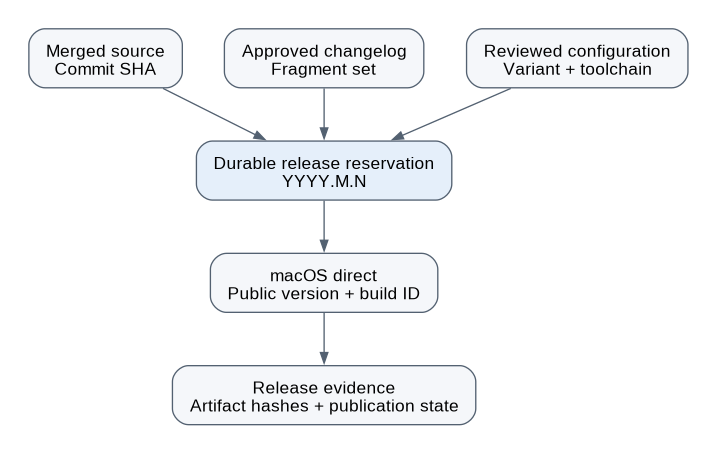
| Field | Meaning |
|---|---|
|
Full UTC year when the version is reserved. |
|
UTC month, 1–12, without zero-padding. |
|
Positive sequence within the month, starting at 1; neither a day nor a severity indicator. |
Calendar ordering: 2026.11.17 < 2026.12.1 < 2027.1.1.
Allocation month does not promise availability on every channel.
-
Allocate centrally after merge through serialized, durable reservations. Retain source/content bindings across retries and UTC date changes; gaps are allowed, reassignment is not.
-
Clock regression must not allocate a version older than an existing successor.
-
Preserve platform, architecture and distribution identities. Build numbers, submission attempts and source commits remain separate; test reruns do not require a new public version.
-
Published package bytes are immutable. A changed public package requires a higher version.
-
Explicitly set Apple’s
CFBundleVersionseparately fromCFBundleShortVersionString; Tauri otherwise copies the public version. Build-number mapping remains open and must respect existing published values and platform limits.
This decision does not add iOS, Windows, Android, Linux or package-manager releases to the macOS-only MVP. If those channels return, preserve CalVer as the public product identity and qualify any required package-version mapping. Windows MSI cannot use a four-digit year directly because its first field is limited to 255; Android’s visible version name and bounded, increasing version code are separate identifiers.
Alternatives
| Alternative | Benefit | Trade-off |
|---|---|---|
Product major/minor/patch |
Communicates change scope and supports numbered marketing milestones. |
Requires per-release classification; a mechanical patch bump misrepresents new capabilities under the former policy. |
Calendar version (selected) |
Communicates the release period and supports automatic allocation without feature-size decisions. |
Does not express compatibility or feature scope; needs separate build identifiers and some future installer mappings. |
Unbounded release counter |
Simple ordering without calendar dependence. |
Provides no date or scope context; Apple’s public version still needs a three-part representation. |
CalVer preserves the three-number shape already consumed by app tooling while removing product-scope classification from routine delivery. It is not a declaration that every release is compatible, nor a substitute for user-oriented release notes.
Consequences and transition
The app can deliver frequent improvements without manufacturing a major/minor marketing event.
Returning from a year-based version to a lower technical 1.0.0 would be a downgrade; any future scheme change must preserve ordering.
A calendar year does not grant new feature-promotion behavior or alter the optional, offline history under REQ-0068.
Keep historical numeric versions, release catalogs, signatures, immutable URLs and migration checkpoints readable. Do not rename published releases or replace their assets. Editorial changes to the GitHub release notes leave the release identity comment and the published catalog unchanged. Compatibility windows use actual publication evidence, not a date inferred from the version string. Test CalVer against supported earlier versions in update comparisons and minimum-app-version checks.
The current builders require consistent committed version pins and a clean source revision. Automatic allocation needs a qualified way to materialize those inputs; dirty-checkout version edits are not an accepted shortcut. The release workflow records the remaining input-materialization and operational decisions.
Verify simultaneous reservations, failed builds, retries after midnight, month/year boundaries, skipped releases and monotonic macOS build identifiers. Qualify signed macOS upgrades from supported existing versions and validate the actual Apple exports before enabling unattended delivery. Documented format compatibility is not an Apple acceptance result for a Situate build.
9.13. ADR-0018: Require changelog declarations for client changes
- Status
-
accepted
- Date
-
2026-11-13
- Implementation
-
CI validates declarations per PR; release assembly collects committed declarations.
Context
The previous release-level workflow captured committed changes, approved English source, accepted translations and finalized a version-specific catalog. Preparing that material after each merge would introduce a manual release queue. Editing one shared changelog or assigning release versions in parallel PRs would instead create contention.
Decision
Require a new, uniquely identified, versionless changelog declaration for each PR that changes the client. Independent fragments avoid shared-file contention; identifiers must be available before the PR number exists.
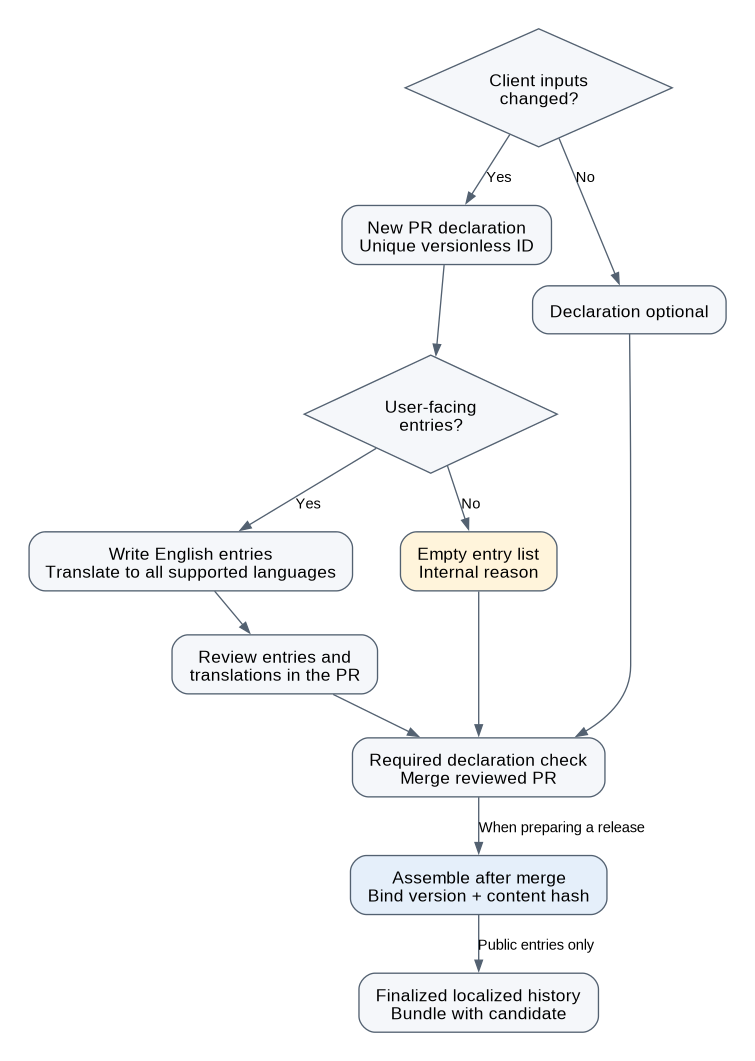
-
The check uses each PR’s changed paths to identify client inputs. Documentation, tests and developer tooling alone need no declaration. Automated PRs follow the same rule.
-
A declaration holds zero or more entries. Empty lists need an internal reason that never appears in public notes; do not generate filler text.
-
Public entries explain observable effects, necessary actions and limitations. Keep
new,changed,fixedandimportantcategories and explicit platform applicability. Current release entries target macOS; preserve historical catalog metadata for deferred platforms. -
In PR review, check the English text against the implementation and each translation against the English text. Declarations store content, not review records.
-
The merge check validates every new declaration and rejects reused IDs, malformed or incomplete entries, missing empty reasons and changes to immutable published catalogs. It does not establish factual or translation accuracy.
-
Configure required checks and review protections separately from workflow definitions. The fragment schema and directory remain implementation choices.
Release assembly
Assign the public version after merge under ADR-0017. Assembly binds source, version, fragments and content digest before signing; no agent generates or rewrites public prose. The release workflow keeps input materialization open rather than choosing a fragment tool here.
-
Keep declarations and release assignments traceable. Failed, cancelled or uncertain delivery does not consume entries or establish public delivery.
-
One macOS candidate may contain several PRs; unpublished changes remain available to later candidates.
-
Preserve offline history at or below the installed version, including skipped versions. Exclude newer uninstalled releases and automatic display; retain existing finalized catalogs without historical imports or retroactive notes.
-
Bundled history needs no separate publication record. A release may have an empty public entry list.
-
Changelog relevance is not app-release impact: internal application/dependency changes may require delivery; documentation-only changes may not.
Alternatives
| Alternative | Benefit | Trade-off |
|---|---|---|
Release-level preparation after merge |
Allows one coherent editorial pass across a release. |
Retains a manual step for every continuous release and moves review away from the change. |
One shared changelog edited in every PR |
Immediately readable and requires little tooling. |
Parallel changes compete for the same sections; version assignment and localization remain release-time work. |
Independent PR fragments for client changes (selected) |
Review stays beside the change; parallel PRs do not share changelog lines. |
Adds fragment validation, translation coordination and release/channel assignment. |
Generate notes from commit subjects |
Low contributor effort and easy automation. |
Commit subjects do not establish user impact, factual accuracy, platform applicability or approved translations. |
Consequences and verification
The final factual/content judgment stays with reviewers. A structurally valid fragment is not evidence that a planned feature shipped or that a test passed. Changelog review does not authorize a build, upload or publication; protected-branch release automation has its own authorization boundary.
Keep historical fragments readable at their original Git revisions and preserve finalized catalogs byte for byte. Test missing declarations on client changes, unrelated changes without declarations, explicit empty lists, reused IDs, missing or mismatched translation entries, concurrent PRs, failed release assembly, retries, unpublished changes and aggregation across skipped macOS candidates. Verify that internal reasons and entries for newer uninstalled versions never appear in app history.
Reference
Towncrier demonstrates independent change fragments and release-time assembly. The fragment pattern is selected; adopting Towncrier, Changesets or another dependency is not.
9.14. ADR-0019: Replace production hosts from versioned images
- Status
-
accepted; automated recovery revised by ADR-0020
- Date
-
2026-11-19
- Implementation
-
The normal Terraform root targets only immutable generations. GitHub Actions qualifies the merged revision with synthetic publication data before staging a replacement. The branch rehearsal uses a separate Hetzner project. Production qualification uses isolated temporary resources in the production project so the resulting snapshot can boot there.
Context
One Hetzner VM serves the production website and direct macOS downloads through Caddy and Nginx. Terraform describes the VM, but bootstrap installs packages from live repositories and operators can update the running proxy separately. Recreating the VM from Terraform alone therefore does not reproduce the serving stack or restore the current publication state. A host change must preserve the direct update contract in REQ-0068.
Decision
Build the production host image from reviewed repository sources with pinned base, package and container inputs. Record its source revision and provider image ID; test that exact image before promoting it. Replace the VM for operating-system, runtime and proxy-configuration changes, including security fixes. First boot may set instance identity, access and state mounts; it must not install mutable software inputs or change the baked serving configuration. Do not bake credentials, TLS private keys, production content or persistent data into the image.
Publish the website independently as a versioned static artifact; updating website content does not replace the VM or rewrite the proxy configuration. Keep website artifacts and their activation pointer, published application bytes and manifests, publication state and the active release pointer recoverable independently of the VM root disk. Keep TLS state recoverable or provide a tested way to reissue certificates. App signing keys remain outside hosting.
Use the same authoritative HCP Terraform workspace and locking under ADR-0014.
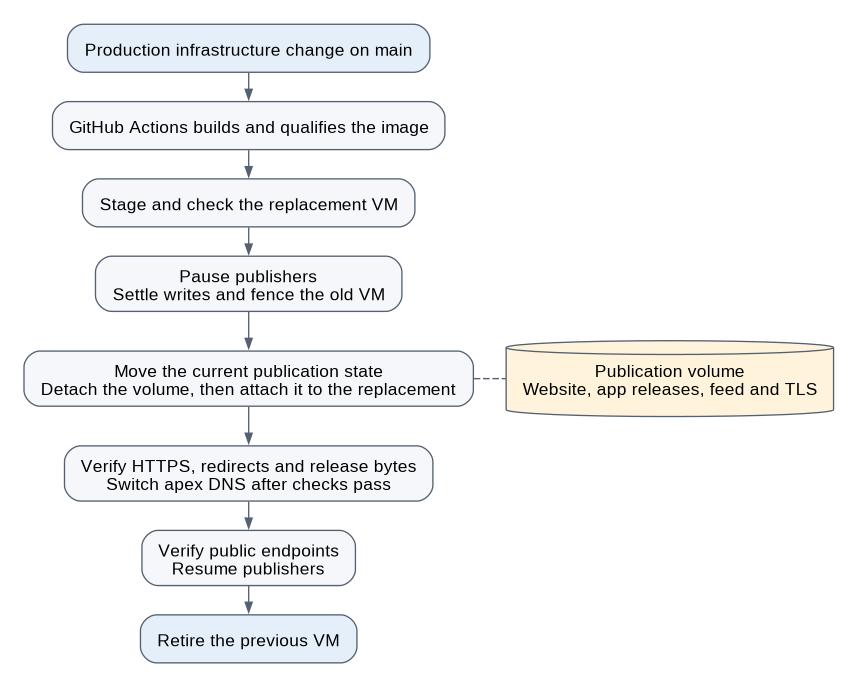
Changes to production infrastructure inputs on protected main trigger GitHub Actions automatically. Pull requests validate changes without production credentials; only trusted runs on main receive them through the production environment.
Once continuous deployment is qualified and enabled, normal deployments need no second manual approval after merge. Build from the merged revision and deploy only the qualified image and checked plans for that revision. A no-change plan does not replace a host.
Serialize production deployments without cancelling an active handoff. Coordinate with website and app publishers, and keep a durable operation record so interruption blocks new changes until the outcome is reconciled.
Stage and verify the replacement alongside the serving VM. If Hetzner cannot provision it, leave the serving VM, volume, DNS and publishers unchanged. Plan a short maintenance window with exactly one writer authority; this is not a high-availability design. Retire only the previous VM after public acceptance; retain the volume and the previous qualified image. A host rollback must serve the latest committed publication state, including releases committed after cutover, or leave traffic paused until that state can be served safely. Never rewind the application feed or overwrite published artifacts as part of host recovery.
The scope is the existing Hetzner website and direct-release host, not optional product services or local development. During the separately approved first migration, import the frozen legacy state into the new volume, verify public production, then delete the legacy VM and remove its deployment path, bootstrap and DNS fallback. Do not maintain a mutable mode. Enable production automation only after an isolated rehearsal and explicit approval of its change policy and spending limits. Out-of-policy changes stop for review.
Alternatives
| Alternative | Benefit | Trade-off |
|---|---|---|
Patch the VM in place |
Uses the current deployment path and avoids overlapping VMs. |
A running host can drift from Git; recovery depends on preserving and restoring the modified host. |
Replace the VM and install the stack at first boot |
Replaces hosts without a custom image build. |
Boot depends on package and registry availability, and the exact serving stack is not tested until the VM is provisioned. |
Replace the VM from a qualified image (selected) |
Test the serving stack before cutover and replace failed hosts from a known version. |
Adds image build and retention work, overlapping VM capacity, and a state handoff to qualify. |
Consequences and verification
Test that a fresh VM boots without fetching runtime packages or images and that a content-only website publication leaves the VM and proxy unchanged.
Before production cutover, rehearse recovery and traffic switch with isolated state, including interruption and rollback after publication has resumed.
Compare both public release metadata documents and versioned artifact hashes before and after the handoff; check website HTTPS and the www and reboot redirects.
Test that unrelated changes do not deploy, failed capacity allocation leaves production untouched, overlapping runs cannot interrupt a handoff, and a failed acceptance check prevents retirement.
Reject plans outside the permitted phase, including changes to mail or deletion of persistent state.
Keep the current production runbook authoritative for the live host until cutover is separately approved.
See the target deployment view for the state and traffic boundaries.
9.15. ADR-0020: Stop failed hosting deployments for operator recovery
- Status
-
accepted; the start of the production recovery record is refined by ADR-0023.
- Date
-
2026-11-19
- Implementation
-
Local verification; production cutover and a live production workflow run remain pending.
Context
ADR-0019 replaces the serving VM while preserving publication state. The initial workflow retained each deployment phase on a dedicated runner to support resumption. Interruption can leave the volume, DNS and serving process in different phases. Correctly resuming each combination would require regularly exercising those recovery paths.
Decision
Use a fresh GitHub-hosted runner for each production deployment. Read infrastructure state from HCP Terraform and supply credentials from the protected production environment. Keep phase results in the running job. Serialize GitHub production jobs and keep Terraform’s workspace lock for individual applies.
Before the first infrastructure change, create a GitHub deployment record. Mark it successful only after the public checks and predecessor retirement complete. If a step fails or the runner exits, stop; do not automatically roll back, resume or retry a write. An unresolved deployment record blocks the next run. The operator inspects HCP Terraform, Hetzner, DNS and the serving host, restores a consistent topology, and then marks the record inactive. GitHub records that an operation is unresolved, not the phase to replay.
This replaces the automated recovery journal from ADR-0019. The volume, publication safety checks and requirement to verify the replacement before retiring the predecessor are unchanged. A read-only failure before the first infrastructure change need not block a later run.
Consequences
No dedicated runner or separate journal store is required. An interruption can require operator intervention during a service outage. Terraform state and verified live observations remain authoritative; job logs help identify the failed step but cannot establish that a failed write had no effect.
Retaining a dedicated runner and resumable journal would reduce some manual recovery work, but would add infrastructure and recovery paths to maintain. Use the manual recovery runbook instead.
9.16. ADR-0021: Publish website content independently of app releases
- Status
-
accepted
- Date
-
2026-11-18
- Hosting gate
-
Revised by ADR-0024.
- Implementation
-
Workflow and image receiver are versioned; production activation requires key enrollment and a qualified replacement.
Context
Reviewed website changes should go live after merge without a second routine approval. The public site and app feeds share Nginx, but a website rollback must not rewind the app feed under REQ-0068.
Decision
Keep Caddy and Nginx on the immutable hosting generation defined in ADR-0019: Replace production hosts from versioned images. After the hosting workflow succeeds, publish the checked static build from protected main through a dedicated SSH entry point that can invoke only the website receiver.
The receiver uses the existing content-addressed website store and shares the host’s volume lock. Nginx reads website content and app distribution through separate read-only mounts.
Automating the full service deploy would make the workflow a Docker operator and couple ordinary edits to runtime changes. A separate hosting platform would avoid that access but add another origin and a routing change for the existing app feed. The content-only path keeps the same public origin and does not require a public staging site.
Consequences
Website revisions switch without restarting Nginx. A failed content check can restore the previous revision without touching app publication. The receiver is baked into the host image, and rollout enrolls the public key separately. Operators must retain the previous website version and reconcile an interrupted switch before publishing again. See the production runbook.
9.17. ADR-0022: Serve release qualification on host loopback
- Status
-
Accepted
- Date
-
2026-11-20
- Hosting gate
-
Revised by ADR-0024.
- Implementation
-
Hosting image and release tooling updated; production rollout and native qualification are separate gates.
Context
The signed macOS update test uses the production HTTPS URL without offering an unqualified build to users. The legacy test starts its own Caddy container and mounts a named certificate volume. The immutable host keeps the TLS bind mount private and does not give the release account Docker access.
Decision
Bake a second HTTPS listener into the existing Caddy service, mapped only to host loopback. Caddy uses its existing certificate and proxies to a separate internal Nginx server that serves only the active candidate feed, packages, and operation identity. The runner reaches this listener through the release account’s restricted SSH forward. The release account controls the candidate files, never the TLS keys, proxy configuration, or Docker.
Stage candidates outside the serving view; activate or retire a single complete view with a directory rename. Keep its ownership journal on the publication volume and require inspection if ownership is uncertain. A failed hosting rollout blocks release creation for that revision; source checks can still run independently.
Alternatives and consequences
Granting Docker access would reuse the legacy implementation but would give the release account host-level authority. A separate privileged listener would require its own control interface and certificate access. Reusing the existing TLS proxy avoids both, but makes rollout of the serving image a prerequisite for release qualification.
Verify that the loopback route presents valid TLS, that the public feed and public release routes never serve candidates, and that retiring the view stops serving it. See the immutable hosting runbook for rollout.
9.18. ADR-0023: Open hosting recovery at production staging
- Status
-
accepted
- Date
-
2026-11-20
Context
The image rehearsal provisions run-scoped Hetzner resources and exercises a storage handoff with synthetic data before Terraform stages a production replacement. Opening the production recovery record before that rehearsal made a test capacity failure block subsequent deployments even after the test resources were gone.
Decision
Keep the existing deployment check at the beginning of the job. Run the image rehearsal and verify its receipt before creating a new recovery record. Create the record before Terraform stages any production resources, so a lost response to the first apply still requires inspection. The remaining production recovery rules in ADR-0020 are unchanged.
A failed rehearsal stops its run without opening a production recovery record. It reports an unverified cleanup separately with the resource label; operators use that label to inspect only the rehearsal inventory. Later runs use distinct labels and do not resume or delete another run’s resources. This avoids unnecessary production recovery, but unresolved test resources can still consume quota and need operator cleanup. See the hosting runbook.
9.19. ADR-0024: Gate delivery on verified hosting
- Status
-
accepted
- Date
-
2026-11-20
- Implementation
-
Workflow and offline verification; live delivery remains to be verified.
Context
Website and macOS delivery used the success of the hosting workflow for their own commit as evidence that hosting was ready. The workflow initialized Terraform even when the active host already matched the desired configuration. A read-only infrastructure failure could therefore block publication to a healthy host.
Decision
Compare the Git tree of the desired Terraform topology and immutable runtime inputs with the most recent successful production operation’s source. Equal inputs do not require Terraform setup or a host replacement. Using the last verified operation, rather than the preceding commit, keeps an undeployed hosting change visible after subsequent app or website merges.
Website and macOS delivery require this same match but do not wait for a hosting workflow to finish for each commit. The website still publishes through the restricted receiver and verifies the public site and feeds. macOS checks baked image provenance and private HTTPS over verified SSH before proceeding to the existing artifact qualification and publication checks. This revises the delivery gates in ADR-0021 and ADR-0022, not their transports.
Alternatives and consequences
Checking only live HTTPS would avoid the deployment lookup but could accept a healthy predecessor lacking a required change. Keeping the per-commit workflow gate would catch that case, but would keep read-only infrastructure maintenance on the delivery path.
The latest production record must be successful; an unresolved or inactive record cannot authorize delivery by falling back to an earlier success. Operator recovery remains mandatory after an interrupted production write, as defined by ADR-0020 and ADR-0023. The record is evidence of the last completed GitHub-managed rollout, not a lease. The host’s publication locks, volume fencing, and live checks still apply.
9.20. ADR-0025: Run macOS delivery as fresh attempts
- Status
-
Accepted
- Date
-
2026-11-21
Context
A durable release claim let a different runner resume retained packages and qualification evidence. It also blocked successors if the old release could not complete. An unpublished build is replaceable; neither its exact version nor its notarized bytes need to reach users.
Decision
Run each hosted creation as a new attempt. Reserve a version and build number with a non-overwriting Git tag before building. Use the tag inventory, not a release or its draft, to determine which numbers are taken. Do not persist recovery checkpoints, claims, or notarization journals on the publication host for new macOS runs. A serialized qualification run can replace the private view left by its predecessor without modifying the public feed.
Publish an exact completed GitHub Release independently of creation. Keep the host lock, byte verification, and forward-only atomic feed switch. Repeating publication of identical bytes verifies the existing release; the public pointer and immutable version directory remain authoritative if the response is lost.
Consequences
A failed attempt may leave a version gap, an unfinished GitHub draft, or a notarization record at Apple. Building a successor costs more than restoring a checkpoint but removes checkpoint restoration from ordinary delivery. The macOS app still needs signing, notarization, exact-artifact qualification, and publication checks. This decision does not change recovery for host replacement or Terraform writes (ADR-0020).
10. Quality Requirements
10.1. Quality overview
The requirements catalog remains the source of product goals and obligations.
The following map connects the quality goals in Introduction and Goals to concrete scenarios and gaps in verification.
Catalog priority must applies to the linked requirements; it does not rank them against one another or establish their implementation status.
Stakeholder importance and technical difficulty have not been ranked here.
| Quality goal and attributes | Authoritative basis | Scenario coverage |
|---|---|---|
Decision authority and recoverability — reliability and user control |
Save, closure and interruption safeguards support recovery. They do not establish the full scope of undo or handling of uncertain external outcomes; see Required outcomes and open verification questions. |
|
Context continuity and traceability — reliability |
Conversation overwrite protection preserves stored records. It does not establish that subsequent work uses the relevant context or that process history distinguishes prepared from performed actions; see Required outcomes and open verification questions. |
|
Content availability and portability — availability and interoperability |
Reference reconstruction after directory transfer checks one portability boundary. Offline manual use and reuse without Situate have separate acceptance conditions in Required outcomes and open verification questions. |
|
Personal fit and understandable organization — operability |
Navigation and organizational-fit evaluation still need representative collections and tasks. Storage and reference checks alone cannot establish understandability. |
The current-client scenarios describe safeguards and their verification boundaries, not complete implementation of the target architecture or a passing result for a particular revision. Data preservation, workspace independence and explicit failure reporting take precedence over silently completing an unsafe operation. Engineering checks are listed separately from product outcomes.
Verification policy
The repository uses one test runner for unit, integration, browser, native and static checks. Quick checks provide local feedback; the default MVP suite covers additional boundaries and dependencies on its selected host. Expensive extended checks and deferred product platforms are not implied by an MVP pass. Missing tools or services are reported as failures rather than silently omitted from a selected suite. Formatting checks are read-only; applying formatting is a separate developer action. Tool versions are pinned so local and CI results can be compared against known inputs. See the test suite guide for commands, platform coverage and CI triggers.
Coverage reports show which instrumented source was executed by tests, not whether all relevant outcomes were asserted.
Pull-request feedback compares coverage with a measured main revision and identifies both revisions.
An unavailable baseline must be shown as unavailable, not as zero coverage; a decrease informs review without imposing a universal percentage gate.
Test failures remain failures independently of the coverage percentage.
macOS is the only active MVP target; iOS, Windows, Linux desktop and Android are deferred. The retained mobile workflow is disabled. iOS runtime, device, signing and store checks are optional deferred work, not macOS development or release gates. Historical iOS fixtures and simulator results do not establish current iOS support. See mobile CI limitations and the explicit iOS application journey.
10.2. Quality scenarios
Each row identifies an event, its operating conditions, the affected part and an observable outcome. The linked tests and policies locate verification mechanisms; they do not qualify every filesystem, platform or failure point. No latency, availability or universal coverage target is established here.
Data preservation and lifecycle coordination
| Situation and catalog basis | Expected behavior and success criterion | Verification boundary |
|---|---|---|
A conversation save is blocked on storage while two workspaces are open and the user closes the saving workspace. REQ-0037 ( |
Closure waits for the save already accepted for execution (Operation Admission). While it waits, the other workspace can save and the shared workspace registry can be inspected. Disk access does not hold the shared registry or active-turn lock; the latter coordinates the current AI turn. See Current client: workspace operations and closure. |
The |
A quit cancellation notification or reply is lost, or an old cancellation arrives after a newer quit attempt starts. REQ-0037 ( |
The native host retains the attempt’s status so the frontend can reconcile the lost message. Repeating a completed cancellation does not repeat restoration of paused file sessions. An older cancellation leaves the newer attempt pending. An unconfirmed cancellation remains visibly retryable; sending it is not proof that restoration succeeded. |
Lifecycle state tests cover failed notification delivery and stale attempt tokens. Frontend coordination reconciles status; see Current client: application quit and cancellation. This protocol does not establish plugin shutdown or synchronization readiness. |
A stored conversation is malformed or uses an unsupported format. REQ-0011 ( |
Loading reports the problem. A later save fails rather than replacing the unreadable original with empty history; the original bytes remain unchanged. This favors preservation over automatic recovery and can block further saving. |
Conversation storage tests check corrupt records and preservation after failed saves; format validation defines accepted records. See Conversation storage and overwrite protection. Rejecting unsupported data does not establish mixed-version compatibility. |
A conversation append stops midway through its final entry, or metadata publication fails after a history append. ADR-0016. |
Complete preceding history remains available. Preserve an incomplete suffix before repairing the append boundary; keep additional complete entries if metadata still selects the old entry. No silent reset or automatic tool replay occurs. |
Verification requires short-write, partial-tail and metadata-ordering fixtures; existing v2 round-trip tests do not establish the append protocol. |
A conversation grows beyond the former 16 MiB ceiling and is continued after compaction or a branch change. ADR-0016. |
The conversation remains continuable without rewriting original history, copying shared ancestors or loading the entire tree. Only the selected ancestry contributes context; older UI history loads on demand. |
Verification requires synthetic large-history, branch/compaction and resource measurements; no latency threshold or native qualification is inferred from a format choice. |
The application terminates with saved waiting input or a tool call lacking its result. REQ-0005. |
Reopening preserves saved input and available outcomes without starting work. A missing result is unknown, not proof of no effects. Unsaved response text and drafts may be lost; execution handles are not reconstructed. |
Owner and native restart scenarios in the storage plan; external effects and history are not one transaction and missing outcomes need not be reconstructible. |
The process is killed after recovery text has been durably stored but the content save has failed. REQ-0042 ( |
Restart restores the exact retained editor text and preserves the original content-file bytes. Confirmation that recovery text was stored (Durable Staging Acknowledgement) is not confirmation that the final content save succeeded. |
The editor recovery fixture and editor smoke flow support termination after that acknowledgement and reopening. This does not establish power-loss durability on every filesystem. |
A structural file operation is interrupted after changing files but before its completed result is committed. REQ-0022, REQ-0035 (both |
Under ADR-0010, restart preserves current files and prior history without replay or rollback. References lacking continuity evidence stay unresolved, including after later path reuse. An interrupted attempt is not reported as complete without verified completion evidence. |
Core interruption tests include interrupted moves and copying continuity gaps. The native reference/restart journey checks completed operations across restart, not every mid-operation interruption. Working-tree changes and Git reference publication are not one atomic transaction. |
Portable references
| Situation and catalog basis | Expected behavior and success criterion | Verification boundary |
|---|---|---|
The application restarts without derived reference state, or a closed workspace is copied to a fresh installation. REQ-0030, REQ-0035, REQ-0038 (all |
Retained Git history and stored reference anchors reproduce the same target, deletion or uncertainty result without another authoritative move journal. ADR-0010 defines Git authority; ADR-0012 extends this model to Markdown. A copied reference does not authorize access to a local workspace session. |
Closed-directory copy/move fixtures include persisted chat and view selectors; Git-derived file references describes cache-free reconstruction. Host authorization and native IPC/restart checks separately cover association with the authorized local session (Runtime Workspace Binding). Neither a portable Diagnostic Workspace Identifier nor the credential association called a Device-local Workspace Namespace substitutes for this authorization. |
Engineering safeguards
These checks enforce development policies supporting modularity, resource control and security. They are not additional catalog priorities or evidence that all user-facing quality goals are satisfied.
| Situation | Expected behavior and success criterion | Verification boundary |
|---|---|---|
A shared UI component imports forbidden application internals. |
Dependency checks reject the forbidden reference rather than allowing the shared library to depend on application implementation details. |
|
A file IPC request or reply has an invalid shape. |
File-boundary validation rejects malformed data rather than treating it as a successful operation. |
Shared contract fixtures, frontend tests and native tests. Shape validation does not authorize workspace access. |
A dependency increases the initial frontend code in a production build. |
The build reports its size, fails above the reviewed uncompressed limit and warns above the gzip threshold. Initial code includes shared static dependencies, not dynamic imports, even when triggered during startup. |
Bundle policy and manifest-based tests; see Initial JavaScript budget. Size does not measure native startup or first-use latency. |
A dependency violates the configured advisory, license, ban or source policy. |
The applicable dependency check reports a failure rather than suppressing the finding to keep CI green. |
Rust dependency policy and CI gates. npm and Rust advisory checks run in the independent dependency monitoring workflow, not required PR or release verification; scheduled scans require explicit enablement. Dependabot monitors npm vulnerabilities and supplies security updates for npm and Cargo. These scans do not establish the absence of every vulnerability. |
The secret scanner detects credentials in source history. |
The history scan reports failure. |
Quality workflow secret scanning. Automated scans do not detect all forms of confidential information. |
Required outcomes and open verification questions
The following catalog obligations are not established by the safeguards above. They remain required outcomes, not claims of missing implementation or passing tests.
| Quality outcome and basis | Acceptance condition from the catalog | Open verification question |
|---|---|---|
Offline manual use — REQ-0008 ( |
With internet access disabled and AI unavailable, a user can read and manually edit locally stored content and reopen saved changes after restart. Local content is usable without waiting for background synchronization; retained offline edits remain available for later configured synchronization. |
Which native macOS evidence covers reading, editing, restart and later synchronization together? This does not require offline AI or access to external services. |
Reuse without Situate — REQ-0009 ( |
Stored notes and tasks open in an ordinary text editor, and documents in appropriate applications, without a special export or a Situate service. Transfer preserves content. |
Which representative destination tools, content types, metadata and relationships demonstrate transferability? Whole-directory reference reconstruction alone does not answer this. |
Context continuity and traceability — REQ-0004, REQ-0005 (both |
Subsequent work uses relevant known context within workspace and task scope. Recorded intent and outcomes let users distinguish preparation from completed actions. |
Which representative multi-step tasks demonstrate context use and understandable process history? Byte preservation alone cannot establish either outcome. |
Personal fit and understandable organization — REQ-0006, REQ-0023 (both |
Users can browse and read their notes without assistant retrieval or explanation, including after reorganization. No particular organizational method is prescribed. |
Which representative collections, methods and navigation tasks establish understandability? No task-duration or success-rate threshold has been agreed here. |
Decision authority and recovery — GOAL-0004, REQ-0022 ( |
Internal changes remain reversible; users can inspect outcomes and stop work without treating interruption as undo or proof that no effects occurred. |
Which scenarios cover the required scope of undo and the presentation of partial or uncertain external outcomes? File interruption and quit-cancellation checks cover narrower boundaries, not a general external-effect recovery protocol. |
11. Risks and Technical Debt
This register covers plugin development, marketplace adoption, application freezes and damaged history. It is not a complete inventory of system risks or existing technical debt. The requirements catalog defines the constraints on mitigation; open questions here do not establish new product decisions.
11.1. Technical risks
These entries describe risks in the documented design, not demonstrated implementation defects or proof of verified mitigation. The CTO owns technical assessment and verification for every entry; marketplace terms and operating commitments also require product and legal decisions. Marketplace review/report operations still need an agreed operational owner before delivery.
Impact judgments describe potential consequences: high means possible loss of data or confidentiality, incompatible execution, or application-wide unavailability; medium means constrained delivery or degraded operation. Likelihood is unknown where occurrence rates and operating evidence are unavailable; the entries do not estimate probabilities. An accepted trade-off remains a risk, and a documented mechanism does not close its verification questions.
Plugin development and adoption
Source and active code can diverge
Basis: REQ-0033 and Runtime View.
Reading editable source as the execution version could load unchecked code or combine incompatible plugin revisions. The runtime description separates editable source from immutable Git revisions. It records selected active revisions in the Active Revision Map, replacing affected selections together during plugin activation publication. A Check Receipt records which revisions and checks were covered; it does not itself activate code. A durable plugin activation attempt distinguishes confirmed activation from an unresolved outcome.
Assessment: high impact; likelihood unknown. Status: mechanisms documented; interrupted-switch and multi-plugin consistency verification remain open here.
Verification and review trigger: when activation storage or switching changes, check interrupted activation, retained history and consistent loading of related plugins. Preserve known outcomes: a failed refresh or notification is not proof that activation failed and does not authorize blind repetition.
Checks may cover outdated dependency revisions
Basis: REQ-0033.
Concurrent developments can change dependencies or consumers after checks. A Check Receipt for earlier revisions does not establish compatibility with the activation state; activating unselected plugins could overwrite independent work. Source or dependency changes require fresh applicable checks before activation. Revision-bound checks and coordinated activation are documented, but they do not promise conflict-free concurrent development. Overlapping development may interfere with or overwrite changes without a development lock, base-version rejection, mandatory reconciliation or automatic merge.
Assessment: high impact; likelihood unknown. Status: concurrent interference accepted; verification of dependency drift remains open here.
Verification and review trigger: when dependency selection or activation coordination changes, check concurrent edits, stale receipts and long-running affected actions. Activation must wait for those actions without aborting or repeating them. Check failed-switch recovery within these constraints rather than introducing a competing-development lock or base-version rejection policy.
Trial safety depends on instructions
Basis: REQ-0033.
Agent-led investigation can read workspace data and connected accounts. Instructions forbidding incidental real external writes cannot technically prevent a model mistake, prompt injection or trusted plugin bypass. Source staging does not isolate external accounts.
Assessment: high impact; likelihood unknown. Status: instruction-only boundary accepted; behavioral verification remains necessary.
Verification and review trigger: when development instructions, tools or reusable connections change, verify instruction propagation, task scope and trial behavior across connection calls. Keep automated tests strictly synthetic. Any stronger technical restriction needs a separate decision; neither tests nor review imply an enforcement guarantee.
Generated artifacts may contain personal material
Code, fixtures, screenshots or a marketplace publication copy can accidentally embed personal data or credentials, especially after real-data trials.
Assessment: high impact; likelihood unknown. Status: artifact review required; no guarantee of harmlessness or legal clearance.
Verification and review trigger: check generated artifacts after real-data investigation and review the separate marketplace publication copy before submission. Use synthetic screenshot data and exercise the complete store-page preview. Manual approval and local review reduce risk but do not guarantee that private material or third-party rights issues have been excluded.
Incomplete developments may accumulate
Basis: REQ-0033.
Leftover development artifacts may grow without a retention limit; actual sizes and growth rates are unmeasured. The MVP has no development-storage display or manual cleanup capability. Closing a view does not stop ongoing work or delete storage.
Assessment: impact unknown until storage growth and disk pressure are measured; likelihood unknown. Status: leftover growth accepted for the MVP without age-based cleanup.
Verification and review trigger: reassess storage policy if measured growth causes disk pressure. Continue removing disposable check state while preserving live files, active code, configurations, history, conversations and evidence of uncertain plugin activation outcomes. Workspace closure and application quit must stop development work; reopening interrupted work waits for user interaction.
Marketplace review has capacity and protection limits
Initial manual per-version review requires operator capacity; automated malware/prompt-injection review is deferred. Blocking prevents adoption of a marketplace version but neither changes existing independent local copies nor warns their users of later security findings. Local security warnings and inconclusive results remain explicitly overridable for the exact candidate and relevant dependency revisions; an override does not waive failed functional or compatibility checks.
Assessment: medium impact for review-capacity constraints; high impact for harmful adopted code; likelihood unknown. Status: manual review and independent-copy limits accepted; operating arrangements and publication terms remain open.
Verification and review trigger: before marketplace delivery, agree review/report ownership and operations, and test immediate blocking at adoption, per-version approval and rejection feedback. Assess uniform reuse terms without promising legal clearance or selecting a project license. Reassess capacity when submission or report evidence becomes available, and protection limits when security findings arise after adoption.
See Coordinated development and activation and Runtime View for development and activation lifecycle boundaries.
Application availability and history recovery
A plugin view can freeze the application
Basis: plugin trust and synchronization ownership and REQ-0032.
Plugin views may run as ordinary Vue components in the host UI without an independently stoppable rendering context. A synchronous loop or other view failure can freeze the application, affect other open workspaces and require forced restart, with possible loss of unsaved state. In-app abort and view removal cannot guarantee stopping such code; service and chat-tool supervision remain unchanged.
Assessment: high impact; likelihood unknown. Status: accepted availability trade-off, conditional on plugin-free startup and repair; platform-specific recovery entry still requires verification.
Verification and review trigger: when plugin loading or recovery entry changes, verify that recovery is reachable after a frozen run and suppresses plugins before loading or execution across restored and subsequently opened workspaces. Built-in management and agent repair must remain usable without executing suspended plugins. Inspection or editing alone must not resume them; checked activation resumes its target only. Recovery is not a sandbox or rollback, and testing or resuming faulty code may freeze the application again. See Recovery Mode and Recovery mode.
Uncontrolled internal-file synchronization can corrupt history
Uncontrolled synchronization or modification of internal files can make repository history unusable. This repository corruption is distinct from a merge conflict in an intact repository. Synchronization plugins supply transport; versioning, conflict handling and history recovery remain core responsibilities for every transport. A preserved damaged backup does not guarantee recoverable history, and history preservation does not protect against physical damage.
Assessment: high impact; likelihood unknown. Status: recognized risk; the recovery procedure and synchronization protocol boundaries remain open.
Verification and review trigger: before adopting or changing an internal-file transport or damaged-history recovery procedure, verify detection and reporting without asserting an unverified cause. History reinitialization requires explicit confirmation of prior-history loss and a preserved damaged-repository backup; it must not proceed if that backup cannot be preserved. Existing content remains the new baseline, and local reinitialization does not itself synchronize or delete histories elsewhere. See History Reinitialization.
Production hosting
Host replacement can serve a stale release feed
The serving VM and publication state have separate lifecycles in Immutable production hosting (target). If both hosts accept writes, or if the previous host returns to service with an old state copy, update checks may advertise an older release or point to missing artifacts.
Assessment: high impact; likelihood unknown until the operator rehearses cutover and recovery. Before switching traffic, pause writers and verify the receiving host against the latest committed state. Rehearse rollback after a new publication, not just before publication resumes. Keep traffic paused if current state cannot be recovered.
11.2. Technical debt
This register records known implementation and verification gaps that affect maintenance, reliability, or delivery. Deferred requirements are not automatically technical debt.
Windows installation without WebView2
Status: Open. The Windows installer includes Microsoft’s bootstrapper, not the WebView2 Runtime. If the runtime is missing, the bootstrapper downloads and installs it before Situate can open. This path has not been verified end to end and matters especially on Windows 10.
Evidence: Both GitHub-hosted Windows images tested already had WebView2 installed. The runtime also remained installed in the Windows 11 test VM clone because Microsoft’s installer blocked its removal. Tests on those images do not show whether Situate can install on a system without the runtime.
Owner and follow-up: The Windows release owner should test the exact release installer on a disposable Windows image without WebView2. Verify that the installer can provision the runtime as part of a standard-user installation and that Situate opens the workspace chooser. This check is outside the automated Windows release checks. Revisit it when a suitable image is available or when changing how the installer supplies WebView2.
12. Glossary
These terms apply across the product requirements and architecture. Component responsibilities and named interfaces are defined in Building Block View and Named interfaces. The definitions describe intended concepts, not implementation evidence. Use the preferred terms below consistently. Keep code identifiers, UI labels and historical decision titles unchanged; explain their relationship to these concepts where needed. Qualify terms with several meanings, especially publication, admission and workspace identity, rather than treating the meanings as interchangeable.
| Term | Definition |
|---|---|
An individual step performed by an agent or plugin, such as a tool invocation. An action is distinct from a stored task and from the user request it serves. Exact execution granularity and tracking of nested actions remain open. |
|
The workspace record selecting the immutable code revision used for each active plugin. Grouped activation replaces the affected selections together; editable source and a successful check receipt do not themselves change active revisions. |
|
The execution logic that uses a model and tools to handle work. Rig supplies the native agent library; the model itself is not the agent, and Situate’s Agent Integration supplies workspace-scoped tools, persistence and model access. |
|
A concrete execution of the agent, started through user interaction or a configured trigger. A conversation can involve multiple runs; a triggered run need not have a visible chat. Interruption and continuation follow the application-bound execution rules, not an always-running server model. |
|
A decision required at a distinct product or access boundary, such as marketplace review or provider authorization. Ordinary agent/plugin actions within a user request do not require per-action approval. Approval is not evidence that an action succeeded. |
|
A file associated with other content, such as an image or PDF. This is a relationship, not a distinct file format; a document can also be an attachment. |
|
Unavailable for new actions because a required plugin dependency is unavailable. Re-enabling that dependency does not automatically restore use of affected dependent plugins; each requires explicit user re-enabling. This is distinct from a suspended execution. |
|
The user-facing interface for interacting with an agent and displaying a conversation. Closing or hiding that view does not itself delete the conversation or close its workspace. |
|
A retained result identifying the plugin revisions and checks covered by a development check. Activation requires a successful receipt applicable to the selected revisions and dependencies; the receipt is not proof of safety against malicious code. Disposable synthetic test state belongs to the check, not to ordinary workspace content. |
|
In UI descriptions, a reusable Vue building block composed into a view, with public properties, events and slots. In the building-block view, an architectural component instead denotes a logical responsibility boundary. Neither usage implies a separately deployed service. |
|
An interaction that asks the user to accept or reject a presented choice. It can confirm a deliberate decision, such as disabling a plugin or discarding unsaved content. Ordinary external-action execution does not use this interaction. It is not synonymous with approval or with technical enforcement against malicious plugins. |
|
A navigable reference to internal or external content. It does not automatically retain a source copy or start agent processing. Live versus historical selection determines which version is selected; identity-based versus path-based resolution determines how the target is found. |
|
A retained, potentially branching exchange between the user and agent, together with the work state needed for continuation. It can span multiple agent runs and application openings. Archiving removes it from the active overview without deleting it or excluding it from context use. |
|
The native execution component that processes a conversation's actions in order and owns its current run, persistence and observable state. Views display that state; closing a view does not terminate the owner or duplicate its execution. |
|
Provider connections, endpoint addresses, selected access, model defaults and conversation-specific model selections associated with one workspace on one device. They persist outside the portable workspace directory and its histories; provider secrets remain in device-local OS secure storage. Neither workspace copying nor any synchronization mode transfers them; see REQ-0015. |
|
The local identifier associating AI connection records with an authorized canonical workspace location on one device. It is not the portable Diagnostic Workspace Identifier or a Runtime Workspace Binding; copying workspace content does not copy this association or grant access to its credentials. |
|
The random identifier retained in portable workspace metadata for diagnostic correlation across devices, copies and restoration. It does not select a local workspace location, grant access, share runtime state or associate copies with the same AI credentials; see ADR-0009. Prefer this qualified term when discussing diagnostics rather than the ambiguous workspace identity. |
|
Prevent or permit use of an installed plugin without deleting its code, configuration or data. Disabling blocks new actions immediately after confirmation; running actions normally finish unless the user chooses to abort. Enabling is distinct from activating a new version and does not bypass recovery mode. |
|
Content managed or accessed as a document, including ordinary PDF, image and other files. This is a content role, not a requirement to convert every document into Markdown. External documents remain external unless copied or imported. |
|
Confirmation that pending recovery content has been durably stored before the final content save. It does not mean that the final destination or its Git history has been saved successfully; see Conversation storage and overwrite protection. |
|
For the official synchronization service, encryption that prevents both the service and its operator from decrypting synchronized user content. Authorized plaintext model processing is a separate flow. Cryptographic protocols and metadata protection remain design work; workspace storage is not implicitly encrypted by this term. |
|
Plugin-defined rules for missed triggers, offline operation and once-across-devices versus per-device execution. These rules do not promise exactly-once execution or execution while a workspace is closed. |
|
The current state of concrete work: running work is executing, waiting work needs an input or condition, and suspended work is paused by an interruption such as operating-system suspension. These descriptions do not define a complete state machine or imply that a plugin is disabled. |
|
A change outside Situate-owned content, such as saving a draft, sending a message, inviting another person or changing shared content. It executes within the requested task and configured access without per-action approval under GOAL-0004. |
|
The continuity of a selected file established by its anchored path and confirmed Git operation history, not an embedded UUID. Managed moves preserve continuity; copies and restorations create separate lineages, and known deletion terminates the old one. Task identity is separate. |
|
A content reference selecting a particular retained revision rather than the current source. It requires an available revision, not universal retention of external sources. |
|
Creating a new repository history from existing content when corruption has made the old history unusable. It requires confirmation of prior-history loss in the new repository and a preserved damaged-repository backup. It neither guarantees recovery of old history nor authorizes replacing remote histories. |
|
A reference resolved through a stable task UUID rather than its containing file or current position. File references instead use Git-anchored paths. Duplicate identities from external copies require user-directed repair rather than arbitrary targeting. |
|
Copying source content into a workspace without changing the source. Notes and tasks are converted into Situate’s Markdown conventions; other documents remain ordinary files. Reconciliation of later source changes remains unspecified. |
|
A plugin role that owns connections and account configuration for external systems and exposes reusable capabilities. Consumers independently select relevant accounts. This role can coexist with workflow and view contributions in the same plugin. |
|
The tab and split-pane arrangement in a workspace’s UI. It is distinct from content and execution ownership. Layout and supported navigation state are device-local, scoped to a workspace and restored on the same device rather than synchronized or transferred with workspace content. Phones normally project one pane at a time without changing that arrangement. |
|
The coordination gate controlling whether a workspace or application lifecycle operation, such as closure or update installation, may start. It is distinct from permission to access a workspace and from acceptance of individual plugin or model requests; see Operation Admission. |
|
A content reference selecting the current source, without requiring a retained snapshot. Deletion or loss of access can leave it unresolved. |
|
An independently developed plugin within a workspace, optionally adopted from a marketplace template. It has its own code history and receives no automatic upstream updates or merges. |
|
Changes that cannot be automatically combined in an intact repository. Unresolved synchronization conflicts pause synchronization for the affected workspace, not local editing or other workspaces. This is distinct from repository corruption. |
|
The AI model used to produce results for agent requests. Protocol compatibility of its endpoint does not establish support for all agent capabilities. |
|
The internal capability through which the Conversation Owner requests model work from native host adapters. It is distinct from Provider Transport, the adapters' communication with a model endpoint. |
|
The configured access point through which model requests and results are exchanged. It can be remote, self-hosted or local to the device; local placement does not make it part of Situate’s product boundary. |
|
The party operating or supplying model access. User-provided access and Situate-managed access have different service and data-processing guarantees. |
|
User-authored or maintained knowledge represented in editable Markdown within a workspace. A note is a content role, not every Markdown file or a mandatory organizational structure. |
|
Acceptance of a specific request for execution after validating its caller, workspace, captured context and applicable lifecycle conditions. Operation admission is not completion, durability or user confirmation and is distinct from Lifecycle Admission. Diagnostic data admission instead means accepting validated events into the bounded logging pipeline; it does not authorize agent or plugin work. |
|
An ongoing matter whose information and next steps can span several organizational areas, such as gathering documents and preparing a reply. It is distinct from an operating-system process, an agent run and the workflow used to handle it. It need not correspond to one conversation. |
|
A region of the layout used to display a view. The pane is the placement container; the view supplies the content or function. |
|
A file reference containing its original workspace-relative path and a Git commit anchor. Confirmed managed moves determine its current location; external moves or uncertain continuity can leave it unresolved. Markdown uses the same model as other files. |
|
A workspace-owned extension using JavaScript and supported host interfaces, optionally contributing views, tools, exports and triggers. Integration and workflow are roles, not mutually exclusive plugin types. Installed plugins are trusted code, not isolated adversaries. |
|
Related changes across one or more plugins that are checked, activated and rolled back together, even across separate code repositories. Activation waits for affected running actions to finish; rollback preserves later independent edits and exposes conflicts. |
|
The separate Git-backed history of one plugin’s code. Plugin configuration, data and plugin-specific histories remain inside the owning plugin directory; the workspace’s general content history is not their storage authority. Directory ownership and history membership are distinct; see workspace storage and history. |
|
A declared required relationship to a concrete plugin or a shared provider interface. Dependencies determine installation prerequisites and affected consumers; they do not automatically cross workspace boundaries. |
|
Functionality or a component explicitly exposed by a plugin for eligible consumers through declared contracts. Internal functions and components are not automatically public. Agent tools are a designated callable part of this functionality, not the whole export surface. |
|
A versioned marketplace starting point adopted as an independent local plugin copy and adapted to the user’s workflow. It is not an automatically updated installed package. |
|
The recorded relevant information, actions and results of organizational work, understandable to the user and reusable for later work. Prepared actions remain distinguishable from performed ones. It is distinct from file version history and does not require copying all external source content. |
|
A plugin-defined contract implemented by interchangeable plugins, allowing a consumer to depend on a capability rather than one concrete provider. The core does not prescribe universal mail, document or task domain contracts. |
|
Communication between native host adapters and the selected model endpoint, including authentication, request dispatch and streamed responses. It implements part of Model Access without moving credential custody into the frontend. |
|
Making prepared content or a selection visible at a defined boundary. Qualify the operation: file publication exposes destination bytes; Git reference publication exposes a history commit; plugin activation publication changes the active revision map; marketplace publication distributes a template. Success at one boundary does not imply success, durability or approval at another. |
|
Restoring a usable state after failure. Plugin repair through recovery mode, handling of repository corruption and investigation of uncertain external outcomes have different responsibilities. Recovery does not necessarily mean rollback or guarantee restoration. |
|
A user-held means of authorizing access to encrypted synchronized content when provisioning a device. Account login alone does not unlock that content. The exact cryptographic construction remains open; this is not a key held by the synchronization operator to recover user data. |
|
Application startup with installed plugins temporarily suspended across restored and subsequently opened workspaces. Built-in management and agent development remain available; inspection and source edits alone do not resume plugins. Explicit resumption or successful checked activation can resume selected targets while unrelated plugins remain suspended; see REQ-0032. This is neither a sandbox nor automatic rollback. |
|
Damage that makes repository history unreliable or unusable, rather than a merge conflict in an intact repository. Preserving a damaged backup leaves recovery possible but does not guarantee it. |
|
A tool-provided operation to reverse a supported external effect. It must be idempotent and check preconditions to avoid overwriting intervening changes. Unsupported reversal is explicitly declared; external rollback requires preview and confirmation. |
|
Selective reversal through new compensating changes, preserving later or independent edits rather than erasing history or blindly restoring old files. Moving to an earlier conversation position can be requested without rolling back associated content. Aborting execution is not rollback. |
|
A top-level plugin tool or exported-function invocation whose nested calls share its execution context. Action root is a synonym; prefer root action. An independent host request has its own lifetime (see Worker Lease), and an ordinary view callback does not automatically group several requests into one root action. |
|
The native host’s association of a request or loaded record with its authorized local workspace session. It is not portable content, a Diagnostic Workspace Identifier or a Device-local Workspace Namespace; a reference containing an identifier cannot grant this authorization. |
|
Staging prepares replacement plugin versions separately from active versions. Activation makes the checked change set active together after affected running actions finish. This version-development lifecycle is distinct from enabling or disabling a plugin and is not a security sandbox. |
|
A service used to exchange portable workspace data between devices. The official Situate service requires end-to-end encryption; custom alternatives may use other content-encryption policies. Device-local AI settings and credentials are excluded from every synchronization mode; see REQ-0013. |
|
The adapter capability that transfers data through a service or storage backend. Versioning, merge-conflict handling and history recovery remain Application Core responsibilities for every transport. Transfer success alone does not establish consistent history. |
|
A managed item of personal work, distinct from a request to Situate or its execution. The default model has text, identity and open/completed state; users can adapt its fields and completion rules. An unmarked checkbox is not automatically a task, and deletion is not universally completion. |
|
A task’s UUID, independent of its containing Markdown file. Under the default convention, the |
|
A capability exposed for agent invocation with a description and declared read/write behavior. Situate supplies built-in tools; plugins designate exported functionality as chat tools. Tool-list visibility controls discovery and context size, not authorization. |
|
A configured source of plugin execution, such as a shortcut, interval, scheduled time or available event. Execution depends on the workspace being open, platform availability and the plugin’s execution policy. |
|
Work assigned by the user to Situate, including its intended scope. It need not create a stored task and may involve several actions or agent runs. It does not authorize unrelated internal changes or external effects. |
|
Recoverable versions of stored content. Organizational content has one Git history per workspace; see Plugin Code History for plugin-owned storage and histories. Version history is distinct from the explanatory process history and is not protection against physical damage or repository corruption. |
|
A UI presentation of content or a function, built in or supplied by a plugin. It is displayed in a pane or maximized. Closing a plugin view releases view-scoped resources, not the plugin’s independent work or its workspace. |
|
An operating-system application window. Several desktop windows can belong to the same workspace; closing its last window triggers workspace closure. Mobile view or workspace switching is not equivalent to closure. |
|
A runtime lifetime handle retained while an independent native host request still owns work or resources. It is released after actual completion and cleanup, not merely when a view closes or cancellation is requested; a lease is not an operating-system process or a security sandbox. |
|
The rules or arrangement of steps used to handle organizational work. It can be adapted to the user’s working method and is distinct from a particular ongoing organizational process or execution. |
|
A plugin role that composes capabilities into individual workflows and, where useful, views. It can consume integration exports without owning duplicate connection logic. Plugins contributing only visual extensions need not be workflow plugins. |
|
A personal organizational system whose portable content, conversations, plugins, workspace configuration and histories reside in one directory. Layout and pane navigation state, operational AI settings and credentials are device-local exceptions to workspace portability. Workspace separation is an ownership and lifecycle boundary, not a malicious-plugin sandbox or a promise of encrypted local storage; a layout describes presentation, not the data boundary. |
|
A lifetime handle retaining an accepted operation for an open workspace session so that closure can wait for its actual completion and cleanup. It is distinct from a plugin Worker Lease, which retains an independent host request while plugin activation waits for affected work to finish. |